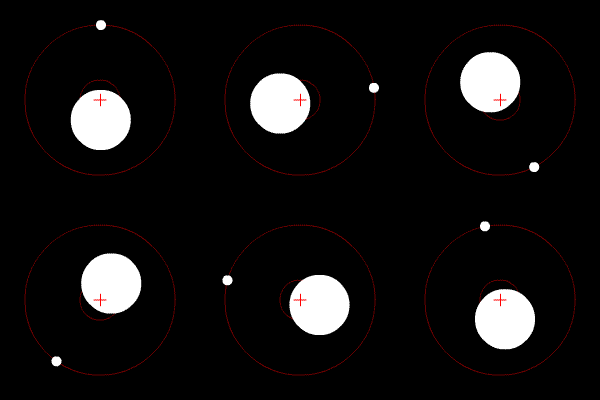
File:Orbit3.gif · Wikimedia Commons · See Wikimedia Commons
gravitational acceleration
Sign in to saveacceleration of an object caused by gravity
Gravitational acceleration is the speed at which an object picks up velocity as it falls due to the pull of gravity. It matters because it determines how quickly objects fall and helps us understand and predict the motion of everything from dropped items to planets orbiting in space.
AI-generated from the Wikipedia summary — may contain errors.
Wikidata facts
- Subclass of
- vector quantity
Show 4 more facts
- different from
- gravitational force
- recommended unit of measurement
- metres per second squared
- described by source
- International System of Units
- maintained by WikiProject
- WikiProject Mathematics
Sources (3)
via Wikidata · CC0
~8 min read
Encyclopedic overview
In physics, gravitational acceleration is the acceleration of an object in free fall within a vacuum, and thus without experiencing drag. This is the steady gain in speed caused exclusively by gravitational attraction. Within the same gravitational field, all bodies accelerate in vacuum at the same rate, regardless of the masses or compositions of the bodies; the measurement and analysis of these rates is known as gravimetry.
At a fixed point on the surface, the magnitude of Earth's gravity results from combined effect of gravitation and the centrifugal force from Earth's rotation. At different points on Earth's surface, the free fall acceleration ranges from 9.764 to 9.834 m/s (32.03 to 32.26 ft/s), depending on altitude, latitude, and longitude. A conventional standard value is defined exactly as 9.80665 m/s² (about 32.1740 ft/s²). Locations of significant variation from this value are known as gravity anomalies. This does not take into account other effects, such as buoyancy or drag.
Excerpted from Wikipedia’s “gravitational acceleration” article, available under the CC BY-SA 4.0 licence.
Gallery (2)
Available in 72 languages
- Español
- Français
- Deutsch
- 中文
- 日本語
- Русский
- Português
- Italiano
- العربية
- हिन्दी
- Afrikaans
- Albanian
- Armenian
- Asturian
- Azerbaijani
- Bahasa Indonesia
- Bangla
- be_x_old
Show 53 more
- Belarusian
- Bosnian
- Bulgarian
- Catalan
- Chuvash
- Croatian
- Czech
- Danish
- Esperanto
- Estonian
- Finnish
- Galician
- Georgian
- Greek
- Hebrew
- Irish
- Kazakh
- Khmer
- Kurdish
- Kyrgyz
- Latvian
- Limburgish
- Macedonian
- Malay
- Marathi
- Mongolian
- Nederlands
- Nepali
- Northern Frisian
- Norwegian
- Norwegian Nynorsk
- Polski
- Romanian
- Serbian
- Serbian (Latin)
- Silesian
- simple
- Slovak
- Slovenian
- Svenska
- Tamil
- Tatar
- Telugu
- Tibetan
- Tiếng Việt
- Türkçe
- Ukrainian
- Uzbek
- Wu Chinese
- zh_min_nan
- zh_yue
- فارسی
- 한국어
via Wikidata sitelinks · CC0