Hans Sebald Beham
Sign in to saveAlso known as Seb. Bæhm, Hans Bohm, Hans Sebald Beheim, Hans Seboldt Boehm, Hans-Sebald Behem, Hans Seboldt Beheim, Sebald Beham, Hans-Sebald Böhm
German artist (1500-1550)
Person · Open Library
- Born
- 1500
- Died
- 1550
- Works
- 8
Top works
- Das Kunst vnd Lere Büchlin, Sebalden Behems
- Von Künstlicher Abmessung
- Die Planeten
- Epitome chronicorum, ac magis insignium historiarum mundi velut index: ab orbe condito ad haec usque tempora
- Die Kleinmeister
via Open Library + Wikidata
Described at
Sebald Beham: Entrepreneur, Printmaker, Painter - Journal of Historians of Netherlandish Art
Sebald Beham (1500–1550) was a highly creative artist who has recently begun to be appreciated for his contributions in the area of printmaking. Until the
jhna.org →The prints of Sebald Beham and his brother Barthel were the subject of a recent exhibition titled Gottlosen Maler at the Albrecht-Dűrer-Haus in Nuremberg (March 3–July 3, 2011), where this essay was included in the exhibition catalogue in German. Revised and expanded for publication in this journal in English, the essay addresses Beham’s biography and historiography and argues that Beham should be viewed as a highly creative and productive entrepreneur and as one of the first “painters” (to use terminology of the time) to specialize in prints. Between 1520 and 1550, he produced a prodigious number of prints. Sebald Beham (1500–1550) was a highly creative artist who has recently begun to be appreciated for his contributions in the area of printmaking.1 Until the 1980s, many scholars valued Beham most as a “godless painter,” a term attached to him during his trial before the Nuremberg city council, a sensational event that takes center stage in many accounts of his career. In actuality, he was a prolific and important contributor to the expanding area of printed images (fig. 1 ).2.") Beham is one of many understudied artists of the German Renaissance-Reformation period. Such artists as Albrecht Dürer, Hans Holbein the Younger, and Hans Baldung Grien have received far more scholarly attention, as indicated by the substantial bodies of published literature focused on their work. Beham belonged to the next generation after Dürer (b. 1471) and Baldung (b. ca.1484). His work stands somewhere between that of Dürer, his putative master, and Baldung, whose wild, excited horses reveal, in woodcut form, an artist grappling with demonic forces. Beham learned much from Dürer, including his graphic style of making lines, but his prints tended to push the social and publishing boundaries of the time more in the manner of Baldung. Yet in contrast to both, Beham stressed prints far more than paintings, tipping the balance in ways rarely seen before, not only in the percentage of his work devoted to prints but also in the sheer number of prints he produced (Martin Schongauer was an even earlier exception–his prints greatly outnumber his known paintings).3 This essay explores Beham’s life and the ways in which he has been portrayed in published studies. It will suggest as well areas for future exploration that acknowledge Beham’s large contribution to both the burgeoning new medium of prints and to new subject areas. Sebald Beham produced his prints, paintings, and drawings before the advent of the specialization and professionalization of the printmaking industry around the middle of the sixteenth century. In the years between 1530 and 1535, the names of designer, woodcutter or block cutter, and printer or publisher (if different from the block cutter or Formschneider ) were only beginning to be recorded, if sporadically, on German woodcuts, and it was not until mid-century that Hieronymus Cock’s publishing house in Antwerp, The Four Winds, began to document the hands involved in the production of an engraving–designer, engraver, and publisher. Beham, who began his career in the 1520s and died in 1550, anticipated some of these developments–for example, putting his monogram on some of his prints–but he appears to have produced his large number of engravings on his own, without a printer other than himself. Beham’s print production as a whole, in engraving, etching, and woodcut, constitutes an early exploration of the genre of secular imagery. His scenes from everyday life anticipate trends in painting that would become a major emphasis in the seventeenth century.4.") According to many art historical accounts, the most decisive event of Sebald Beham’s life was the trial of 1525 before the Nuremberg town council, which will be discussed below.6 This episode was indeed crucial, but it was not all defining. The event does, however, raise the interesting issue of the scant survival of biographical information for Beham and his contemporaries. Sch
Excerpt from a page describing this subject · 40,000 chars · not written by Vinony
Wikidata facts
- Instance of
- human
- Given name
- Hans
- Gender
- male
- Citizenship
- Germany
- Place of birth
- Nuremberg
- Place of death
- Frankfurt
- Sibling
- Barthel Beham
- Occupation
- draftsperson
- Languages spoken
- German
- Field of work
- painting
- Movement
- German Renaissance
- Image
- Portrait of Sebald Beham.jpg
Show 6 more facts
- name in native language
- Sebald Beham
- described at URL
- jhna.org/articles/sebald-beham-entrepreneur-printmaker-painter
- Commons category
- Sebald Beham
- date of birth
- 1500-01-01
- date of death
- 1550-11-22
- Commons Creator page
- Sebald Beham
Sources (7)
via Wikidata · CC0
Works in European collections
36 objects attributed to Hans Sebald Beham, held across European museums, libraries & archives · via Europeana
Portrait of Martin Luther as Junker Jörg
Portrait of Martin Luther as Junker Jörg

Farmer; peasant woman

Gideon defeating Midianites

St. Jerome, wandering

Hercules robbing Iole

April. Milking and butter

Fortitudo

Ornament with male half figure

Matthew
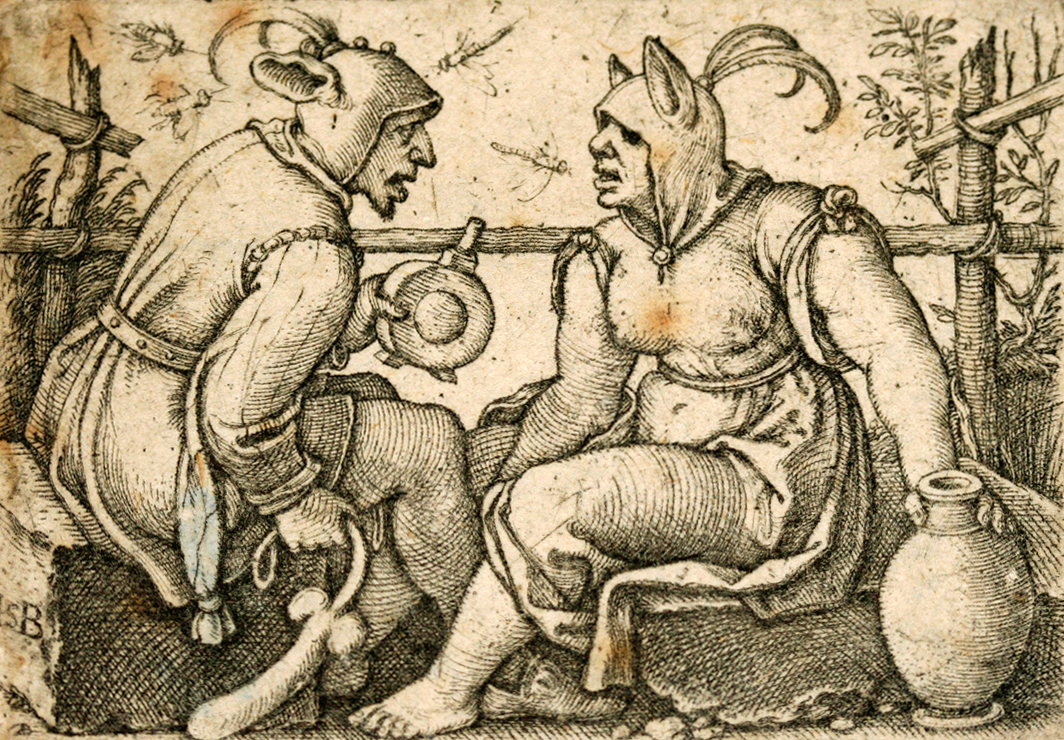
The Fool and the Närrin

Capture of Christ

Weather builder - This hurts nit

Temperancia

Part of a frieze with foliate to the right

Medal on Emperor Ferdinand of Hungary and Bohemia

King Josia and the High Priest Hilkia

A Peasant Gray

Peasant lovers

Peasant love couple surprised by a woman

The Lady and Death

Chapter and base of a column

Moses teaching the Jews

Piper

St. Jerome, standing
Milenci
Kladenie do hrobu
Ironing Christ
Dvaja sedliaci zo sedliackej vojny
Saint Thomas
Christ among the disciples
Three amorets
Standing representation
The Praying Knight
Storage Life
Leda with the Swan