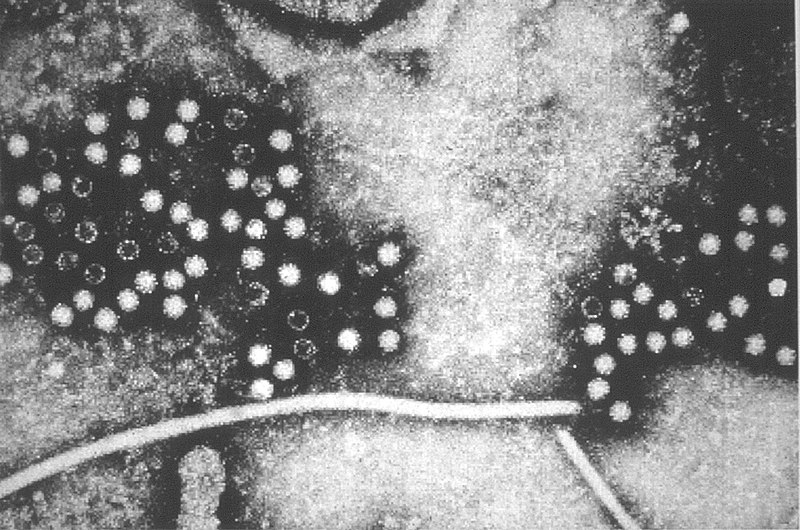
File:Hepatitis_E_virus.jpg · Wikimedia Commons · See Wikimedia Commons
hepatitis E
Sign in to saveAlso known as hepatitis type E
an inflammation of the liver caused by infection with the hepatitis E virus
Key facts
- Specialty
- Infectious disease , Hepatology
- Symptoms
- Nausea, jaundice
- Complications
- Liver failure
- Causes
- Hepatitis E virus (HEV)
- Diagnostic method
- Blood test
- Differential diagnosis
- Hepatitis A
- Treatment
- Rest, ribavirin (if chronic)
- Frequency
- 28 million worldwide (2013)
via Wikipedia infobox
Wikidata facts
- Subclass of
- disease
- Image
- Hepatitis E virus.jpg
- Number of deaths
- 44000
Show 11 more facts
- disease transmission process
- fecal–oral route
- health specialty
- obstetrics and gynaecology
- has cause
- hepatitis E virus
- exact match
- identifiers.org/doid/DOID:4411
- Commons category
- Hepatitis E
- number of cases
- 3300000
- drug or therapy used for treatment
- ribavirin
- symptoms and signs
- hepatomegaly
- medical examination
- ELISA
- possible treatment
- entéro-absorbant
- facet of
- women's health
Sources (7)
via Wikidata · CC0
~21 min read
Encyclopedic overview
Hepatitis E is inflammation of the liver caused by infection with the hepatitis E virus (HEV); it is a type of viral hepatitis. Hepatitis E has mainly a fecal-oral transmission route that is similar to hepatitis A, although the viruses are unrelated. HEV is a positive-sense, single-stranded, nonenveloped, RNA icosahedral virus and one of five known human hepatitis viruses: A, B, C, D, and E.
Like hepatitis A, hepatitis E usually follows an acute and self-limiting course of illness (the condition is temporary and the individual recovers) with low death rates in resource-rich areas; however, it can be more severe in pregnant women and people with a weakened immune system, with substantially higher death rates. In pregnant women, especially in the third trimester, the disease is more often severe and is associated with a clinical syndrome called fulminant liver failure, with death rates around 20%. Whereas pregnant women may have a rapid and severe course, organ transplant recipients who receive medications to weaken the immune system and prevent organ rejection can develop a slower and more persistent form called chronic hepatitis E, which is so diagnosed after 3 months of continuous viremia. HEV can be clustered genetically into 8 genotypes, and genotypes 3 and 4 tend to be the ones that cause chronic hepatitis in the immunosuppressed.
Excerpted from Wikipedia’s “hepatitis E” article, available under the CC BY-SA 4.0 licence.