File:Conquista_Hispania.svg · Wikimedia Commons · See Wikimedia Commons
Hispania
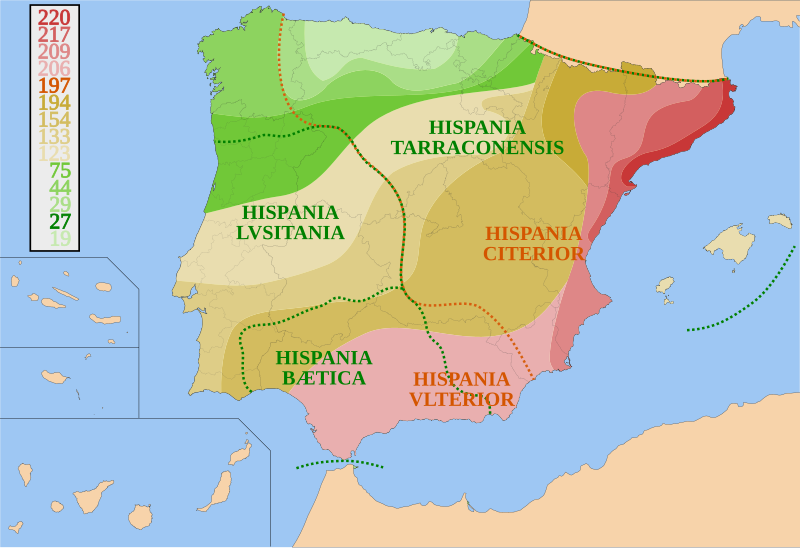
Sign in to saveHispania was the Roman name for the Iberian Peninsula. Under the Roman Republic, it was divided into two provinces: Hispania Citerior and Hispania Ulterior. During the Roman Empire, under the Principate, Hispania Ulterior was subdivided into Baetica and Lusitania, while Hispania Citerior was reorganized as Hispania Tarraconensis.
Hispania was the Roman name for the Iberian Peninsula, which the Romans initially divided into two provinces but later reorganized into multiple provinces as their empire expanded. Understanding Hispania's provincial structure matters because it shows how Rome administered and controlled this important western territory during different periods of Roman rule.
AI-generated from the Wikipedia summary — may contain errors.
Key facts
- Country.conventional_long_name
- Hispania
- Country.common_name
- Roman Empire
- Country.era
- Classical antiquity
- Country.status
- Empire
- Country.government_type
- Autocracy
- Country.p1
- Carthaginian Iberia
- Country.s1
- Visigothic Kingdom
- Country.s2
- Kingdom of the Suebi
- Country.s3
- Spania
- Country.today
- SpainPortugal
- Country.year_start
- 218 BC
- Country.year_end
- 472
- Country.image_map
- Conquista Hispania.svg
- Country.image_map_caption
- Timeline of the Roman conquest of Hispania (220 BC–19 BC), with Roman provincial boundaries shown
- Country.common_languages
- Latin, various Paleohispanic languages
- Country.religion
- Traditional indigenous and Roman religion, followed by Christianity
- Country.leader1
- Trajan
- Country.leader2
- Hadrian
via Wikipedia infobox
Wikidata facts
- Instance of
- historical period
- Has part
- Hispania Ulterior
- Country
- Portugal
- Image
- Roman Empire.png
Show 10 more facts
- topic's main category
- Category:Hispania
- replaced by
- al-Andalus
- replaces
- Iberia
- located in/on physical feature
- Iberian Peninsula
- time period
- classical antiquity
- facet of
- ancient civilization
- economy of topic
- economy of Roman Iberia
- Commons category
- Roman Hispania
- category of associated people
- Category:Romans from Hispania
- P12749
- Ferdinand Hellmesberger
Sources (3)
via Wikidata · CC0
~31 min read
Encyclopedic overview
18 sectionsContents
- Etymology
- Languages
- History
- Background
- Roman conquest
- Roman rule
- Germanic conquest
- Administrative divisions
- Economy
- Climate
- Sources and references
- Modern sources in Spanish and Portuguese
- Other modern sources
- Classical sources
- Further reading
- See also
- References
- External links
Hispania was the Roman name for the Iberian Peninsula. Under the Roman Republic, it was divided into two provinces: Hispania Citerior and Hispania Ulterior. During the Roman Empire, under the Principate, Hispania Ulterior was subdivided into Baetica and Lusitania, while Hispania Citerior was reorganized as Hispania Tarraconensis.
Beginning with Diocletian’s Tetrarchy (AD 293), the territory of Tarraconensis was further divided to create the provinces of Carthaginensis and Gallaecia (also called Callaecia, the origin of the name of modern Galicia). All the Hispanic provinces on the mainland, together with the Balearic Islands and the North African province of Mauretania Tingitana, were later organized into the Diocesis Hispaniarum, governed by a vicarius.
Excerpted from Wikipedia’s “Hispania” article, available under the CC BY-SA 4.0 licence.
Gallery (24)
On the map
2 mapped locations
Available in 58 languages
- Español
- Français
- Deutsch
- 中文
- 日本語
- Русский
- Português
- Italiano
- العربية
- Albanian
- Albanian
- Armenian
- Asturian
- Azerbaijani
- Bahasa Indonesia
- Basque
- Belarusian
- Breton
Show 39 more
- Catalan
- Central Kurdish
- Croatian
- Czech
- Danish
- Egyptian Arabic
- Esperanto
- Filipino
- Finnish
- Galician
- Greek
- Hebrew
- Hungarian
- Kurdish
- Lingua Franca Nova
- Lithuanian
- Macedonian
- Malagasy
- Malay
- Nederlands
- Norwegian
- Norwegian Nynorsk
- Occitan
- Polski
- Serbian
- Serbian (Latin)
- simple
- Slovak
- Slovenian
- Svenska
- Tiếng Việt
- Türkçe
- Ukrainian
- Urdu
- Welsh
- Western Frisian
- فارسی
- ไทย
- 한국어
via Wikidata sitelinks · CC0