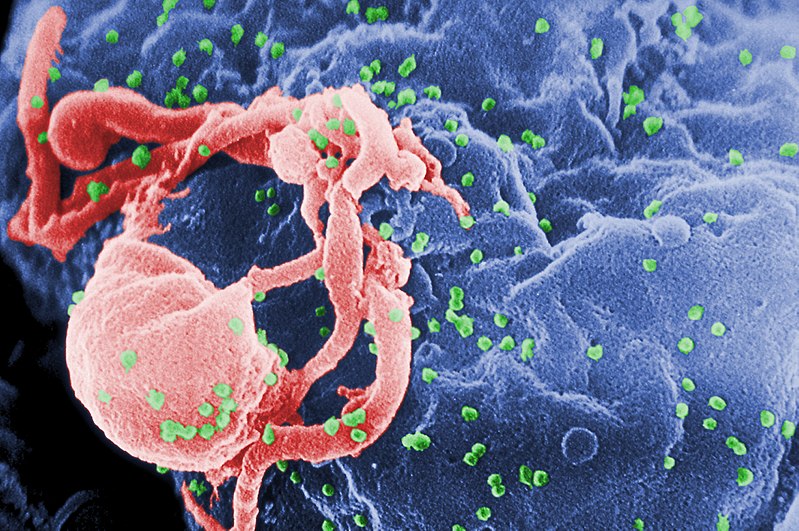
File:HIV-budding-Color.jpg · Wikimedia Commons · See Wikimedia Commons
Also known as human immunodeficiency virus, gay-related immune virus/deficiency
Human immunodeficiency viruses (HIVs) are two species of Lentivirus (a subgroup of retrovirus) that infect humans. Over time, they cause acquired immunodeficiency syndrome (AIDS), a condition in which progressive failure of the immune system allows life-threatening opportunistic infections and cancers to thrive. Without treatment, the average survival time after infection with HIV is estimated to be 9 to 11 years, depending on the HIV subtype.
HIV is a virus that gradually damages the immune system, eventually leading to AIDS, a condition where the body becomes vulnerable to dangerous infections and cancers. Without treatment, people with HIV typically survive 9 to 11 years after infection, which is why early detection and medical care are important.
AI-generated from the Wikipedia summary — may contain errors.
Research
457,845 papers- Editorial: Anti-infective 2020: HIV-From pathogenesis to treatment.Current opinion in pharmacology · 2020Huerta LDOI: 10.1016/j.coph.2020.12.001
- [HIV infection].ReviewNihon rinsho. Japanese journal of clinical medicine · 2010Nomaguchi M, Adachi A
- HIV sequence databases.ReviewAIDS reviews · 2003Kuiken C, Korber B, Shafer RW
- [The history of HIV].ReviewUirusu · 2025Shioda TDOI: 10.2222/jsv.75.135
- NF-κB sub-pathways and HIV cure: A revisit.ReviewEBioMedicine · 2021Wong LM, Jiang GDOI: 10.1016/j.ebiom.2020.103159
- [Diagnosing HIV in Switzerland].ReviewTherapeutische Umschau. Revue therapeutique · 2014Schüpbach J, Berger C, Böni J et al.DOI: 10.1024/0040-5930/a000537
- Antiretroviral Therapy for HIV-2 Infection in Non-Endemic Regions.ReviewAIDS reviews · 2020Mendoza C, Lozano AB, Caballero E et al.DOI: 10.24875/AIDSRev.M20000029
- HIV and the spectrum of human disease.ReviewThe Journal of pathology · 2015Lucas S, Nelson AMDOI: 10.1002/path.4449
via PubMed
Wikidata facts
- Image
- HIV-budding-Color.jpg
Show 8 more facts
- taxon common name
- 人类免疫缺陷病毒
- has effect
- HIV infection
- Commons category
- HIV
- external data available at URL
- requenarolania.wixsite.com/jmr-miclin/tema-4-hiv
- time of discovery or invention
- 1983-00-00
- prevalence
- 0.0075
- entry receptor
- CD4 molecule
- facet of
- LGBTQ health
Sources (12)
via Wikidata · CC0
~45 min read
Encyclopedic overview
21 sectionsContents
- Virology
- Classification
- Structure and genome
- Tropism
- <span id="Replication cycle">Replication cycle</span>
- Entry to the cell
- Replication and transcription
- Recombination
- Assembly and release
- Spread within the body
- Genetic variability
- Diagnosis
- Research
- Treatment and transmission
- History
- Origins
- Discovery
- See also
- References
- Further reading
- External links
Human immunodeficiency viruses (HIVs) are two species of Lentivirus (a subgroup of retrovirus) that infect humans. Over time, they cause acquired immunodeficiency syndrome (AIDS), a condition in which progressive failure of the immune system allows life-threatening opportunistic infections and cancers to thrive. Without treatment, the average survival time after infection with HIV is estimated to be 9 to 11 years, depending on the HIV subtype.
In most cases, HIV is a sexually transmitted infection and occurs by contact with or transfer of blood, pre-ejaculate, semen, and vaginal fluids. Non-sexual transmission can occur from an infected mother to her infant during pregnancy, during childbirth by exposure to her blood or vaginal fluid, and through breast milk. Within these bodily fluids, HIV is present as both free virus particles and virus within infected immune cells. Research has shown (for both same-sex and opposite-sex couples) that HIV is not contagious during sexual intercourse without a condom if the HIV-positive partner has a consistently undetectable viral load.
Excerpted from Wikipedia’s “HIV” article, available under the CC BY-SA 4.0 licence.
Gallery (38)
Available in 109 languages
- Español
- Français
- Deutsch
- 中文
- 日本語
- Русский
- Português
- Italiano
- العربية
- हिन्दी
- Afrikaans
- Albanian
- Albanian
- Amharic
- Armenian
- Assamese
- Asturian
- Azerbaijani
Show 90 more
- Bahasa Indonesia
- Balinese
- Bangla
- Basque
- be_x_old
- Belarusian
- Bikol
- Bosnian
- Bulgarian
- Buriat
- Catalan
- Central Kurdish
- Chuvash
- Croatian
- Czech
- Danish
- Egyptian Arabic
- Esperanto
- Estonian
- Filipino
- Finnish
- fiu_vro
- Galician
- Georgian
- Greek
- Hebrew
- Hungarian
- Icelandic
- Ido
- Iloko
- Inuktitut
- Irish
- Kannada
- Kara-Kalpak
- Kashmiri
- Kazakh
- Kinyarwanda
- Kyrgyz
- Latin
- Latvian
- Lingala
- Lithuanian
- Lombard
- Macedonian
- Madurese
- Malay
- Malayalam
- Marathi
- Mari
- Mingrelian
- Nederlands
- Nepali
- Northern Frisian
- Norwegian
- Occitan
- Odia
- Pashto
- Polski
- Punjabi
- Romanian
- Santali
- Serbian
- Serbian (Latin)
- simple
- Sinhala
- Slovak
- Slovenian
- Sundanese
- Svenska
- Swahili
- Tajik
- Tamil
- Telugu
- Tiếng Việt
- Türkçe
- Turkmen
- Ukrainian
- Uzbek
- Waray
- Welsh
- Western Frisian
- Wu Chinese
- Yakut
- Yoruba
- Zaza
- zh_min_nan
- zh_yue
- فارسی
- ไทย
- 한국어
via Wikidata sitelinks · CC0