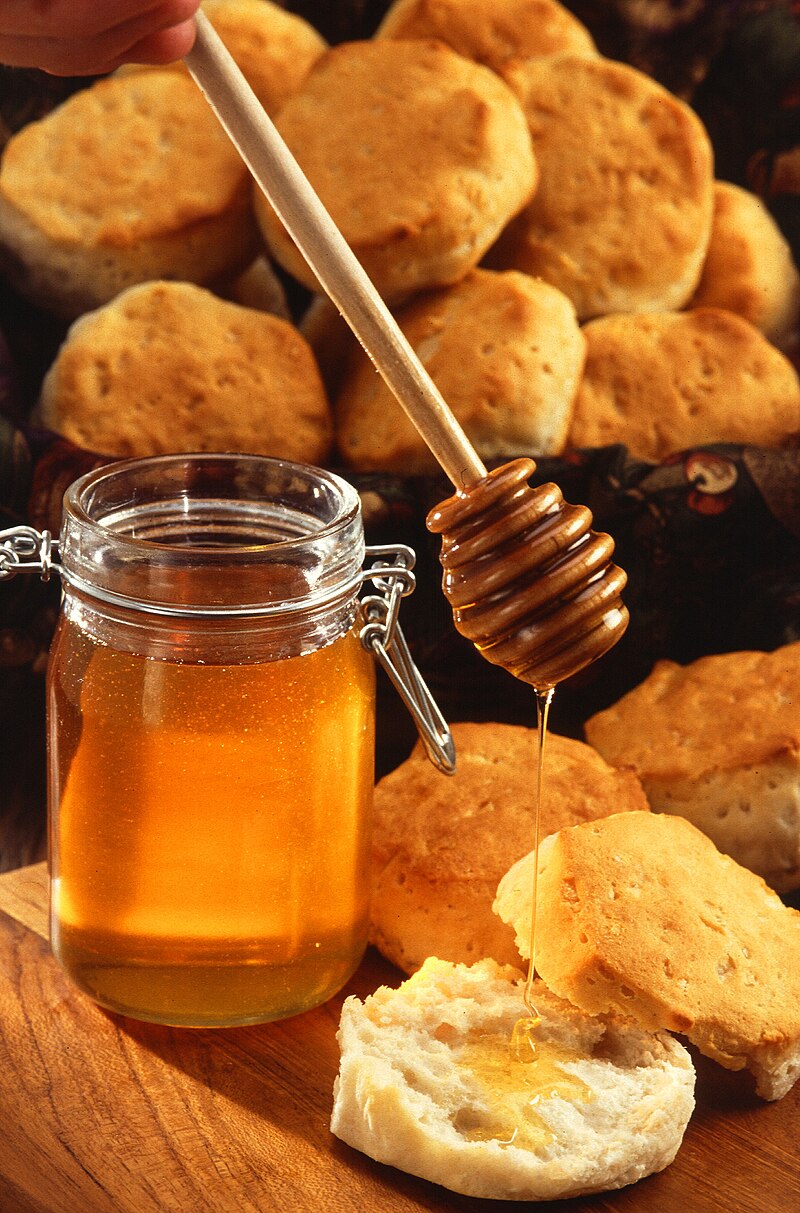
File:Runny_hunny.jpg · Wikimedia Commons · See Wikimedia Commons
honey
Sign in to saveAlso known as Mel
Honey is a sweet and viscous substance made by several species of bees, the best-known of which are honey bees. Honey is made and stored to nourish bee colonies. Bees produce honey by gathering and then refining the sugary secretions of plants (primarily floral nectar) or the secretions of other insects, like the honeydew of aphids. This refinement takes place both within individual bees, through regurgitation and enzymatic activity, and during storage in the hive, through water evaporation that concentrates the honey's sugars until it is thick and viscous.
OverviewAI-generated
Honey is a natural product of the taxa Apis mellifera and Apis. It is produced through beekeeping and gathering, using nectar and water as materials. The substance is classified as a confection, syrup, and fodder, and serves as a food ingredient and organic matter. It possesses the characteristics of hygroscopy and viscosity.
Nutritionally, honey contains 378 kcal of energy per serving, with 78.4 grams of carbohydrates and 71.1 grams of sugars. It includes 0.1 grams of fiber, 0.2 grams of proteins, and 0.02 grams of salt, while containing no fat or saturated fat. It is categorized as honeys in Openfoodfacts and holds a Nova classification of 2. Uses for honey include being a spread, an ingredient, and medicine. The Unicode character 🍯 represents the subject.
Synthesized by Vinony from 29 facts across 4 sources: Wikidata, PubMed, Openfoodfacts, Vinony graph. Generated from structured data (not the Wikipedia text) and checked against those facts — may still contain errors.
Nutrition · Open Food Facts
Typical values per 100 g · averaged across 59 products
- Energy
- 378 kcal
- Fat
- 0 g
- — of which saturates
- 0 g
- Carbohydrates
- 78.4 g
- — of which sugars
- 71.1 g
- Fibre
- 0.1 g
- Protein
- 0.2 g
- Salt
- 0.02 g
via Open Food Facts · ODbL
Research
21,020 papers- Honey: its medicinal property and antibacterial activity.ReviewAsian Pacific journal of tropical biomedicine · 2011Mandal MD, Mandal SDOI: 10.1016/S2221-1691(11)60016-6
- Honey for wound healing, ulcers, and burns; data supporting its use in clinical practice.ReviewTheScientificWorldJournal · 2011Al-Waili N, Salom K, Al-Ghamdi AADOI: 10.1100/tsw.2011.78
- Honey therapies for dermatological disorders: more than just a sweet elixir.ReviewInternational journal of dermatology · 2024Jodidio M, Schwartz RADOI: 10.1111/ijd.16925
- Honey as a Treatment in Otorhinolaryngology: A Review by Subspecialty.ReviewThe Annals of otology, rhinology, and laryngology · 2019Tharakan T, Bent J, Tavaluc RDOI: 10.1177/0003489418815188
- Honey and children: only a grandma's panacea or a real useful tool?ReviewInternational journal of food sciences and nutrition · 2021Pecoraro L, Flore AI, Dalle Carbonare L et al.DOI: 10.1080/09637486.2020.1811958
- Exploring honey's potential as a functional food for natural sleep aid.ReviewFood & function · 2024Zulkifli MF, Masimen MAA, Ridzuan PM et al.DOI: 10.1039/d4fo02013h
- Selected honey as a multifaceted antimicrobial agent: review of compounds, mechanisms, and research challenges.ReviewFuture microbiology · 2025Machado A, Toubarro D, Baptista J et al.DOI: 10.1080/17460913.2025.2498233
- Honey for managing oral mucositis induced by cancer therapies: An overview of systematic reviews.ReviewComplementary therapies in medicine · 2025Anshasi H, Abufarsakh B, Alkhawaldeh JM et al.DOI: 10.1016/j.ctim.2025.103197
via PubMed
Wikidata facts
- Instance of
- organic matter
- Material used
- water
- Image
- Runny hunny.jpg
- Has use
- medicine
Show 9 more facts
- Commons category
- Honey
- topic's main category
- Category:Honey
- Commons gallery
- Honey
- fabrication method
- gathering
- has characteristic
- hygroscopy
- natural product of taxon
- Apis
- on focus list of Wikimedia project
- Wikipedia:Vital articles/Level/4
- hashtag
- honey
- Unicode character
- 🍯
via Wikidata · CC0
~54 min read
Encyclopedic overview
46 sectionsContents
- Formation
- By honey bees
- By other insects
- Human intervention
- Production
- Collection
- Preservation
- Adulteration
- Production
- Modern uses
- Food
- Fermentation
- Physical and chemical properties
- Phase transitions
- Rheology
- Electrical and optical properties
- Hygroscopy and fermentation
- Thermal characteristics
- Acid content and flavor effects
- Volatile organic compounds
- Classification
- Plant source
- Monofloral
- Polyfloral
- Honeydew honey
- Classification by packaging and processing
- Grading
- Indicators of quality
- Nutrition
- Sugar profile
- Medical use and research
- Wounds and burns
- Antibiotic
- Cough
- Other
- Health hazards
- Botulism
- Toxic honey
- Folk medicine
- History
- Religious significance
- Popular culture
- See also
- References
- Bibliography
- External links
Honey is a sweet and viscous substance made by several species of bees, the best-known of which are honey bees. Honey is made and stored to nourish bee colonies. Bees produce honey by gathering and then refining the sugary secretions of plants (primarily floral nectar) or the secretions of other insects, like the honeydew of aphids. This refinement takes place both within individual bees, through regurgitation and enzymatic activity, and during storage in the hive, through water evaporation that concentrates the honey's sugars until it is thick and viscous.
Honey bees stockpile honey in the hive. Within the hive is a structure made from wax called honeycomb. The honeycomb is made up of hundreds or thousands of hexagonal cells, into which the bees regurgitate honey for storage. Other honey-producing species of bee store the substance in different structures, such as the pots made of wax and resin used by the stingless bee.
Excerpted from Wikipedia’s “honey” article, available under the CC BY-SA 4.0 licence.
Gallery (36)
Available in 194 languages
- Español
- Français
- Deutsch
- 中文
- 日本語
- Русский
- Português
- Italiano
- العربية
- हिन्दी
- abstract
- Afrikaans
- Albanian
- Albanian
- Amharic
- Aragonese
- Aramaic
- Armenian
Show 175 more
- Asturian
- Aymara
- azb
- Azerbaijani
- Bahasa Indonesia
- Balinese
- Bangla
- Bashkir
- Basque
- bat_smg
- Bavarian
- be_x_old
- Belarusian
- Bhojpuri
- Bikol
- Bosnian
- Breton
- Bulgarian
- Buriat
- Burmese
- Catalan
- Central Kurdish
- Chechen
- Cherokee
- Cheyenne
- Chuvash
- Cornish
- Corsican
- Croatian
- Czech
- dag
- Danish
- Egyptian Arabic
- Erzya
- Esperanto
- Estonian
- Extremaduran
- Fiji Hindi
- Filipino
- Finnish
- Frafra
- Friulian
- Galician
- Georgian
- Goan Konkani
- Greek
- Guarani
- Haitian Creole
- Hakka Chinese
- Hebrew
- Hungarian
- hyw
- Iban
- Icelandic
- Ido
- Iloko
- Ingush
- Interlingua
- Irish
- Javanese
- Kabyle
- Kannada
- Kanuri
- Kashmiri
- Kazakh
- kge
- Kinyarwanda
- Kurdish
- Kyrgyz
- Ladino
- Latin
- Latvian
- Lezghian
- Ligurian
- Lingala
- Lingua Franca Nova
- Lithuanian
- Lombard
- Low German
- Luxembourgish
- Macedonian
- Madurese
- Malagasy
- Malay
- Malayalam
- map_bms
- Marathi
- Mari
- Minangkabau
- Mingrelian
- Moksha
- Mongolian
- Mossi
- nah
- Navajo
- nds_nl
- Neapolitan
- Nederlands
- Nepali
- Newari
- Northern Frisian
- Norwegian
- Norwegian Nynorsk
- nrm
- Occitan
- Odia
- Old English
- olo
- Ossetic
- Pashto
- Piedmontese
- Polski
- Punjabi
- Quechua
- roa_rup
- Romanian
- rsk
- Rundi
- Rusyn
- Sanskrit
- Sardinian
- Saterland Frisian
- Scots
- Scottish Gaelic
- Serbian
- Serbian (Latin)
- Shona
- Sicilian
- simple
- Sindhi
- Sinhala
- skr
- Slovak
- Slovenian
- Somali
- Southern Sotho
- Sundanese
- Svenska
- Swahili
- Tajik
- Talysh
- Tamil
- Tatar
- Telugu
- Tiếng Việt
- Toki Pona
- Tulu
- Tumbuka
- Türkçe
- Turkmen
- Tyap
- Ukrainian
- Urdu
- Uyghur
- Uzbek
- Veps
- Volapük
- Walloon
- Waray
- Welsh
- West Flemish
- Western Frisian
- Western Mari
- Western Panjabi
- Wu Chinese
- Yakut
- Yiddish
- Yoruba
- zh_classical
- zh_min_nan
- zh_yue
- Zhuang
- فارسی
- ไทย
- 한국어
via Wikidata sitelinks · CC0