
Indonesia
Sign in to saveAlso known as Republic of Indonesia, id, ID, INA, IDN
Indonesia, officially the Republic of Indonesia, is a country in Southeast Asia and Oceania, between the Indian and Pacific oceans. Comprising over 17,000 islands, including Sumatra, Java, Sulawesi, and parts of Borneo and New Guinea, Indonesia is the world's largest archipelagic state and the 14th-largest country by area, at . Indonesia has significant areas of wilderness that support one of the world's highest levels of biodiversity. It shares land borders with Papua New Guinea, Timor-Leste, and Malaysia, as well as maritime borders with seven other countries, including Australia, Singapore,
OverviewAI-generated
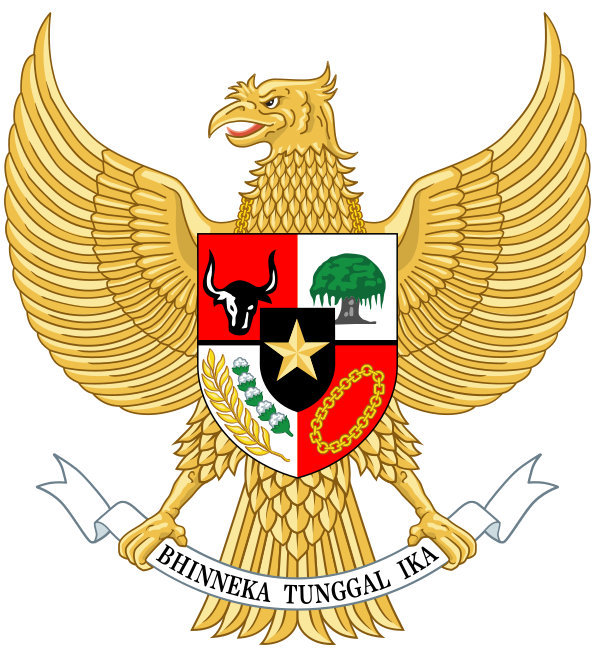
Indonesia, officially the Republic of Indonesia, is a country in South-Eastern Asia. Its capital is Jakarta, and it has an area of 1904569. The nation’s motto is Bhinneka Tunggal Ika. It uses the rupiah as its currency and .id as its top-level domain. The official name is also recorded as Indonésia and République d’Indonésie. The country’s inception dates are 1945-08-17 and 1949-12-27.
The population is listed as 275439000, 284438782, or 283487931. Ethnic groups include Malays, Javanese, Sundanese people, and Batak. The legislative body is the People's Consultative Assembly, and the head of government holds the office of President of Indonesia. Indonesia maintains diplomatic relations with Canada, Italy, Brazil, and Germany. It has 47.7220336902463 percent forest area and 58.7509635387997 percent urban population. The emergency phone number is 112.
Synthesized by Vinony from 68 facts across 9 sources: Wikidata, REST Countries, Open Meteo, Openweathermap, World Bank, OpenStreetMap, PubMed, Vinony graph, Geo. Generated from structured data (not the Wikipedia text) and checked against those facts — may still contain errors.
Weather now
cached 18h ago7-day forecast
via Open-Meteo
Country

- Capital
- Jakarta
- Population
- 284,438,782
- Region
- Asia · South-Eastern Asia
- Demonym
- Indonesian
- Currencies
- IDR (Rp)
- Languages
- Indonesian
- Calling code
- +62
- Drives on
- Left
- Gini
- 38.2 (2019)
- FIFA code
- IDN
- TLD
- .id
- Timezones
- UTC+07:00 · +2 more
- Borders
- TLS, MYS, PNG
via REST Countries
Indicators · World Bank
- GDP
- $1.4T(2024)
- Population
- 283,487,931(2024)
- Life expectancy
- 71.3 yrs(2024)
- Unemployment
- 3.2 %(2025)
- Urban population
- 58.8 %(2024)
- Internet users
- 72.8 %(2024)
- Forest area
- 47.7 %(2023)
- Renewable energy
- 20.2 %(2021)
via World Bank Open Data · CC BY 4.0
Wikipedia views (30d)
305,183 totalvia Wikimedia Pageviews API
Key facts
- Country.conventional_long_name
- Republic of Indonesia
- Country.common_name
- Indonesia
- Country.image_flag
- Flag of Indonesia.svg
- Country.image_coat
- National emblem of Indonesia Garuda Pancasila.svg
- Country.symbol_type
- Emblem
- Country.national_motto
- (Old Javanese)"Unity in Diversity"
- Country.other_symbol
- (Sanskrit)"The Five Principles"
- Country.other_symbol_type
- National ideology and philosophy:
- Country.national_anthem
- "Great Indonesia"File:Indonesia Raya instrumental.ogg
- Country.capital
- Jakarta
- Country.largest_city
- capital
- Country.official_languages
- Indonesian
- Country.demonym
- Indonesian
- Country.languages_type
- Indigenous languages
- Country.languages_sub
- yes
- Country.languages
- 718 languages
- Country.languages2_type
- Writing system
- Country.languages2
- Latin (predominantly)
via Wikipedia infobox
Research
68,689 papers- HIV/AIDS in Indonesia: current treatment landscape, future therapeutic horizons, and herbal approaches.ReviewFrontiers in public health · 2024Jocelyn, Nasution FM, Nasution NA et al.DOI: 10.3389/fpubh.2024.1298297
- Indonesia's Unique Social System as Key to Successful Implementation of Community- and Home-Based Palliative Care.ReviewJCO global oncology · 2023Eng V, Sudoyo AW, Nuhonni SA et al.DOI: 10.1200/GO.22.00290
- Strengthening Indonesia's health workforce through partnerships.ReviewPublic health · 2015Kurniati A, Rosskam E, Afzal MM et al.DOI: 10.1016/j.puhe.2015.04.012
- From Archipelago to Pandemic Battleground: Unveiling Indonesia's COVID-19 Crisis.ReviewJournal of epidemiology and global health · 2023Harapan BN, Harapan T, Theodora L et al.DOI: 10.1007/s44197-023-00148-7
- Challenges and Strategies for Controlling Indonesia's Emerging and Re-Emerging Infection Diseases (EID-REIDs).ReviewActa medica Indonesiana · 2024Triyono EA, Arini M, Asmarawati TP et al.
- Re-Emerging Trend of Mpox Infection: The Indonesia's Experience and Review.ReviewActa medica Indonesiana · 2024Nelwan EJ, Tanadi C, Pajala FB et al.
- Harnessing Indonesia's biodiversity for sustainable water treatment: a review of local plant-based solutions.ReviewEnvironmental science and pollution research international · 2025Imaduddin M, Eilks IDOI: 10.1007/s11356-025-36485-2
- Indonesia.Department of State publication. Background notes series · 1989United States. Department of State. Bureau of Public Affairs
via PubMed
Travel guide
Understand
With 17,500 islands, 6,000 of them inhabited, Indonesia is the largest archipelago in the world. To imagine how vast Indonesia is, Indonesia stretches from west to east as wide as the United States or Western and Eastern Europe combined, yet more than two thirds of the area is sea water.
With more than 260 million people, Indonesia is the fourth most populous country in the world — after India, China and the United States — and by far the largest in Southeast Asia.
The population is not spread equally among the five biggest islands, Java, Sumatra, Sulawesi, Kalimantan and Papua; Java has half of the population. More than 50% of foreign tourists enter Indonesia through the airport of Bali, and most of the rest come in through Jakarta's Soekarno-Hatta International Airport for business or as a hub to other Indonesia tourist destinations or through Batam mostly by ferry from Singapore. These three arrival sites account for about 90% of foreign arrivals.
Indonesia also has the largest Muslim population in the world, mostly Sunni. Indonesia is a member of the G20 and although it has potential to become a world leader, it is still hampered by corruption and shortcomings in education as well as an infrastructure hampered by difficult terrain and water.
Indonesia's tropical forests are the second-largest in the world after Brazil, and are being logged and cut down to grow oil palm plantations at the same alarming speed. While the rich shop and party in the cities and …
Get in
Indonesia offers a multitude of visas via its official e-Visa website. The easiest to get is the 30-day electronic visa on arrival / B1 tourist visa, which is approved within minutes after supplying passport details, the intended address of stay in Indonesia, and a PDF copy of outbound transportation (e.g. a flight which can be cancelled later if plans change). The visa application wizard makes the process pretty straightforward. Just make sure to check "Credit/debit card" for the payment type. The fee for the 30-day visa is 500,000 IDR, and the visa can be extended for another 30 days. There is also a 60-day tourist visa (C1, also known as 211A), which can be issued within 5 business days for a cost of 1,500,000 IDR and can be extended twice, for a total of 180 days.
Alternatively, a visa can be obtained on arrival, but the process will take longer due to queues at the airport. A minimum of 6 months' validity must be available in your passport and it must contain at least one or more blank pages. This same rule applies to any visa extension that may be sought whilst in the country.
In addition to the visa, all travelers must complete the All Indonesia arrival card before arrival. The website opens 72 hours before your flight, and replaces previous customs, immigration and health form.
With the visa obtained online, and their passport in hand, tourists can pass through certain entry points in minutes (e.g. the Denpasar airport in Bali) using auto-gates, without needing to …
Eat
300px|thumb|Spiced nasi kuning (rice coloured yellow with turmeric) shaped into the ceremonial tumpeng (cone) and topped with dried beef abon
With 17,000 islands to choose from, Indonesian food is an umbrella term covering a vast variety of regional cuisines found across the nation. But, if used without further qualifiers, the term tends to mean the food originally from the central and eastern parts of the main island Java. Now widely available throughout the archipelago, Javanese cuisine features an array of simply seasoned dishes, the predominant flavorings the Javanese favor being peanuts, chillies, sugar (especially Javanese coconut sugar) and various aromatic spices.
All too often, many backpackers seem to fall into a rut of eating nothing but nasi goreng (fried rice), and perhaps commonly available Javanese dishes, but there are much more interesting options lurking about if you're adventurous enough to seek them out. In West Java, Sundanese dishes composed of many fresh vegetables and herbs are commonly eaten raw. Padang is famous for the spicy and richly-seasoned Minangkabau cuisine, which shares some similarities to cooking in parts of neighboring Malaysia, and eateries specializing in the buffet-style nasi padang are now ubiquitous across the nation. The Christian Batak people and the Hindu Balinese are great fans of pork, while the Minahasa of North Sulawesi are well known for eating almost everything, including dog and fruit bat, and a very liberal usage of chil…
Drink
thumb|Avocado juice (jus alpukat) with a squirt of chocolate syrup or condensed chocolate milk
Quite a few Indonesians believe that cold drinks are unhealthy, so specify dingin when ordering if you prefer your water, bottled tea or beer cold, rather than at room temperature.
Sleep
thumb|A guesthouse in South Sulawesi Accommodation options at popular travel destinations like Bali and Jakarta run the gamut from cheap backpacker guesthouses to some of the most opulent (and expensive) five-star hotels and resorts imaginable. Off the beaten track, though, your options will be more limited. Probably the most common lodging choice for backpackers is the losmen, or guesthouse, which also go by the names wisma or pondok. Often under US$15/night, basic losmen are fan-cooled and have shared bathroom facilities, usually meaning Asian-style squat toilets and bak mandi (water storage tank) baths, from which you ladle water over yourself (do not enter one or use it as a sink.) Very small losmen, essentially homestays or rented rooms, are known as penginapan. For a longer stay, try a kost (boardinghouse) with similar facilities, if not better - though many only accept a specific gender with perempuan/wanita/cewek for ladies and pria/laki-laki/cowok for gents.
The next step up on the scale are cheap or budget hotels, usually found even in the smallest towns and cities, typically near transport terminals and tourist areas. These may have some more little luxuries like air-conditioning, hot water, wi-fi and even a mini breakfast, but a few are often depressing otherwise, with tiny, often windowless rooms. Prices can be quite competitive with losmen and kost, starting at US$20/night. Some reliable local chains include POP!, Amaris by Santika and Favehotel.
Hotels of suf…
Stay safe
thumb|[[Mount Semeru, a popular tourist attraction in East Java, erupting in 2004]]
Indonesia has been and continues to be wracked by every pestilence known to man: earthquakes, tsunamis, volcanoes, terrorism, civil strife, plane crashes, sinking boats, and corruption make the headlines on a depressingly regular basis. However, it is important to retain a sense of proportion and remember Indonesia's vast size: a tsunami in Aceh will not cause the slightest ripple on the beaches of Bali, and street battles in troubled Papua are irrelevant in the jungles of Borneo.
Scams are rare in the less touristy areas, though be more cautious in Bali.
Stay healthy
The bad news is that every disease known to humans can be found somewhere in Indonesia — the good news is that you most probably will not go there.
Malaria prophylaxis is not necessary for Java or Bali, but is wise if travelling for extended periods in remote areas of Sumatra, Borneo, Lombok or points east.
Dengue fever can be contracted anywhere, so using insect repellents (DEET) and mosquito nets is highly advisable. The common advice to turn your air-con to its lowest setting to deter mosquitoes doesn't work - they simply fly under the covers and enjoy your body heat while sucking up a bloody cocktail; a fan on medium or high is much more effective. Dengue can take up to 10 days to manifest, and early symptoms resemble a bad flu with headache and muscle pains. If you get a red rash on your back or sides, particularly one that temporarily goes away when pressed, head to a doctor immediately.
Hepatitis B is also common, mainly in Lombok and Lesser Sunda Islands, and getting vaccinated before arriving in Indonesia is wise, but Hepatitis B cannot be transmitted by foods. Food hygiene is often questionable, and getting vaccinated for hepatitis A and possibly typhoid fever is a wise precaution. Both kinds of hepatitis vaccines should be administered 6 months before your itinerary. See a doctor if what seems like travellers' diarrhoea does not clear up within a few days, or is accompanied by a fever.
Oralit is a cheap, widely-available brand of rehydration salts, you sh…
Respect
thumb|The Torajan symbol used in parts of Indonesia resembles a Swastika but has nothing to do with Nazism
Do not be surprised if a few locals interact with foreigners, especially those of European descent, in a way that may be taken as "rude and overreacting". They may refer to you as a "bule" (literally, albino) and do things such as constant staring, taking pictures with you, greeting you with laughter, and then asking questions to some extent. You might also see some form of astonishment or amusement for doing what they do that they assume you don't. This is not meant to be an insult, but a form of curiosity. A few Buddhist and Hindu temples and homes may have a Swastika placed somewhere. They are religious symbols, not a form of anti-Semitism or support of Nazism, which they pre-date.
Connect
Keeping in touch with the outside world from Indonesia is rarely a problem, at least if you stay anywhere close to the beaten track.
Travel guide from Wikivoyage (CC BY-SA 4.0)
~40 min read
Encyclopedic overview
44 sectionsContents
- Etymology
- History
- Early history
- Colonial era
- Post-World War II
- Geography
- Climate
- Geology
- Biodiversity
- Environment and conservation
- Government and politics
- Parties and elections
- Administrative divisions
- Foreign relations
- Military
- Law enforcement and human rights
- Economy
- Tourism
- Science and technology
- Infrastructure
- Transport
- Energy
- Demographics
- Ethnic groups and languages
- Religion
- Education
- Healthcare
- Culture
- Art and architecture
- Music, dance and clothing
- Theatre and cinema
- Literature and mass media
- Cuisine
- Sports
- See also
- Notes
- References
- Citations
- Bibliography
- External links
- Government
- History
- Tourism
- Maps
Indonesia, officially the Republic of Indonesia, is a country in Southeast Asia and Oceania, between the Indian and Pacific oceans. Comprising over 17,000 islands, including Sumatra, Java, Sulawesi, and parts of Borneo and New Guinea, Indonesia is the world's largest archipelagic state and the 14th-largest country by area, at 1,904,569 square kilometres (735,358 square miles). Indonesia has significant areas of wilderness that support one of the world's highest levels of biodiversity. It shares land borders with Papua New Guinea, Timor-Leste, and Malaysia, as well as maritime borders with seven other countries, including Australia, Singapore, and the Philippines.
The Indonesian archipelago has been inhabited since prehistoric times, with early human presence evidenced by fossils of Homo erectus and Homo sapiens, and megalithic sites. By the early second millennium, it had become a crossroads for international trade linking East and South Asia. Over the centuries, external influences—including Hinduism, Buddhism and later Islam—were absorbed into local societies, which introduced lasting cultural and religious influences. European powers later competed to monopolise trade in the Spice Islands of Maluku during the Age of Discovery, followed by three and a half centuries of Dutch colonial rule, before Indonesia proclaimed its independence in the aftermath of World War II.
Excerpted from Wikipedia’s “Indonesia” article, available under the CC BY-SA 4.0 licence.
Gallery (59)
On the map
6 mapped locations
Available in 293 languages
- Español
- Français
- Deutsch
- 中文
- 日本語
- Русский
- Português
- Italiano
- العربية
- हिन्दी
- Abkhazian
- abstract
- Achinese
- Adyghe
- Afrikaans
- Akan
- Albanian
- Albanian
Show 274 more
- Amharic
- ami
- Angika
- Aragonese
- Armenian
- Arpitan
- Assamese
- Asturian
- Avaric
- Awadhi
- Aymara
- azb
- Azerbaijani
- Bahasa Indonesia
- Balinese
- Bangla
- Banjar
- Bashkir
- Basque
- bat_smg
- Batak Toba
- Bavarian
- bdr
- be_x_old
- Belarusian
- Betawi
- Bhojpuri
- Bikol
- Bishnupriya
- Bislama
- blk
- Bosnian
- Breton
- btm
- Buginese
- Bulgarian
- Buriat
- Burmese
- Catalan
- cbk_zam
- cdo
- Cebuano
- Central Dusun
- Central Kurdish
- Chamorro
- Chechen
- Cherokee
- Cheyenne
- Church Slavic
- Chuvash
- Colognian
- Cornish
- Corsican
- Crimean Tatar
- Croatian
- Czech
- dag
- Danish
- Divehi
- dty
- Dzongkha
- Egyptian Arabic
- Erzya
- Esperanto
- Estonian
- Ewe
- Extremaduran
- Faroese
- Fiji Hindi
- Fijian
- Filipino
- Finnish
- fiu_vro
- Fula
- Gagauz
- Galician
- Gan Chinese
- gcr
- Georgian
- Gilaki
- Goan Konkani
- Gorontalo
- gpe
- Greek
- Guarani
- Gujarati
- Haitian Creole
- Hakka Chinese
- Hausa
- Hawaiian
- Hebrew
- Hungarian
- hyw
- Iban
- Icelandic
- Ido
- Iloko
- Inari Sami
- Ingush
- Interlingua
- Interlingue
- Inuktitut
- Inupiaq
- Irish
- Jamaican Creole English
- Javanese
- Kabardian
- Kabyle
- Kannada
- Kanuri
- Kara-Kalpak
- Karachay-Balkar
- Kashmiri
- Kashubian
- Kazakh
- kbp
- kge
- Khmer
- Kikuyu
- Kinyarwanda
- Komi
- Kongo
- Kurdish
- Kyrgyz
- Ladino
- Lao
- Latin
- Latvian
- Lezghian
- Ligurian
- Limburgish
- Lingala
- Lingua Franca Nova
- Lithuanian
- lld
- Lojban
- Lombard
- Low German
- Lower Sorbian
- Luxembourgish
- Macedonian
- Madurese
- Maithili
- Malagasy
- Malay
- Malayalam
- Maltese
- Manipuri
- Manx
- Māori
- map_bms
- Marathi
- Mari
- Mazanderani
- Minangkabau
- Mingrelian
- Mirandese
- mnw
- Moksha
- Mongolian
- Moroccan Arabic
- N’Ko
- Navajo
- nds_nl
- Neapolitan
- Nederlands
- Nepali
- Newari
- Nias
- Nigerian Pidgin
- Northern Frisian
- Northern Sami
- Norwegian
- Norwegian Nynorsk
- Novial
- nup
- Nyanja
- Occitan
- Odia
- Old English
- olo
- Oromo
- Ossetic
- Pampanga
- Pangasinan
- Papiamento
- Pashto
- Picard
- Piedmontese
- Polski
- Punjabi
- Quechua
- roa_tara
- Romanian
- Rusyn
- Samoan
- Sango
- Sanskrit
- Santali
- Sardinian
- Saterland Frisian
- Scots
- Scottish Gaelic
- Serbian
- Serbian (Latin)
- Shan
- Shona
- Sicilian
- Silesian
- simple
- Sindhi
- Sinhala
- Slovak
- Slovenian
- Somali
- Sranan Tongo
- Standard Moroccan Tamazight
- Sundanese
- Svenska
- Swahili
- Swati
- szy
- Tachelhit
- Tajik
- Talysh
- Tamil
- Taroko
- Tatar
- tay
- tdd
- Telugu
- Tetum
- Tibetan
- Tiếng Việt
- Tigrinya
- Tok Pisin
- Toki Pona
- Tongan
- Tsonga
- Tumbuka
- Türkçe
- Turkmen
- Tyap
- Udmurt
- Ukrainian
- Upper Sorbian
- Urdu
- Uyghur
- Uzbek
- Venetian
- Veps
- Volapük
- Walloon
- Waray
- Welsh
- West Flemish
- Western Frisian
- Western Mari
- Western Panjabi
- Wolof
- Wu Chinese
- Yakut
- Yiddish
- Yoruba
- Zaza
- Zeelandic
- zh_classical
- zh_min_nan
- zh_yue
- Zhuang
- Zulu
- فارسی
- ไทย
- 한국어
via Wikidata sitelinks · CC0