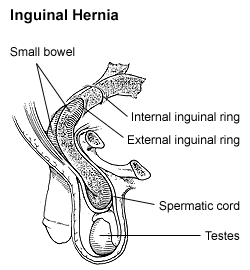
File:Inguinalhernia.gif · Wikimedia Commons · See Wikimedia Commons
inguinal hernia
Sign in to saveintestinal disease characterized by a protrusion of abdominal cavity contests through the inguinal canal
Key facts
- Pronunciation
- / ˈ ɪ ŋ ɡ w ɪ n əl ˈ h ɜːr n i ə /
- Specialty
- General surgery
- Symptoms
- Pain, bulging in the groin
- Complications
- Strangulation
- Usual onset
- < 1 year old, > 50 years old
- Risk factors
- Family history , smoking , chronic obstructive pulmonary disease , obesity , pregnancy , peritoneal dialysis , collagen vascular disease , connective tissue disease, previous open appendectomy
- Diagnostic method
- Based on symptoms, medical imaging
- Treatment
- Conservative , surgery
- Frequency
- 27% (males), 3% (females)
- Deaths
- 59,800 (2015)
via Wikipedia infobox
Research
22,354 papers- The history of inguinal hernia surgery.Rozhledy v chirurgii : mesicnik Ceskoslovenske chirurgicke spolecnosti · 2023
- Robotic Inguinal Hernia Repair.The Surgical clinics of North America · 2020
- The Minimally Invasive Inguinal Hernia: Current Trends and Considerations.The Surgical clinics of North America · 2023
- Inguinal hernia.The Medical journal of Australia · 1947
- Inseparable interaction of the prostate and inguinal hernia.International journal of urology : official journal of the Japanese Urological Association · 2018
via PubMed
Wikidata facts
- Subclass of
- disease
- Image
- Inguinalhernia.gif
Show 9 more facts
- topic's main category
- Category:Inguinal hernias
- Commons category
- Inguinal hernia
- health specialty
- gastroenterology
- NCI Thesaurus ID
- C34691
- ICPC 2 ID
- D89
- exact match
- purl.obolibrary.org/obo/HP_0000023
- on focus list of Wikimedia project
- WikiProject Medicine
- ICD-9-CM
- 550.90
- P8168
- Boots Mussulli
via Wikidata · CC0
~17 min read
Encyclopedic overview
An inguinal hernia or groin hernia is a hernia (protrusion) of abdominal cavity contents through the inguinal canal. Symptoms, which may include pain or discomfort, especially with or following coughing, exercise, or bowel movements, are absent in about a third of patients. Symptoms often get worse throughout the day and improve when lying down. A bulging area may occur that becomes larger when bearing down. Inguinal hernias occur more often on the right than the left side. The main concern is strangulation, where the blood supply to part of the intestine is blocked. This usually produces severe pain and tenderness in the area.
Risk factors for the development of a hernia include: smoking, chronic obstructive pulmonary disease, obesity, pregnancy, peritoneal dialysis, collagen vascular disease, and previous open appendectomy, among others. Predisposition to hernias is genetic and they occur more often in certain families. Deleterious mutations causing predisposition to hernias seem to have dominant inheritance (especially for men). It is unclear if inguinal hernias are associated with heavy lifting. Hernias can often be diagnosed based on signs and symptoms. Occasionally, medical imaging is used to confirm the diagnosis or rule out other possible causes.
Excerpted from Wikipedia’s “inguinal hernia” article, available under the CC BY-SA 4.0 licence.