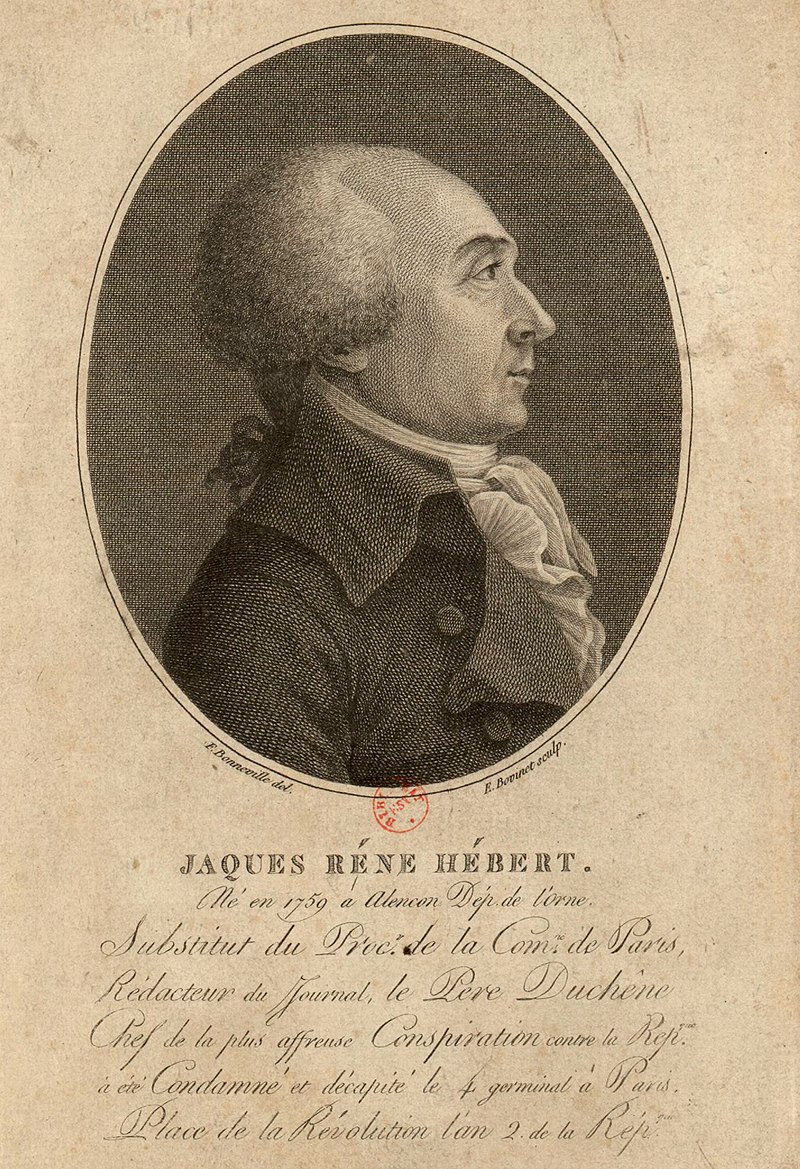
File:Jacques_René_Hébert.JPG · Wikimedia Commons · See Wikimedia Commons
Jacques Hébert
Sign in to saveAlso known as Jacques Rene Hébert, Jacques René Hébert
French journalist and politician
Key facts
- Born
- Jacques René Hébert , ( 1757-11-15 ) 15 November 1757, Alençon , Kingdom of France
- Died
- 24 March 1794 (1794-03-24) (aged 36), Paris, French First Republic
- Cause of death
- Beheaded
- Resting place
- Errancis Cemetery
- Party
- The Mountain (1792–1794)
- Other political affiliations
- Jacobin Club (1789–1792), Cordeliers Club (1792–1794)
- Spouse
- Marie Marguerite Françoise Hébert ( married</span>"}]]}'>m. 1792 )
- Children
- Virginie-Scipion Hébert (1793–1830)
- Parent s
- Jacques Hébert (?–1766) and Marguerite La Beunaiche de Houdré (1727–1787)
- Occupation
- Journalist, writer, publisher, politician
via Wikipedia infobox
Wikidata facts
- Instance of
- human
- Given name
- Jacques
- Gender
- male
- Citizenship
- France
- Place of birth
- Alençon
- Place of death
- Paris
- Occupation
- writer
- Political party
- Cordeliers
- Languages spoken
- French
- Participant in
- French Revolution
- Image
- Jacques René Hébert.JPG
Show 8 more facts
- name in native language
- Jacques-René Hébert
- cause of death
- decapitation
- Commons category
- Jacques-René Hébert
- nickname
- Le Père Duchesne
- date of birth
- 1757-11-15
- date of death
- 1794-03-24
- place of burial
- Errancis Cemetery
- manner of death
- capital punishment
Sources (1)
via Wikidata · CC0
~21 min read
Encyclopedic overview
Jacques René Hébert ( French: [ʒak ʁəne ebɛʁ]; 15 November 1757 – 24 March 1794) was a French journalist and a prominent figure of the French Revolution. The founder and editor of the radical newspaper Le Père Duchesne, he was the chief spokesman for the Parisian sans-culottes. He and his followers, known as the Hébertists, played a major role in ushering in some of the most radical measures of the revolutionary period that culminated in the Reign of Terror.
Born in Alençon into a bourgeois family, Hébert was brought to ruin by a lawsuit and fled to Paris in 1780, where he lived in destitution for nearly a decade. At the outbreak of the revolution he found success as a pamphleteer, and in 1790 he founded Le Père Duchesne, a newspaper noted for its provocative tone and ribald language that enjoyed immense popularity and widespread circulation among the Parisian working class. Hébert initially advocated in favour of a constitutional monarchy, focusing his attacks on the aristocracy and clergy. Following Louis XVI's failed flight to Varennes, he became violently critical of the monarchy as well. A member of the Cordeliers club, Hébert supported the Insurrection of 10 August 1792 and the September Massacres, and through his vitriolic rhetoric he played an active role in the fall of the Girondins in mid-1793.
Excerpted from Wikipedia’s “Jacques Hébert” article, available under the CC BY-SA 4.0 licence.