
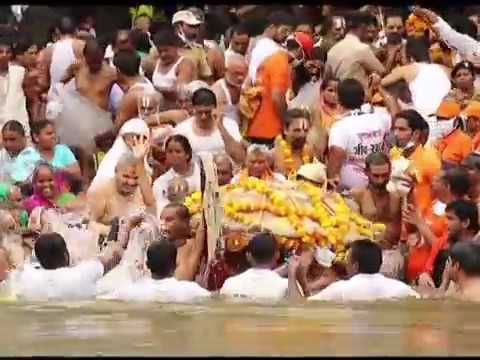
File:Third_Shahi_Snan_in_Hari_Ki_Pauri.jpg · Wikimedia Commons · See Wikimedia Commons
Kumbh Mela is a major Hindu pilgrimage and festival held in India where millions of devotees gather to bathe in sacred rivers, believing it will cleanse them spiritually and free them from sin. It is one of the world's largest religious gatherings and is considered deeply significant in Hindu tradition and practice.
AI-generated from the Wikipedia summary — may contain errors.
Described at
Kumbh Mela - UNESCO Intangible Cultural Heritage
ich.unesco.org →Kumbh Mela (the festival of the sacred Pitcher) is the largest peaceful congregation of pilgrims on earth, during which participants bathe or take a dip in a sacred river. Devotees believe that by bathing in the Ganges one is freed from sins liberating her/him from the cycle of birth and death. Millions of people reach the place without any invitation. The congregation includes ascetics, saints, sadhus, aspirants-kalpavasis and visitors. The festival is held at Allahabad, Haridwar, Ujjain and Nasik every four years by rotation and is attended by millions of people irrespective of caste, creed or gender. Its primary bearers, however, belong to akhadas and ashrams, religious organizations, or are individuals living on alms. Kumbh Mela plays a central spiritual role in the country, exerting a mesmeric influence on ordinary Indians. The event encapsulates the science of astronomy, astrology, spirituality, ritualistic traditions, and social and cultural customs and practices, making it extremely rich in knowledge. As it is held in four different cities in India, it involves different social and cultural activities, making this a culturally diverse festival. Knowledge and skills related to the tradition are transmitted through ancient religious manuscripts, oral traditions, historical travelogues and texts produced by eminent historians. However, the teacher-student relationship of the sadhus in the ashrams and akhadas remains the most important method of imparting and safeguarding knowledge and skills relating to Kumbh Mela.
Excerpt from a page describing this subject · 7,934 chars · not written by Vinony
Wikidata facts
- Country
- India
- Official website
- kumbhmelaallahabad.gov.in
- Image
- Kumbh Mela2001.JPG
- Participant
- hijra
Show 4 more facts
- Commons category
- Kumbh Mela
- topic's main category
- Category:Kumbh Mela
- described at URL
- ich.unesco.org/es/RL/01258
- on focus list of Wikimedia project
- Wikipedia:Vital articles/Level/4
via Wikidata · CC0
~40 min read
Encyclopedic overview
Kumbh Mela (Sanskrit: Kumbha Mēlā, pronounced [kʊˈmbʱᵊ melaː]; lit. 'festival of the Sacred Pitcher') is a Hindu pilgrimage, celebrated every four or twelve years, correlated with the partial or full revolution of Jupiter. These are held at four locations–Prayagraj, Haridwar, Nashik, and Ujjain, with varying time intervals. As per the Puranas, these sites are considered to have received the drops of the divine nectar (amrita) during the Samudra Manthana (churning of the ocean of milk). The Kumbh Mela lasts between one and three months, with the Amavasya day attracting the largest crowds. The festival attracts millions of people, with the largest gathering recorded at Prayag. About 660 million attended the Kumbh Mela in 2025, and 200 million in 2019, making it one of the largest gatherings in the world. It has been inscribed on the UNESCO Representative List of Intangible Cultural Heritage of Humanity.
The Kumbh Mela is observed cycle at each site approximately once every 12 years based on the Hindu luni-solar calendar and the relative positions of Jupiter, the Sun, and the Moon. As per Hindu astrology, specific alignments of the Jupiter, the Sun, and the Moon only occur at the four Kumbh locations in a 12-year cycle. The Prayag and Haridwar festivals are held with a six year gap in between, and feature a Maha (major) and Ardha (half) Kumbh Melas. The Kumbh Melas at Ujjain and Nashik are observed in the same year or one year apart, typically about three years after the Prayag Kumbh Mela. The festival is held at the confluence of major rivers, and people take a ritual dip in the waters, believed to be a means of prāyaścitta (atonement) for the past mistakes, and cleansing of their sins. Various fairs, educational events, religious discourses, mass gatherings of monks, and entertainment are also conducted during the festivities.
Excerpted from Wikipedia’s “Kumbh Mela” article, available under the CC BY-SA 4.0 licence.
Gallery (12)
Available in 64 languages
- Español
- Français
- Deutsch
- 中文
- 日本語
- Русский
- Português
- Italiano
- العربية
- हिन्दी
- Afrikaans
- Assamese
- Asturian
- Awadhi
- Bahasa Indonesia
- Bangla
- Basque
- be_x_old
Show 45 more
- Bhojpuri
- Catalan
- Czech
- Danish
- Esperanto
- Fiji Hindi
- Finnish
- Greek
- Gujarati
- Hebrew
- Hungarian
- Kannada
- Kashmiri
- Lithuanian
- Macedonian
- Maithili
- Malay
- Malayalam
- Marathi
- Nederlands
- Nepali
- Norwegian
- Norwegian Nynorsk
- Odia
- Polski
- Punjabi
- Sanskrit
- Serbian
- simple
- Sindhi
- Svenska
- syl
- Tamil
- Tatar
- Telugu
- Tiếng Việt
- Tulu
- Türkçe
- Ukrainian
- Urdu
- Welsh
- zh_yue
- فارسی
- ไทย
- 한국어
via Wikidata sitelinks · CC0