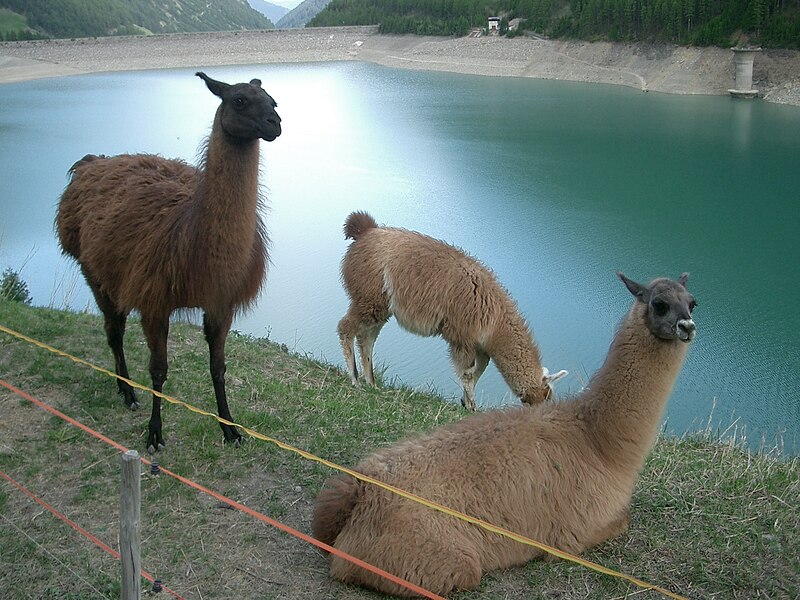
File:Llamas,_Vernagt-Stausee,_Italy.jpg · Wikimedia Commons · See Wikimedia Commons
Lama glama
Sign in to saveAlso known as llama
The llama (; or ) (Lama glama) is a domesticated South American camelid, widely used as a meat and pack animal by Andean cultures since the pre-Columbian era.
OverviewAI-generated
Lama glama is a species within the family Camelidae, classified under the order Artiodactyla, class Mammalia, phylum Chordata, and kingdom Animalia. The taxon is also referred to by the common names lama andyjska, lama, and llama. It is described in the Brockhaus and Efron Encyclopedic Dictionary and the Encyclopædia Britannica 11th edition. The scientific name was established by Linnaeus in 1758.
The species is native to Ecuador, Peru, Chile, and Bolivia. It exhibits diurnal activity. Biological records indicate a gestation period of 358 days and a litter size of one. The longest observed lifespan is 28.9 years. The Unicode character 🦙 represents the organism.
Occurrences of the species have been recorded in the United States by institutions including RBINS-SCIENTIFIC HERITAGE, CAS, and SMM. The taxon is listed as accepted in the World Register of Marine Species. It appears in the Commons category and gallery for Lama glama. The species is sequenced in the DNazoo database.
Synthesized by Vinony from 42 facts across 6 sources: Wikidata, GBIF, Gbif Occ, WoRMS, iDigBio, Vinony graph. Generated from structured data (not the Wikipedia text) and checked against those facts — may still contain errors.
Species
Lama glama
SPECIES
- KingdomAnimalia
- PhylumChordata
- ClassMammalia
- OrderArtiodactyla
- FamilyCamelidae
大羊駝(学名:Lama glama),又名家羊駝,是南美洲的駱駝科,和多種相似動物合稱為駱馬或美洲駝。在印加帝國及其他安地斯山脈地區是原住民廣泛蓄養的動物。在南美洲,大羊駝是用來背負重物、製造纖維及作為食物。 完全成長的大羊駝全高1.6-1.8米。牠們重約127-204公斤。初出生的大羊駝重約9-14公斤。大羊駝是群居的動物,喜歡與其他的大羊駝組成族群。大羊駝所生產的纖維非常柔軟及沒有羊毛脂。牠們在幾次嘗試後就可以學會東西,非常聰明。牠們可以背負其體重的25-30%的重物行走幾里路。 大羊駝在4000萬年前源自於北美洲中央的平原。牠們在約300萬年前的南北美洲生物大遷徙遷往南美洲。在冰河時期,牠們在北美洲消失。直至2007年,在南美洲有超過700萬頭大羊駝及羊駝。另外由於從南美洲進口的關係,美國及加拿大在20世紀末就有超過10萬頭大羊駝及6500-7000頭羊駝。
via GBIF
Museum specimens
- Specimen records
- 442
- With media
- 25
- Family
- Camelidae
- Collections
- RBINS-SCIENTIFIC HERITAGE, CAS, SMM
- Recorded in
- United States
Wikidata facts
- Instance of
- taxon
- Parent taxon
- Lama panchitoe
- Image
- Lama glama Laguna Colorada 2.jpg
Show 16 more facts
- taxon name
- Lama glama
- taxon rank
- species
- Commons category
- Lama glama
- Commons gallery
- Lama glama
- gestation period
- 358
- Unicode character
- 🦙
- longest observed lifespan
- 28.9
- litter size
- 1
- different from
- Lama panchitoe
- taxon common name
- llama
- sequenced genome URL
- www.dnazoo.org/assemblies/Lama_glama
- on focus list of Wikimedia project
- Wikipedia:Vital articles/Level/4
- taxon range
- Paraguay
- diel cycle
- diurnality
- short name
- L. glama
- IPA transcription
- ˈʝama
via Wikidata · CC0
~26 min read
Encyclopedic overview
21 sectionsContents
- Classification
- Characteristics
- Reproduction
- Mating
- Gestation
- Crias
- Breeding methods
- Nutrition
- Behavior
- Guard behavior
- Fiber
- Medical uses
- History of domestication
- Pre-Incan cultures
- Inca Empire
- Spanish Empire
- United States
- Culture
- See also
- Notes
- External links
The llama (; or ) (Lama glama) is a domesticated South American camelid, widely used as a meat and pack animal by Andean cultures since the pre-Columbian era.
Llamas are social animals and live with others as a herd. Their wool is soft and contains only a small amount of lanolin. Llamas can learn simple tasks after a few repetitions. When using a pack, they can carry about 25 to 30% of their body weight for 8 to 13 km (5–8 miles). The name llama (also historically spelled "lama" or "glama") was adopted by European settlers from native Peruvians.
Excerpted from Wikipedia’s “Lama glama” article, available under the CC BY-SA 4.0 licence.
Gallery (46)
Available in 102 languages
- Español
- Français
- Deutsch
- 中文
- 日本語
- Русский
- Português
- Italiano
- العربية
- हिन्दी
- Afrikaans
- Albanian
- Aragonese
- Armenian
- Asturian
- Aymara
- azb
- Azerbaijani
Show 83 more
- Bahasa Indonesia
- Balinese
- Bangla
- Basque
- bat_smg
- Belarusian
- Bikol
- Breton
- Bulgarian
- Burmese
- Catalan
- Cebuano
- Chuvash
- Croatian
- Czech
- Danish
- Egyptian Arabic
- Esperanto
- Estonian
- Filipino
- Finnish
- Galician
- Greek
- Guarani
- Haitian Creole
- Hebrew
- Hungarian
- Icelandic
- Ido
- Interlingua
- Irish
- Javanese
- Kabyle
- Kotava
- Kyrgyz
- Latin
- Latvian
- Lithuanian
- Macedonian
- Malagasy
- Malay
- Malayalam
- Marathi
- Mari
- Mazanderani
- Mongolian
- Navajo
- Nederlands
- Northern Frisian
- Norwegian
- Norwegian Nynorsk
- Occitan
- Ossetic
- Pashto
- Polski
- Quechua
- Romanian
- Saterland Frisian
- Scots
- Serbian
- Serbian (Latin)
- Sicilian
- Silesian
- simple
- Slovak
- Slovenian
- Svenska
- Swahili
- Tamil
- Tiếng Việt
- Türkçe
- Udmurt
- Ukrainian
- Walloon
- Waray
- Welsh
- West Flemish
- Western Panjabi
- Wu Chinese
- zh_yue
- فارسی
- ไทย
- 한국어
via Wikidata sitelinks · CC0