
File:Lavash,_Temple_Fortune,_London_(4444275978).jpg · Wikimedia Commons · See Wikimedia Commons
lavash
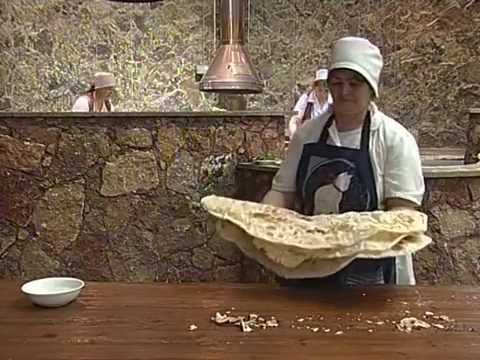
Sign in to saveLavash (; ) is a thin flatbread usually leavened, traditionally baked in a tandoor (tonir or tanoor) or on a sajj, and common to the cuisines of South Caucasus, West Asia, and the areas surrounding the Caspian Sea. Lavash is widespread in Armenia.
Lavash is a thin, leavened flatbread traditionally baked in a tandoor or on a flat griddle, commonly found in the cuisines of the South Caucasus, West Asia, and areas around the Caspian Sea, with particular prominence in Armenia. It matters as a staple bread that reflects the culinary traditions and cultural identity of multiple regions across this geographic area.
AI-generated from the Wikipedia summary — may contain errors.
Key facts
- Food.name
- Lavash
- Food.image
- Lavash, Temple Fortune, London (4444275978).jpg
- Food.type
- Flatbread
- Food.place_of_origin
- Possibly Armenia or Middle East
- Food.region
- West Asia
- Food.served
- Hot or cold
- Intangible heritage.ICH
- Flatbread making and sharing culture: Lavash, Katyrma, Jupka, Yufka
- Intangible heritage.State Party
- Armenia
- Intangible heritage.ID
- 01181
- Intangible heritage.Region
- ENA
- Intangible heritage.Year
- 2016
- Intangible heritage.Session
- 11th
- Intangible heritage.List
- Representative
- Intangible heritage.Countries
- Azerbaijan, Iran, Kazakhstan, Kyrgyzstan, and Turkey
via Wikipedia infobox
Described at
Lavash, the preparation, meaning and appearance of traditional bread as an expression of culture in Armenia - UNESCO Intangible Cultural Heritage
ich.unesco.org →Lavash is a traditional thin bread that forms an integral part of Armenian cuisine. Its preparation is typically undertaken by a small group of women, and requires great effort, coordination, experience and special skills. A simple dough made of wheat flour and water is kneaded and formed into balls, which are then rolled into thin layers and stretched over a special oval cushion that is then slapped against the wall of a traditional conical clay oven. After thirty seconds to a minute, the baked bread is pulled from the oven wall. Lavash is commonly served rolled around local cheeses, greens or meats, and can be preserved for up to six months. It plays a ritual role in weddings, where it is placed on the shoulders of newlyweds to bring fertility and prosperity. The group work in baking lavash strengthens family, community and social ties. Young girls usually act as aides in the process, gradually becoming more involved as they gain experience. Men are also involved through the practices of making cushions and building ovens, and pass on their skills to students and apprentices as a necessary step in preserving the vitality and viability of lavash making. 1. Knowledge and practices concerning nature and the universe (308) 2. Oral traditions and expressions (384) 3. Performing arts (411) 4. Social practices, rituals and festive events (584) 5. Traditional craftsmanship (460)
Excerpt from a page describing this subject · 8,472 chars · not written by Vinony
Wikidata facts
- Subclass of
- finger food
- Part of
- Armenian cuisine
- Country of origin
- Middle East
- Material used
- dough
- Image
- Pan armenio en el mercado de Yerevan.JPG
Show 3 more facts
- Commons category
- Lavash
- cuisine
- Kyrgyz cuisine
- described at URL
- ich.unesco.org/es/RL/00985
Sources (1)
via Wikidata · CC0
~9 min read
Encyclopedic overview
11 sectionsContents
- Etymology
- History
- Preparation
- Serving
- Consumption
- Traditions and customs
- In art
- See also
- References
- Works cited
- External links
Lavash (; ) is a thin flatbread usually leavened, traditionally baked in a tandoor (tonir or tanoor) or on a sajj, and common to the cuisines of South Caucasus, West Asia, and the areas surrounding the Caspian Sea. Lavash is widespread in Armenia.
In 2014, "Lavash, the preparation, meaning and appearance of traditional bread as an expression of culture in Armenia" was inscribed in the UNESCO Representative List of the Intangible Cultural Heritage of Humanity. In 2016, the making and sharing of flatbread (lavash, katyrma, jupka or yufka) in communities of Azerbaijan, Iran, Kazakhstan, Kyrgyzstan, and Turkey was inscribed on the list as well. Lavash is similar to yufka, but in Turkish cuisine lavash (lavaş) is prepared with a yeast dough while yufka is typically unleavened.
Excerpted from Wikipedia’s “lavash” article, available under the CC BY-SA 4.0 licence.
Gallery (10)
Available in 60 languages
- Español
- Français
- Deutsch
- 中文
- 日本語
- Русский
- Português
- Italiano
- العربية
- हिन्दी
- Afrikaans
- Armenian
- Awadhi
- Azerbaijani
- Bahasa Indonesia
- Bashkir
- Basque
- be_x_old
Show 41 more
- Belarusian
- Bulgarian
- Catalan
- Chuvash
- Czech
- Egyptian Arabic
- Esperanto
- Estonian
- Georgian
- Greek
- Hebrew
- hyw
- Interlingua
- Javanese
- Kurdish
- Latvian
- lbe
- Lithuanian
- Luxembourgish
- Malayalam
- Nederlands
- Norwegian
- Norwegian Nynorsk
- Ossetic
- Pashto
- Polski
- Serbian
- Serbian (Latin)
- simple
- Slovak
- Svenska
- Tamil
- Tatar
- Türkçe
- Ukrainian
- Uzbek
- Veps
- Western Panjabi
- zh_yue
- فارسی
- 한국어
via Wikidata sitelinks · CC0