law of cosines
Also known as cosine law, cosine formula, cosine rule
property of all triangles on a Euclidean plane
AI overview
The law of cosines is a mathematical formula that describes a fundamental property of all triangles on a flat surface, relating the lengths of a triangle's sides to one of its angles. It matters because it allows you to find unknown side lengths or angles in a triangle when you know some but not all of this information.
AI-generated from the Wikipedia summary — may contain errors.
Wikidata facts
- Image
- Law of cosines with an obtuse angle.svg
Show 1 more fact
- Commons category
- Law of cosines
Sources (2)
via Wikidata · CC0
~34 min read
Article
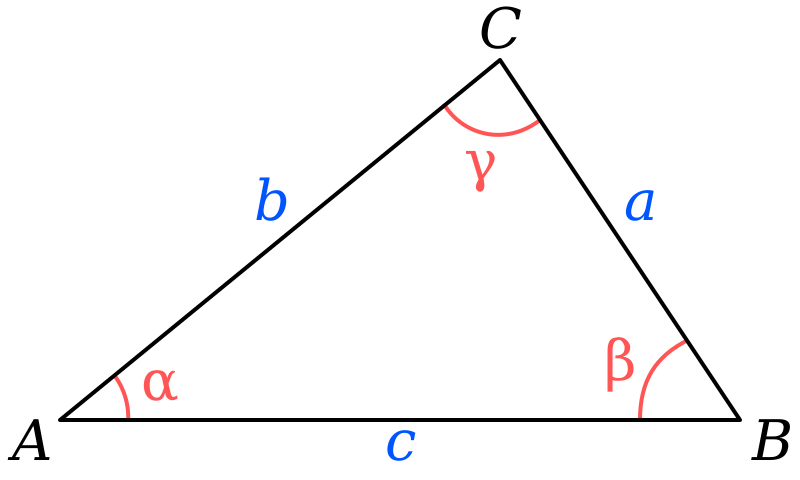
Fig. 1 – A triangle. The angles α (or A), β (or B), and γ (or C) are respectively opposite the sides a, b, and c. In trigonometry, the law of cosines (also known as the cosine formula or cosine rule) relates the lengths of the sides of a triangle to the cosine of one of its angles. For a triangle with sides
a