
Liberia
Sign in to saveAlso known as Republic of Liberia, lr, Liber
Liberia, officially the Republic of Liberia, is a country on the West African coast. It is bordered by Sierra Leone to its northwest, Guinea to its north, Ivory Coast to its east, and the Atlantic Ocean to its south and southwest. It has a population of around 5.5million and covers an area of . The official language is English. Over 20 indigenous languages are spoken, reflecting the country's ethnic and cultural diversity. The capital and largest city is Monrovia.
OverviewAI-generated
Liberia, officially the Republic of Liberia, is a sovereign state and republic located in Western Africa. Its capital is Monrovia. The country shares borders with Guinea, Sierra Leone, and Ivory Coast. English is the official language. The national anthem is "All Hail, Liberia, Hail!" and its top-level Internet domain is .lr.
The population is recorded as 5,248,621 and 5,612,817 in different datasets. The area is 111,369 square kilometers. Liberia contains administrative entities including Bomi County, Bong County, Gbarpolu County, and Grand Bassa County. Its highest point is Mount Wuteve. The country is a member of the United Nations and the African Union.
The currency includes the Liberian dollar, British West African pound, and United States dollar. The telephone country code is 231. Forest area covers 78.1422342192691 percent of the land. Renewable energy accounts for 92.8 percent. The life expectancy is 62.324 years. Urban population is 55.5387986654968 percent. Internet users comprise 32.23360062 percent of the population.
Synthesized by Vinony from 67 facts across 9 sources: Wikidata, REST Countries, Openweathermap, Open Meteo, World Bank, OpenStreetMap, PubMed, Vinony graph, Geo. Generated from structured data (not the Wikipedia text) and checked against those facts — may still contain errors.
Weather now
7-day forecast
via Open-Meteo
Country
- Capital
- Monrovia
- Population
- 5,248,621
- Region
- Africa · Western Africa
- Demonym
- Liberian
- Currencies
- LRD ($)
- Languages
- English
- Calling code
- +231
- Drives on
- Right
- Gini
- 35.3 (2016)
- FIFA code
- LBR
- TLD
- .lr
- Timezones
- UTC
- Borders
- GIN, CIV, SLE
via REST Countries
Indicators · World Bank
- GDP
- $4.8B(2024)
- Population
- 5,612,817(2024)
- Life expectancy
- 62.3 yrs(2024)
- Unemployment
- 2.9 %(2025)
- Urban population
- 55.5 %(2024)
- Internet users
- 32.2 %(2024)
- Forest area
- 78.1 %(2023)
- Renewable energy
- 92.8 %(2022)
via World Bank Open Data · CC BY 4.0
Wikipedia views (30d)
114,295 totalvia Wikimedia Pageviews API
Key facts
- Country.conventional_long_name
- Republic of Liberia
- Country.common_name
- Liberia
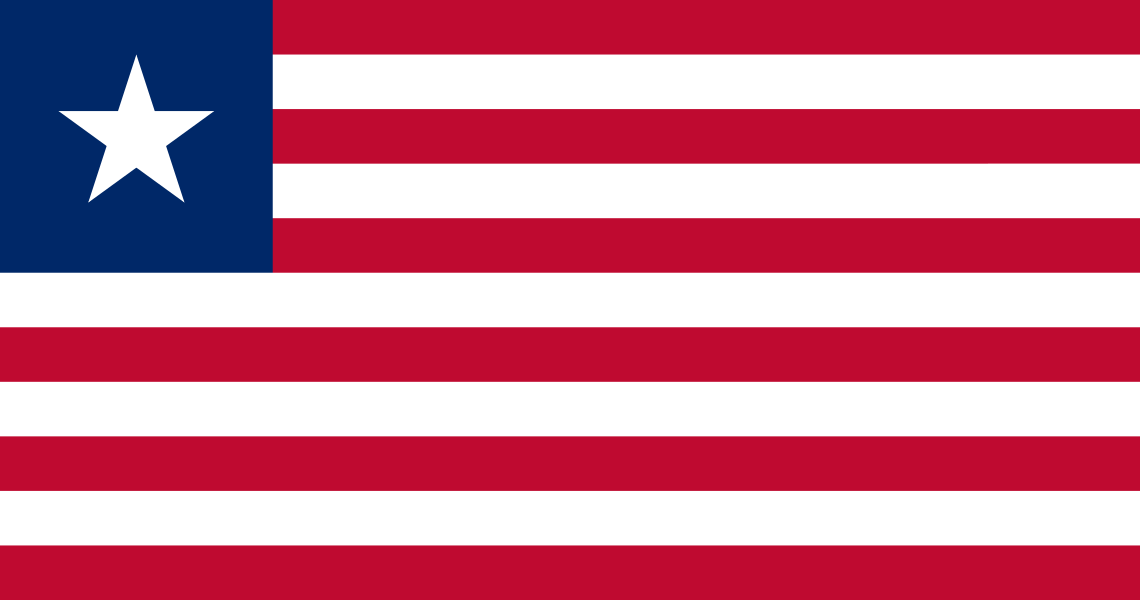
- Country.image_flag
- Flag of Liberia.svg
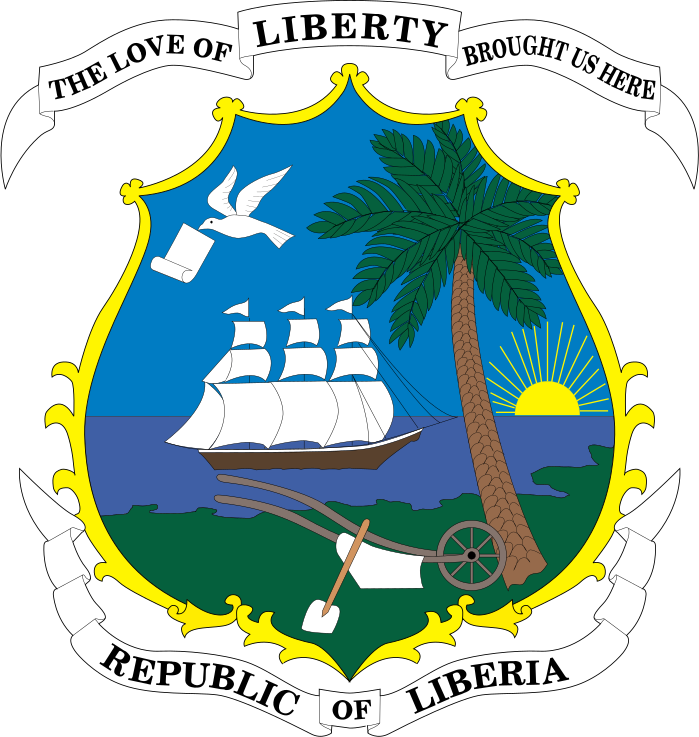
- Country.image_coat
- Coat of arms of Liberia.svg
- Country.symbol_type
- Coat of arms
- Country.national_motto
- "The Love of Liberty Brought Us Here"
- Country.national_anthem
- "All Hail, Liberia, Hail!"
- Country.official_languages
- English
- Country.languages_type
- Vernacularlanguages
- Country.ethnic_groups_year
- 2008
- Country.religion_year
- 2018
- Country.demonym
- Liberian
- Country.capital
- Monrovia
- Country.largest_city
- Monrovia
- Country.government_type
- Unitary presidential republic
- Country.leader_title1
- President
- Country.leader_name1
- Joseph Boakai
- Country.leader_title2
- Vice President
via Wikipedia infobox
Research
3,107 papers- Monkeypox Virus Clade IIa Infections, Liberia, 2023-2024.Emerging infectious diseases · 2025Nyan DC, Berry IM, Shobayo BI et al.DOI: 10.3201/eid3109.250271
- Liberia.Department of State publication. Background notes series · 1987United States. Department of State. Bureau of Public Affairs
- [Liberia].Jeune Afrique (Paris, France : 1980) · 1996
- Documenting the development, adoption and pre-ebola implementation of Liberia's integrated disease surveillance and response (IDSR) strategy.ReviewBMC public health · 2023Nyenswah TG, Skrip L, Stone M et al.DOI: 10.1186/s12889-023-17006-7
- Health Management Workforce Capacity-Building in Liberia, Post-Ebola.Annals of global health · 2021Talbert-Slagle K, Koomson F, Candy N et al.DOI: 10.5334/aogh.3250
- Liberia's Community Health Assistant Program: Scale, Quality, and Resilience.Global health, science and practice · 2021Healey J, Wiah SO, Horace JM et al.DOI: 10.9745/GHSP-D-20-00509
- Suicidal behaviours among adolescents in Liberia.BMC psychiatry · 2020Quarshie EN, Onyeaka HK, Oppong Asante KDOI: 10.1186/s12888-020-02985-3
- Epidemiological stratification and sub-national tailoring of malaria interventions in Liberia.ReviewMalaria journal · 2025Koko VS, Hinneh DL, Kumeh O et al.DOI: 10.1186/s12936-025-05536-x
via PubMed
Wikidata facts
- Instance of
- country
- Official name
- la République du Libéria
- Demonym
- ليبيرية
- Country
- Liberia
- Contains
- Sinoe County
- Continent
- Africa
- Capital
- Monrovia
- Official language
- English language
- Currency
- Liberian dollar
- Population
- 5214030
- Area
- 111369
- Body of water
- Atlantic Ocean
- Head of government
- Joseph Boakai
- Head of state
- Joseph Boakai
- Form of government
- republic (until 1980)
- Legislature
- Legislature of Liberia
- Anthem
- All Hail, Liberia, Hail!
- Shares border with
- Ivory Coast
- Highest point
- Mount Wuteve
- Image
- Liberian Capitol Building.jpg
- Life expectancy
- 62.505
- Nominal GDP
- 4001047150
- Unemployment rate
- 4
- Calling code
- +231
Show 55 more facts
- Licence plate code
- LB
- Electrical plug type
- Schuko
- Mains voltage
- 220
- Motto
- Ein Cariad at Ryddid a Ddaeth a Ni Yma
- Flag
- flag of Liberia
- Coat of arms
- coat of arms of Liberia
- top-level Internet domain
- .lr
- Commons category
- Liberia
- member of
- African Continental Free Trade Area
- topic's main category
- Category:Liberia
- inception
- 1822-01-07
- category for people who died here
- Category:Deaths in Liberia
- category for people born here
- Category:Births in Liberia
- category for films shot at this location
- Category:Films shot in Liberia
- category of associated people
- Category:Liberian people
- office held by head of government
- President of Liberia
- office held by head of state
- President of Liberia
- topic's main Wikimedia portal
- Portal:Liberia
- Commons gallery
- Liberia
- lowest point
- Atlantic Ocean
- mobile country code
- 618
- driving side
- right
- geography of topic
- Geography of Liberia
- marriageable age
- 18
- diplomatic relation
- North Korea
- located in/on physical feature
- West Africa
- total fertility rate
- 4.719
- maritime identification digits
- 637
- described by source
- The Nuttall Encyclopædia
- native label
- Republic of Liberia
- Unicode character
- 🇱🇷
- central bank
- Central Bank of Liberia
- history of topic
- history of Liberia
- BTI Status Index
- 5.28
- BTI Governance Index
- 5.01
- economy of topic
- economy of Liberia
- demographics of topic
- demographics of Liberia
- different from
- Liberia
- Democracy Index
- 5.32
- replaces
- Republic of Maryland
- Human Development Index
- 0.481
- P11012
- Lausanne
- hashtag
- Liberia
- on focus list of Wikimedia project
- Wikipedia:Vital articles/Level/4
- Happy Planet Index score
- 46
- Gini coefficient
- 35.3
- Inequality-adjusted Human Development Index
- 0.330
- P12749
- hassium
- birth rate
- 30.996
- male population
- 2640702
- death rate
- 8.632
- rural population
- 2488813
- female population
- 2661979
- urban population
- 2813868
- P8168
- La Chapelle
Sources (15)
via Wikidata · CC0
Travel guide
Understand
Liberia is a country with historical ties to the United States since it was founded by freed black slaves before the Underground Railroad, American Civil War era of the nineteenth century. The capital, Monrovia, was named after James Monroe. Liberia's flag closely resembles the American flag, reflecting the historical ties between the two countries.
Get in
thumb|375px|A map showing the visa requirements of Liberia, with countries in dark blue having visa-free access
See
thumb|300px|Downtown Monrovia
'Blo Degbo' Human face rock in Paynesville, near Monrovia (Note: this is not a developed tourist destination, so make sure it is a safe place to visit) Rain forests are usually found in remote areas, most are unique and have many attractive features, but on the other hand some are risky because of their wildlife.
There are plenty of beaches around Monrovia. Out towards the airport after ELWA junction is ELWA beach. Set inside a compound there is a marked safe swimming area, a clean beach and plenty of families at the weekends, though without facilities. Further on is Thinkers (pronounced Tinkers) with a food and drinks service, though the waves are a bit rough here, and it is not safe to walk up or down the beach too far. CE CE beach out the other way, over the bridge out to Hotel Africa is very well set up with palm umbrellas, drinks service and a buffet, and a well protected swimming area.
For an interesting day trip, Robertsport offers a glimpse of Liberia's cultural history as well as clean, beautiful beaches. A group of South Africans has set up a tent camp for those wishing to spend the night on the beach and the UN also offers accommodations on a first-come basis. Beware the strong tides.
The city of Buchanan, a several hour car ride from Monrovia, also offers sublime beaches and a selection of restaurants and guest houses.
Do
Liberia has several nightclubs. While places like Deja Vu cater to a largely expat crowd, explore places more popular with locals. 146 on Carey Street features Liberian music, freestyle sessions, and live performances from Liberia's most popular musicians.
Eat
Eating Liberian food can be enjoyable and inexpensive. Liberian meals like palm butter, cassava leaf, potato greens, chock rice, and jollof's rice will barely leave a dent in your budget (US$2-3 with a non-alcoholic drink). Portions are usually enormous. Another popular local dish is fufu (fermented dough made from the cassava plant) and soup (the most common are goat soup and pepper soup). And for those who like to eat on the go, fruit and snacks can be bought from street vendors throughout Monrovia. Peanuts, fried plantain chips, roasted ears of corn or plantains, bananas, mangos, and other fruits cost L$5-20 (or US$0.10-0.30). Especially delicious are the various breads sold freshly baked in the morning. Some breads resemble banana bread, other breads are more like corn bread. All are delicious although somewhat oily.
Drink
thumb|Club beer Club beer is the staple drink, served everywhere. Local gin is also available.
Bagged water is sold on most street corners. While it is supposed to be filtered and safe, it is not guaranteed to be. Stick with bottled water to be sure. You can buy bottled water at any supermarket, restaurant, or at the Total gas stations.
Sleep
Usually hotels are considered quite safe as the owners will employ guards. However, don't be complacent and make sure that you are aware of your security also in the hotels. Be prepared to pay your entire bill in cash (US dollars).
Stay safe
Do not walk around at night, and make sure that your car doors are locked when you drive around. Thieves will often reach into a car when stopped and grab whatever they can, so keep the glass up especially in busy areas of Monrovia (redlight). Rape and armed robbery are common and on the rise. Hotels, etc. have private guards and are rather safe.
There are some gangs of former combatants, armed with machetes and sometimes guns, who walk around poorer areas of Monrovia (Redlight). There are also former combatants in the Palm Grove Cemetery on Center Street. Do not walk there alone at all.
The corner of Randall and Carey is also considered dangerous and supposedly a hang-out for drug dealers.
Avoid any desolate places, and stay in groups.
Keep an eye on the locals, if they are carrying on as normal and you see plenty of women and children about, it is unlikely that there will be major sources of concern. If, however, people have disappeared from a usually busy location, or you find yourself surrounded only by youths, you should try to make a hasty retreat.
UNMIL has calmed the country (in general) but it is already now anticipated that when UNMIL leaves the security situation will be worse.
It is advisable to inform your embassy that you are in the country in case of evacuation.
Furthermore, learn as much about the security situation as you can. Locals are a key source of information. Be careful, however, not to believe everything you hear. Rumours spread like wild…
Stay healthy
thumb|The world's most famous soft drink is available here too HIV, while still low, is on the increase. Prostitution is rampant.
Typhoid, malaria, and worms are very common. In general Liberia is a hotbed for infectious diseases so disinfectants and gels are advisable (especially as handshakes are the norm).
There are few doctors usable by international visitors so getting medical help may pose problems. There is apparently a Jordanian wing at the Kennedy hospital for private patients. MSF will also see foreigners, but only in dire cases.
Bagged water is sold on most street corners. While it is supposed to be filtered and safe, it is not guaranteed to be. Stick with bottled water to be sure. You can buy bottled water at any supermarket, restaurant, or at the Total gas stations.
Liberia experienced a terrible Ebola outbreak in 2014 and 2015 but was declared completely Ebola-free. However, there has been a single case of the disease afterwards.
Respect
It is customary to always greet people wherever you go. Liberians don't take kindly to being ignored and will call you "rude". Word tends to get around quite quickly in Liberia, and the locals will often warn you of security threats if they know you and know that you are approachable.
Don't assume the worst in people; just because Liberia has a lot of social and political problems doesn't mean that every Liberian is alike. By being a bit open-minded, you'll find that almost all Liberians are friendly, sociable, and approachable.
Do not be too direct with your words; Liberians are quite sensitive to being beckoned directly. If you absolutely must discuss personal or sensitive matters, temper your words with a degree of diplomacy and respect.
Saying "no" directly to requests is considered rude, which is why Liberians may often pester you until you give in. Instead, say something along the lines of "later", "tomorrow", "I'll try", or "I'll see what I can do".
Liberia is one of the poorest countries in the world. Many Liberians live in poverty and are barely able to make ends meet. As a tourist, you may be asked by people to give money or gifts. Giving money to the elderly or the physically challenged will not go amiss, but bear in mind that you could be encouraging people (unintentionally) to be dependent on foreign visitors and this, in turn, could give people more of a reason to harass and pester tourists like you. If you really want to make a difference in the communi…
Travel guide from Wikivoyage (CC BY-SA 4.0)
~40 min read
Encyclopedic overview
43 sectionsContents
- History
- Indigenous people
- Mande expansion
- Early colonization
- Political formation
- Early 20th century
- World Wars and interwar period
- Late 20th-century political instability
- 21st century
- Geography
- Climate
- Biodiversity and conservation
- Administrative divisions
- Government and politics
- Military
- Foreign relations
- Law enforcement and crime
- Corruption
- Economy
- Trends
- Shipping flag of convenience
- Major industries
- Agriculture
- Mining
- Transportation
- Energy
- Demographics
- Ethnic groups
- Languages
- Religion
- Education
- Health
- Culture
- Media
- Polygamy
- Cuisine
- Sport
- Measurement system
- See also
- Notes
- References
- Further reading
- External links
Liberia, officially the Republic of Liberia, is a country on the West African coast. It is bordered by Sierra Leone to its northwest, Guinea to its north, Ivory Coast to its east, and the Atlantic Ocean to its south and southwest. It has a population of around 5.5 million and covers an area of 43,000 square miles (111,369 km). The official language is English, though over 20 indigenous languages are spoken, reflecting the country's ethnic and cultural diversity. The capital and largest city is Monrovia.
Liberia began in the early 19th century as a project of the American Colonization Society (ACS), which fomented the emigration of Black Americans from the United States to Africa. Between 1822 and the outbreak of the American Civil War in 1861, more than 15,000 freed and free-born African Americans, along with 3,198 Afro-Caribbeans, relocated to Liberia. Gradually developing an Americo-Liberian identity, the settlers carried their culture and tradition with them while colonizing the indigenous population. Led by the Americo-Liberians, Liberia declared independence on July 26, 1847, which the U.S. did not recognize until February 5, 1862.
Excerpted from Wikipedia’s “Liberia” article, available under the CC BY-SA 4.0 licence.
Gallery (59)
On the map
3 mapped locations
Available in 251 languages
- Español
- Français
- Deutsch
- 中文
- 日本語
- Русский
- Português
- Italiano
- العربية
- हिन्दी
- Abkhazian
- Achinese
- Adyghe
- Afrikaans
- Akan
- Albanian
- Albanian
- Amharic
Show 232 more
- ami
- Angika
- Aragonese
- Armenian
- Arpitan
- Asturian
- azb
- Azerbaijani
- Bahasa Indonesia
- Balinese
- Bambara
- Bangla
- Banjar
- Bashkir
- Basque
- bat_smg
- Bavarian
- be_x_old
- Belarusian
- Betawi
- Bhojpuri
- Bikol
- Bishnupriya
- Bislama
- Bosnian
- Breton
- Bulgarian
- Buriat
- Burmese
- Catalan
- cbk_zam
- cdo
- Cebuano
- Central Kurdish
- Chechen
- Cherokee
- Chuvash
- Cornish
- Corsican
- Crimean Tatar
- Croatian
- Czech
- dag
- Danish
- Divehi
- dty
- Egyptian Arabic
- Esperanto
- Estonian
- Ewe
- Extremaduran
- Faroese
- Fiji Hindi
- Filipino
- Finnish
- fiu_vro
- Fon
- Frafra
- Fula
- Gagauz
- Galician
- Ganda
- gcr
- Georgian
- Gilaki
- gpe
- Greek
- Guarani
- guw
- Haitian Creole
- Hakka Chinese
- Hausa
- Hawaiian
- Hebrew
- Hungarian
- Icelandic
- Ido
- Igbo
- Iloko
- Inari Sami
- Interlingua
- Interlingue
- Irish
- Jamaican Creole English
- Javanese
- Kabyle
- kai
- Kannada
- Kanuri
- Kara-Kalpak
- Karachay-Balkar
- Kashmiri
- Kashubian
- Kazakh
- kbp
- kge
- Kikuyu
- Kinyarwanda
- Kongo
- Kotava
- Kurdish
- Kyrgyz
- Ladino
- Lao
- Latin
- Latvian
- Ligurian
- Limburgish
- Lingala
- Lingua Franca Nova
- Lithuanian
- lld
- Lombard
- Low German
- Lower Sorbian
- Luxembourgish
- Macedonian
- Malagasy
- Malay
- Malayalam
- Maltese
- Manipuri
- Manx
- Māori
- Marathi
- Mari
- Mazanderani
- Minangkabau
- Mingrelian
- Mirandese
- Moksha
- Mongolian
- Moroccan Arabic
- N’Ko
- nds_nl
- Nederlands
- Nepali
- Newari
- Nigerian Pidgin
- Northern Frisian
- Northern Sami
- Northern Sotho
- Norwegian
- Norwegian Nynorsk
- Novial
- nrm
- nup
- Obolo
- Occitan
- Old English
- olo
- Oromo
- Ossetic
- Pampanga
- Papiamento
- Pashto
- Piedmontese
- Polski
- Punjabi
- Quechua
- Romanian
- Romansh
- Samoan
- Sango
- Sanskrit
- Sardinian
- Saterland Frisian
- Scots
- Scottish Gaelic
- Serbian
- Serbian (Latin)
- Shan
- Shona
- Sicilian
- Silesian
- simple
- Sindhi
- Sinhala
- Slovak
- Slovenian
- Somali
- Southern Sotho
- Standard Moroccan Tamazight
- Sundanese
- Svenska
- Swahili
- Swati
- szy
- Tajik
- Talysh
- Tamil
- Taroko
- Tatar
- tay
- Telugu
- Tibetan
- Tiếng Việt
- Toki Pona
- Tsonga
- Tswana
- Tumbuka
- Türkçe
- Turkmen
- Udmurt
- Ukrainian
- Upper Sorbian
- Urdu
- Uyghur
- Uzbek
- Venetian
- Veps
- Volapük
- Waray
- Welsh
- Western Frisian
- Western Mari
- Western Panjabi
- Wolof
- Wu Chinese
- Yakut
- Yiddish
- Yoruba
- Zaza
- Zeelandic
- zh_classical
- zh_min_nan
- zh_yue
- Zhuang
- Zulu
- فارسی
- ไทย
- 한국어
via Wikidata sitelinks · CC0