
Lucian of Samosata
Also known as Lucianus, Lucian, Loukianos, Lucianus Samosatenus
Lucian of Samosata (Λουκιανὸς ὁ Σαμοσατεύς, 125 – after 180) was a Hellenized Syrian satirist, rhetorician and pamphleteer who is best known for his characteristic tongue-in-cheek style, with which he frequently ridiculed philosophers and priests, speculative beliefs about the nature of the universe, religious practices, and superstitions. Although his native language was probably Syriac, all of his extant works are written entirely in ancient Greek (mostly in the Attic Greek dialect popular during the Second Sophistic period).
AI overview
Lucian of Samosata was a Greek-writing Syrian satirist and rhetorician (125–after 180) famous for his witty, mocking style, which he used to ridicule philosophers, priests, superstitions, and religious practices. His works, written in ancient Greek despite his likely native Syriac language, represent an important example of skeptical and irreverent intellectual commentary from the Roman imperial period.
AI-generated from the Wikipedia summary — may contain errors.
Person · Open Library
- Born
- ca. 125 AD
- Died
- ca. 180 AD
- Works
- 333
Top works
- Homeric ballads and comedies of Lucian
- Certain select dialogues of Lucian
- Dialogi Lvciani selectiores, svperorvm, marinorum, & inferorum
- Opera Graece et Latine
- Dialogues, selected from Lucian. ; Together with his method of writing history
via Open Library + Wikidata
Listeners · Last.fm
- Listeners
- 7
- Total plays
- 16
<a href="https://www.last.fm/music/Lucian+of+Samosata">Read more on Last.fm</a>
Recent publications · Crossref
Works in European collections
36 objects attributed to Lucian of Samosata, held across European museums, libraries & archives · via Europeana

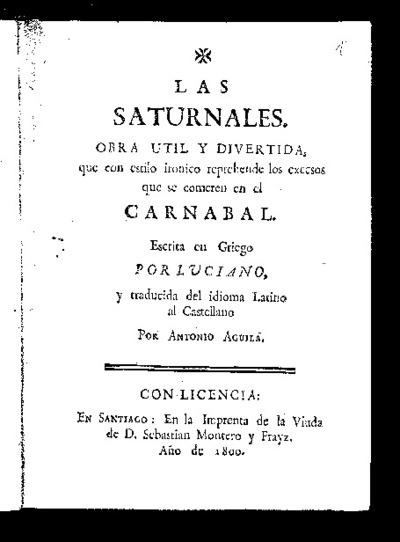
Saturnalia, Cronosolon
Tade enestin en tÅ?ide tÅ?i bibliÅi. Loukianou. Philostratou Eikones. Tou autou HÄ "rÅ?à ¯ ka Tou autou Bioi Ån. Philostratou neÅ?terou Eikoneis. Kallistratou Ekphraseis. Que (!) ad volumine continentur. Luciani Opera. Icones Philostrati. Eiusdem Heroica. Eiusdem uità ³ Sophistarum. Icones Iunioris Philostrati. Descriptiones Callition...
~37 min read
Article
20 sectionsContents
- Life
- Biographical sources
- Background and upbringing
- Education and career
- Views
- Works
- ''A True Story''
- Satirical dialogues
- Treatises and letters
- Pseudo-Lucian
- Legacy
- Byzantine
- Renaissance and Reformation
- Early modern period
- Modern period
- Editions
- Notes
- References
- Bibliography
- External links
Lucian of Samosata (Λουκιανὸς ὁ Σαμοσατεύς, 125 – after 180) was a Hellenized Syrian satirist, rhetorician and pamphleteer who is best known for his characteristic tongue-in-cheek style, with which he frequently ridiculed philosophers and priests, speculative beliefs about the nature of the universe, religious practices, and superstitions. Although his native language was probably Syriac, all of his extant works are written entirely in ancient Greek (mostly in the Attic Greek dialect popular during the Second Sophistic period).
Everything that is known about Lucian's life comes from his own writings, which are often difficult to interpret because of his extensive use of sarcasm. According to his oration The Dream, he was the son of a lower middle class family from the city of Samosata along the banks of the Euphrates in the remote Roman province of Syria. As a young man, he was apprenticed to his uncle to become a sculptor, but, after a failed attempt at sculpting, he ran away to pursue an education in Ionia. He may have become a travelling lecturer and visited universities throughout the Roman Empire. After acquiring fame and wealth through his teaching, Lucian finally settled down in Athens for a decade, during which he wrote most of his extant works. In his fifties, he may have been appointed as a highly paid government official in Egypt, after which point he disappears from the historical record.


![O naybijednieyssým stawu welikych Panuow Luczya[n] a](https://api.europeana.eu/thumbnail/v2/url.json?uri=https%3A%2F%2Fimagines.manuscriptorium.com%2Floris%2FNKCR__-NKCR__54_D_000014_2WO2UVA-cs%2FIMG00000001%2Ffull%2F!400%2C400%2F0%2Fdefault.jpg&type=IMAGE)


