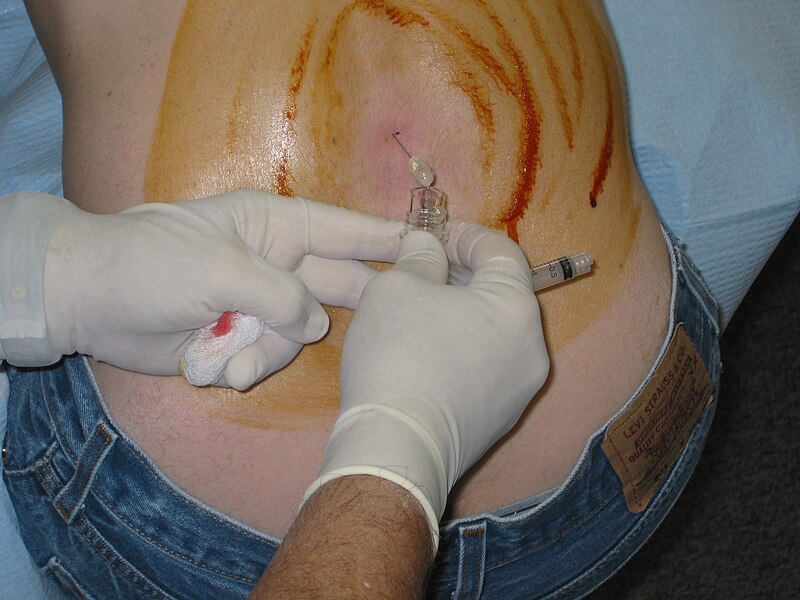
File:Thisisspinaltap.jpg · Wikimedia Commons · See Wikimedia Commons
lumbar puncture
Sign in to saveAlso known as rachicentesis, spinal puncture, spinal tap, LP, lumbar tap, spinal tapping
procedure to collect cerebrospinal fluid
Key facts
- Other names
- Spinal tap
- Icd 9 cm
- 03.31
- Mesh
- D013129
via Wikipedia infobox
Research
18,242 papers- Preventing Post-Lumbar Puncture Headache.Annals of emergency medicine · 2021
- Lumbar Puncture Complications: A Review of Current Literature.Current pain and headache reports · 2024
- Technological advances and changing indications for lumbar puncture in neurological disorders.The Lancet. Neurology · 2018
- Lumbar puncture.Acute medicine · 2011
- Lumbar puncture.Nursing standard (Royal College of Nursing (Great Britain) : 1987) · 2008
via PubMed
Wikidata facts
- Instance of
- medical procedure
- Subclass of
- biopsy
- Image
- Blausen 0617 LumbarPuncture.png
Show 2 more facts
- Commons category
- Lumbar puncture
- on focus list of Wikimedia project
- Wikipedia:Vital articles/Level/4
via Wikidata · CC0
~23 min read
Encyclopedic overview
Lumbar puncture (LP), also known as a spinal tap, is a medical procedure in which a needle is inserted into the spinal canal, most commonly to collect cerebrospinal fluid (CSF) for diagnostic testing. The main reason for a lumbar puncture is to help diagnose diseases of the central nervous system, including the brain and spine. Examples of these conditions include meningitis and subarachnoid hemorrhage. It may also be used therapeutically in some conditions. Increased intracranial pressure (pressure in the skull) is a contraindication, due to risk of brain matter being compressed and pushed toward the spine. Sometimes, lumbar punctures cannot be performed safely (for example due to a severe bleeding tendency). It is regarded as a safe procedure, but post-dural-puncture headache is a common side effect if a small atraumatic needle is not used.
The procedure is typically performed under local anesthesia using a sterile technique. A hypodermic needle is used to access the subarachnoid space and collect fluid. Fluid may be sent for biochemical, microbiological, and cytological analysis. Using ultrasound to landmark may increase success.
Excerpted from Wikipedia’s “lumbar puncture” article, available under the CC BY-SA 4.0 licence.