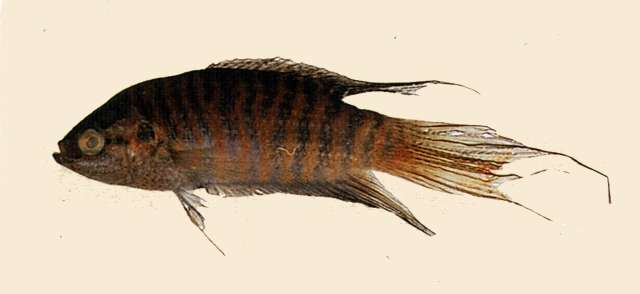
Encyclopedia of Life · EOL (see source)
Macropodus
Sign in to saveMacropodus is a genus of small to medium-sized labyrinth fish native to freshwater habitats in eastern Asia. Most species are restricted to southern China (including Hong Kong and Taiwan) and Vietnam, but M. opercularis occurs as far north as the Yangtze basin, and M. ocellatus occurs north to the Amur River, as well as in Japan and Korea. In China, they are often used for fights, so they are named Chinese bettas because of their similarity to the genus Betta. A few species in the genus are regularly seen in the aquarium trade, and M. opercularis has been introduced to regions far outside its
Species
GENUS
- KingdomAnimalia
- PhylumChordata
- ClassTeleostei
- OrderPerciformes
- FamilyOsphronemidae
Paradiesfische (Macropodus), auch Makropoden oder Großflosser, sind eine Gattung aus der Unterordnung der Labyrinthfische und mit derzeit vier bekannten Arten in Südost- und Ostasien verbreitet. Makropode, links das Weibchen, rechts das Männchen. Beim Männchen ist deutlich die Verzweigung der Schwanzflossenstrahlen zu erkennen Inhaltsverzeichnis 1 Merkmale 2 Verbreitung 3 Ökologie 4 Fortpflanzung 5 Systematik 6 Bedeutung für den Menschen 7 Gefährdung 8 Literatur 9 Einzelnachweise 10 Weblinks Merkmale Makropoden sind Labyrinthfische, das heißt, sie besitzen eine über den Kiemenbögen liegende Atemhöhle, das sogenannte Labyrinth, deren Wände aus einem stark durchbluteten und zum Gasaustausch fähigen Gewebe bestehen. Die Luft für diese zusätzliche Atmung wird an der Wasseroberfläche mit dem Maul aufgenommen, während gleichzeitig die verbrauchte Luft über die Kiemendeckel ausgestoßen wird. Alle Makropodenarten sind so sehr an diese akzessorische Atmung angepasst, dass die Kiemenfunktion nur noch eine untergeordnete Rolle spielt. Behindert man sie am Zugang zur Atmosphäre, ertrinken sie. Die Ausbildung des Labyrinthorgans ist eine Anpassung an sauerstoffarme Verhältnisse und ermöglicht g
via GBIF
Wikidata facts
- Image
- Paradise fish female and male 02.jpg
Show 2 more facts
- taxon name
- Macropodus
- Commons category
- Macropodus
Sources (1)
via Wikidata · CC0
~1 min read
Article
2 sectionsContents
- Species
- References
Macropodus is a genus of small to medium-sized labyrinth fish native to freshwater habitats in eastern Asia. Most species are restricted to southern China (including Hong Kong and Taiwan) and Vietnam, but M. opercularis occurs as far north as the Yangtze basin, and M. ocellatus occurs north to the Amur River, as well as in Japan and Korea. In China, they are often used for fights, so they are named Chinese bettas because of their similarity to the genus Betta. A few species in the genus are regularly seen in the aquarium trade, and M. opercularis has been introduced to regions far outside its native range.
==Species== As of 2014, the recognized species in this genus are: Macropodus baviensis H. D. Nguyễn & V. H. Nguyễn, 2005 Macropodus erythropterus Freyhof & Herder, 2002 (Red-backed paradisefish) Macropodus hongkongensis Freyhof & Herder, 2002 Macropodus lineatus V. H. Nguyễn, S. V. Ngô & H. D. Nguyễn, 2005 Macropodus ocellatus Cantor, 1842 (Round-tailed paradisefish) Macropodus oligolepis V. H. Nguyễn, S. V. Ngô & H. D. Nguyễn, 2005 Macropodus opercularis (Linnaeus, 1758) (Paradise fish) Macropodus phongnhaensis S. V. Ngô, V. H. Nguyễn & H. D. Nguyễn, 2005 Macropodus spechti Schreitmüller, 1936 (Black paradisefish)
Available in 21 languages
- Français
- Deutsch
- 中文
- Русский
- Italiano
- Cebuano
- Egyptian Arabic
- Georgian
- Kazakh
- Kyrgyz
- Lithuanian
- Nederlands
- Polski
- Svenska
- Tamil
- Tiếng Việt
- Türkçe
- Ukrainian
via Wikidata sitelinks · CC0