File:Hestemøj.jpg · Wikimedia Commons · See Wikimedia Commons
manure
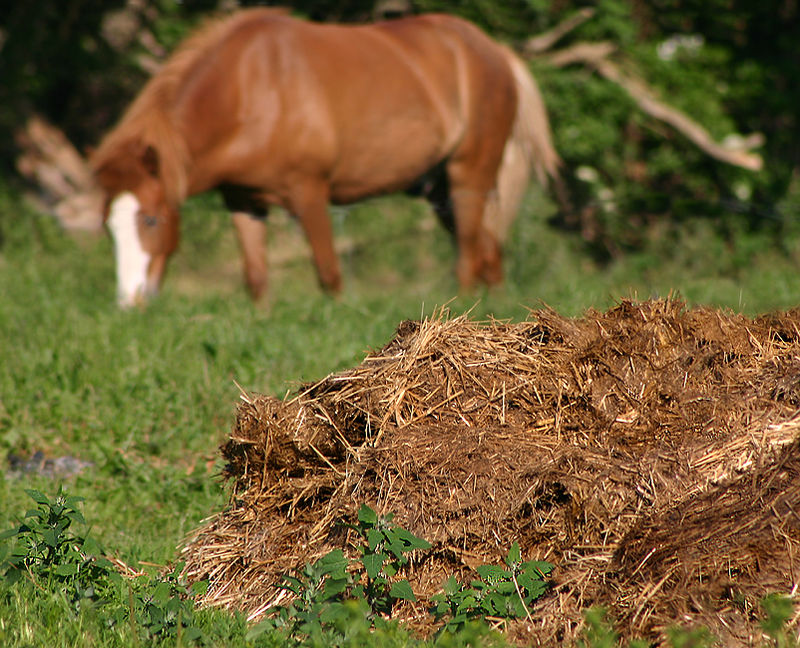
Sign in to savethumb|Animal manure is often a mixture of animal feces and bedding straw, as in this example from a [[stable.]]
Manure is a mixture of animal waste and bedding material, such as straw, that accumulates in places where livestock are kept. It matters because it is commonly used as a fertilizer to enrich soil for growing crops.
AI-generated from the Wikipedia summary — may contain errors.
Research
18,367 papers- Manure-borne pathogens as an important source of water contamination: An update on the dynamics of pathogen survival/transport as well as practical risk mitigation strategies.ReviewInternational journal of hygiene and environmental health · 2020Alegbeleye OO, Sant'Ana ASDOI: 10.1016/j.ijheh.2020.113524
- Animal manure application promotes nitrogen and organic carbon accumulation in soil organic matter fractions: A global meta-analysis.ReviewThe Science of the total environment · 2025Denoncourt C, Chantigny MH, Angers DA et al.DOI: 10.1016/j.scitotenv.2025.180097
- Technologies to recover nitrogen from livestock manure - A review.ReviewThe Science of the total environment · 2021Pandey B, Chen LDOI: 10.1016/j.scitotenv.2021.147098
- Impact of Bacillus subtilis on manure solids, odor, and microbiome.Journal of environmental management · 2023Hwang O, Yun YM, Trabue SDOI: 10.1016/j.jenvman.2023.117390
- Manure application: A trigger for vertical accumulation of antibiotic resistance genes in cropland soils.Ecotoxicology and environmental safety · 2022Mu M, Yang F, Han B et al.DOI: 10.1016/j.ecoenv.2022.113555
- Utilization of current pyrolysis technology to convert biomass and manure waste into biochar for soil remediation: A review.ReviewThe Science of the total environment · 2023Tan S, Zhou G, Yang Q et al.DOI: 10.1016/j.scitotenv.2022.160990
- Contrasting dynamics of manure-borne antibiotic resistance genes in different soils.Ecotoxicology and environmental safety · 2022Zhang H, Ling H, Zhou R et al.DOI: 10.1016/j.ecoenv.2022.114162
- Fall-applied manure can conserve excess soil-profile inorganic-N for the subsequent cropping year.Journal of environmental quality · 2025Lentz RD, Ippolito JADOI: 10.1002/jeq2.70040
via PubMed
Wikidata facts
- Subclass of
- organic matter
- Material used
- excrement
- Image
- Manure (DFdB).JPG
Show 4 more facts
- Commons category
- Manure
- by-product of
- animal husbandry
- fabrication method
- fermentation
- on focus list of Wikimedia project
- WikiProject Climate change
via Wikidata · CC0
~8 min read
Encyclopedic overview
11 sectionsContents
- Types
- Animal manure
- Compost
- Green manure
- Uses
- Animal manure
- Issues
- Livestock antibiotics
- See also
- References
- External links
thumb|Animal manure is often a mixture of animal feces and bedding straw, as in this example from a [[stable.]]
Manure is organic matter that is used as organic fertilizer in agriculture. Most manure consists of animal feces; other sources include compost and green manure. Manures contribute to the fertility of soil by adding organic matter and nutrients, such as nitrogen, that are utilised by bacteria, fungi, and other organisms in the soil. Higher organisms then feed on the fungi and bacteria in a chain of life that comprises the soil food web.
Excerpted from Wikipedia’s “manure” article, available under the CC BY-SA 4.0 licence.
Gallery (12)
Available in 76 languages
- Español
- Français
- Deutsch
- 中文
- 日本語
- Русский
- Português
- Italiano
- العربية
- हिन्दी
- Aragonese
- Armenian
- Aymara
- Azerbaijani
- Bahasa Indonesia
- Bashkir
- Basque
- bat_smg
Show 57 more
- Bavarian
- Belarusian
- Breton
- Catalan
- Chuvash
- Czech
- Danish
- Esperanto
- Estonian
- Finnish
- Galician
- Greek
- Hebrew
- Ido
- Igbo
- Irish
- Javanese
- Kannada
- Kazakh
- Latvian
- Lithuanian
- Lombard
- Low German
- Luxembourgish
- Malagasy
- Malay
- Nederlands
- Nepali
- Northern Frisian
- Norwegian
- Pashto
- Pennsylvania German
- Polski
- Punjabi
- Quechua
- Scottish Gaelic
- Serbian
- Sicilian
- simple
- Somali
- Svenska
- Swahili
- Tajik
- Tamil
- Telugu
- Tiếng Việt
- Türkçe
- Tyap
- Ukrainian
- Uzbek
- Venetian
- Walloon
- Welsh
- Western Frisian
- Wu Chinese
- فارسی
- 한국어
via Wikidata sitelinks · CC0