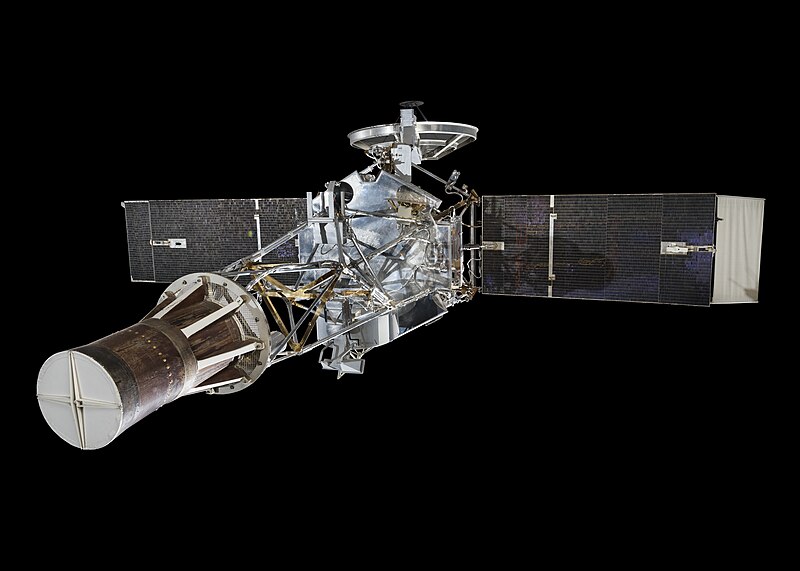
File:Mariner_2_Engineering_Model.jpg · Wikimedia Commons · See Wikimedia Commons
Mariner 1
Sign in to saveFirst US attempt to fly by Venus
In the Vinony graph
Vinony's link graph records 271 inbound references to Mariner 1, and connects out to Environmental Research Satellite, Aviation Week & Space Technology and Cape Canaveral Launch Complex 12.
It is catalogued under topics including 1962 in Florida, July 1962 in the United States and Mariner program.
Vinony links it to 43 Wikipedia language editions.
Key facts
- Mission type
- Venus flyby
- Operator
- NASA / JPL
- Mission duration
- 4 minutes and 54 seconds, Failed to orbit
- Spacecraft type
- Ranger Block I
- Manufacturer
- Jet Propulsion Laboratory
- Launch mass
- 202.8 kilograms (447 lb)
- Launch date
- July 22, 1962, 09:21:23 ( 1962-07-22UTC09:21:23Z ) GMT
- Rocket
- Atlas LV-3 Agena-B
- Launch site
- Cape Canaveral , LC-12
- Disposal
- Launch failure
- Destroyed
- July 22, 1962, 09:26:17.5 ( 1962-07-22UTC09:26:18Z ) GMT
via Wikipedia infobox
Wikidata facts
- Instance of
- space probe
- Part of
- Mariner program
- Operator
- Jet Propulsion Laboratory
- Followed by
- Mariner 2
- Duration
- 293
- Mass
- 202.8
- Manufacturer
- Jet Propulsion Laboratory
- Image
- Mariner 2 Engineering Model.jpg
- Significant event
- destruction
Show 5 more facts
- Commons category
- Mariner 1
- UTC date of spacecraft launch
- 1962-07-22
- Commons gallery
- Mariner 1
- start point
- Cape Canaveral Launch Complex 12
- cause of destruction
- software bug
Sources (1)
via Wikidata · CC0
~19 min read
Encyclopedic overview
Mariner 1 was the first spacecraft of NASA's interplanetary Mariner program, built to conduct the first American planetary flyby of Venus. Developed by Jet Propulsion Laboratory and originally planned to be a purpose-built probe launched summer 1962, Mariner 1's design was changed when the Centaur proved unavailable at that early date. Mariner 1 and its sibling spacecraft Mariner 2 were then adapted from the lighter Ranger lunar spacecraft. Mariner 1 carried a suite of experiments to determine the temperature of Venus as well to measure magnetic fields and charged particles near the planet and in interplanetary space.
Mariner 1 was launched by an Atlas-Agena rocket from Cape Canaveral's Pad 12 on July 22, 1962. Shortly after liftoff, errors in communication between the rocket and its ground-based guidance systems caused the rocket to veer off course, and it had to be destroyed by range safety. The errors were traced to a mistake in a specification of the hand-written guidance equations which were then subsequently codified in the computer program.
Excerpted from Wikipedia’s “Mariner 1” article, available under the CC BY-SA 4.0 licence.