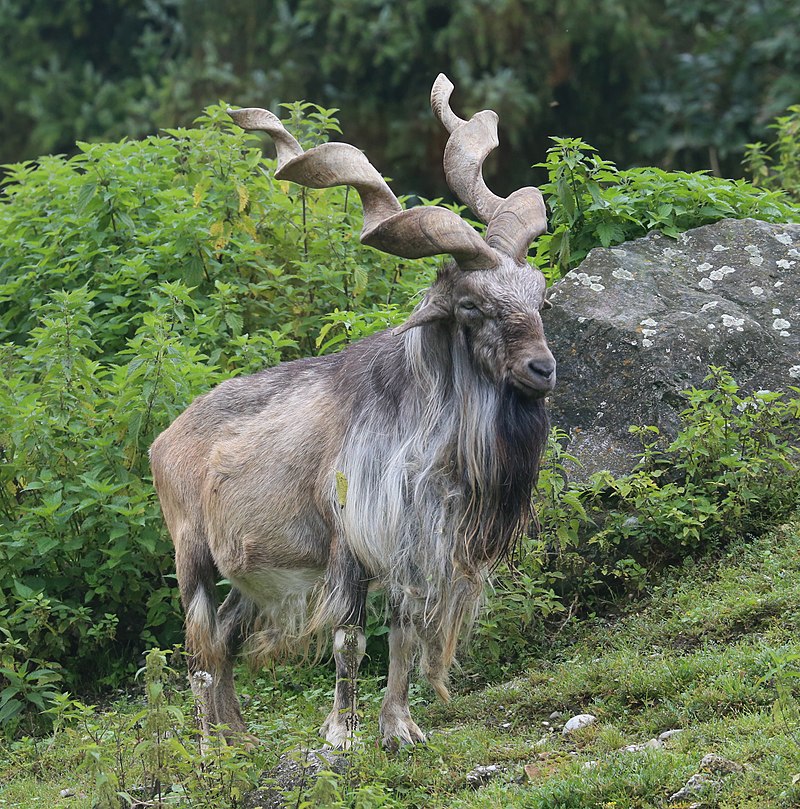
File:Markhor_Schraubenziege_Capra_falconeri_Zoo_Augsburg-02.jpg · Wikimedia Commons · See Wikimedia Commons
Markhor
Sign in to saveAlso known as Capra falconeri, Maarkhor, Markor
The markhor (Capra falconeri) is a large wild Capra species native to the mountain regions at the crossroads of Central and South Asia, including the Karakoram and Himalayas. It occurs in parts of Turkmenistan, Uzbekistan, Tajikistan, Afghanistan, Pakistan, and India. It has been listed on the IUCN Red List as Near Threatened since 2015.
The markhor is a large wild goat native to the mountainous regions where Central and South Asia meet, including areas in Turkmenistan, Uzbekistan, Tajikistan, Afghanistan, Pakistan, and India. It has been classified as Near Threatened on the IUCN Red List since 2015, indicating that its population is declining and requires conservation attention.
AI-generated from the Wikipedia summary — may contain errors.
Species
Near Threatenedvia IUCN
Wikidata facts
Show 10 more facts
- CITES Appendix
- Appendix I of CITES
- taxon rank
- species
- IUCN conservation status
- Near Threatened
- Commons category
- Capra falconeri
- longest observed lifespan
- 19.1
- taxon name
- Capra falconeri
- Commons gallery
- Capra falconeri
- taxon common name
- marcár
- gestation period
- 152
- short name
- C. falconeri
Sources (1)
via Wikidata · CC0
~13 min read
Encyclopedic overview
13 sectionsContents
- Description
- Distribution and habitat
- Behaviour and ecology
- Predators
- Taxonomy
- Relationship with the domestic goat
- Threats
- Hunting
- Conservation
- In culture
- Etymology
- References
- External links
The markhor (Capra falconeri) is a large wild Capra species native to the mountain regions at the crossroads of Central and South Asia, including the Karakoram and Himalayas. It occurs in parts of Turkmenistan, Uzbekistan, Tajikistan, Afghanistan, Pakistan, and India. It has been listed on the IUCN Red List as Near Threatened since 2015.
The markhor is the national animal of Pakistan, where it is also known as the screw-horn or screw-horned goat. The word "markhor" is derived from the Persian word markhar, meaning "curly" because of its curly horns. The word, which comes from both Pashto and mainly classical Persian languages, is combined from "mar" and "khor" and more literally means "snake eater", referencing the ancient belief that the markhor would actively kill and consume snakes.
Excerpted from Wikipedia’s “Markhor” article, available under the CC BY-SA 4.0 licence.
Gallery (17)
Available in 65 languages
- Español
- Français
- Deutsch
- 中文
- 日本語
- Русский
- Português
- Italiano
- العربية
- हिन्दी
- Assamese
- Azerbaijani
- Bahasa Indonesia
- Balinese
- Bangla
- Basque
- Belarusian
- Breton
Show 46 more
- Bulgarian
- Catalan
- Cebuano
- Czech
- Egyptian Arabic
- Esperanto
- Estonian
- Filipino
- Finnish
- Georgian
- Greek
- Hebrew
- Hungarian
- Irish
- Kannada
- Kashmiri
- Kazakh
- Kotava
- Kyrgyz
- Lithuanian
- Malay
- Navajo
- Nederlands
- Norwegian
- Norwegian Nynorsk
- Polski
- Punjabi
- Scots
- Serbian
- simple
- Sindhi
- Slovak
- Slovenian
- Svenska
- Tajik
- Tamil
- Tiếng Việt
- Türkçe
- Ukrainian
- Urdu
- Uzbek
- Waray
- Western Panjabi
- Wu Chinese
- فارسی
- 한국어
via Wikidata sitelinks · CC0