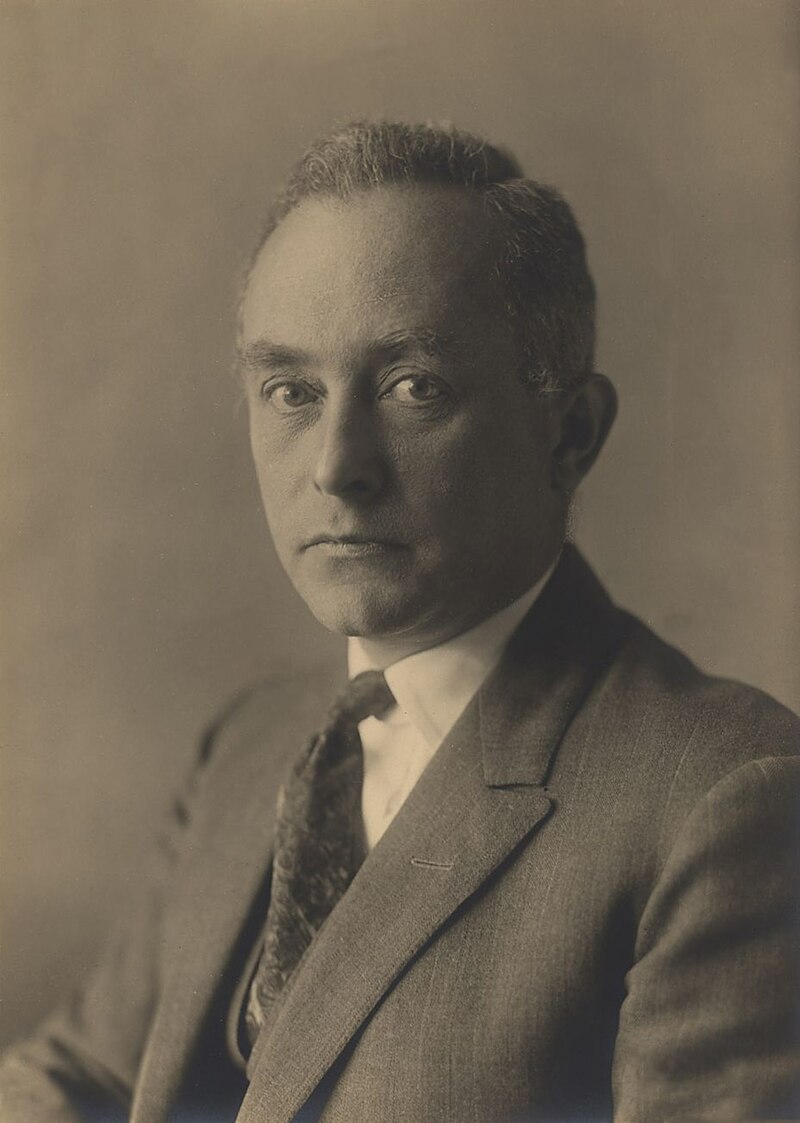
File:Max_Born.jpg · Wikimedia Commons · See Wikimedia Commons
Max Born
Sign in to saveGerman-Jewish physicist and mathematician (1882-1970)
OverviewAI-generated
Max Born was a physicist born on December 11, 1882, and died on January 5, 1970. He was recognized in the Royal Society collection, the Nobel Laureates collection, the Nobel Physics collection, and the American Academy Arts Sciences collection.
Born received one Nobel Prize. He had an Erdős number of 3.
Synthesized by Vinony from 9 facts across 3 sources: Wikidata, Nobel Prize, Vinony collections. Generated from structured data (not the Wikipedia text) and checked against those facts — may still contain errors.
Nobel Prize
- The Nobel Prize in Physics1954
“for his fundamental research in quantum mechanics, especially for his statistical interpretation of the wavefunction”
Shared · 1/2 portion
Wikidata facts
- Instance of
- human
- Given name
- Jacob
- Gender
- male
- Citizenship
- United Kingdom of Great Britain and Ireland
- Place of birth
- Wrocław
- Place of death
- Göttingen
- Father
- Gustav Born
- Occupation
- theoretical physicist
- Position held
- professor
- Educated at
- Gonville and Caius College
- Languages spoken
- English language
- Religion
- Lutheranism
- Notable work
- Born-Oppenheimer approximation
- Doctoral advisor
- Carl David Tolmé Runge
- Student of
- J. J. Thomson
- Doctoral student
- Otto Friedrich Bollnow
- Field of work
- quantum mechanics
- Conflict
- World War I
- Military branch
- Imperial German Army
- Image
- Max Born.jpg
- Work location
- Göttingen
- Residence
- Bad Pyrmont
Show 17 more facts
- topic's main category
- Category:Max Born
- member of
- National Academy of Sciences
- place of burial
- Göttingen City Cemetery
- Commons category
- Max Born
- date of birth
- 1882-12-11
- date of death
- 1970-01-05
- Erdős number
- 3
- student
- Wolfgang Pauli
- Commons gallery
- Max Born
- nominated for
- Nobel Prize in Physics
- ethnic group
- Jewish people
- on focus list of Wikimedia project
- Wikipedia:Vital articles/Level/4
- interested in
- physics
- P8168
- MX
- name in native language
- Max Born
- maintained by WikiProject
- WikiProject Mathematics
- archives at
- Berlin State Library
Sources (13)
via Wikidata · CC0
~40 min read
Encyclopedic overview
Max Born ( German: [ˈmaks ˈbɔʁn] ; 11 December 1882 – 5 January 1970) was a German–British theoretical physicist who was instrumental in the development of quantum mechanics. He also made contributions to solid-state physics and optics, and supervised the work of a number of notable physicists in the 1920s and 1930s. He shared the 1954 Nobel Prize in Physics with Walther Bothe "for his fundamental research in quantum mechanics, especially for his statistical interpretation of the wavefunction."
Born entered the University of Göttingen in 1904, where he met the three renowned mathematicians Felix Klein, David Hilbert, and Hermann Minkowski. He wrote his Ph.D. thesis on the subject of the stability of elastic wires and tapes, winning the university's Philosophy Faculty Prize. In 1905, he began researching special relativity with Minkowski, and subsequently wrote his habilitation thesis on the Thomson model of the atom. A chance meeting with Fritz Haber in Berlin in 1918 led to discussion of how an ionic compound is formed when a metal reacts with a halogen, which is now known as the Born–Haber cycle.
Excerpted from Wikipedia’s “Max Born” article, available under the CC BY-SA 4.0 licence.
Gallery (7)
Available in 100 languages
- Español
- Français
- Deutsch
- 中文
- 日本語
- Русский
- Português
- Italiano
- العربية
- हिन्दी
- Afrikaans
- Armenian
- Asturian
- azb
- Azerbaijani
- Bahasa Indonesia
- Balinese
- Bangla
Show 81 more
- Basque
- Belarusian
- Bosnian
- Bulgarian
- Buriat
- Catalan
- Central Kurdish
- Croatian
- Czech
- Danish
- Egyptian Arabic
- Esperanto
- Estonian
- Filipino
- Finnish
- Galician
- Georgian
- Greek
- Haitian Creole
- Hakka Chinese
- Hebrew
- Hungarian
- Ido
- Interlingua
- Irish
- Javanese
- Kannada
- Kazakh
- Kurdish
- Kyrgyz
- Latin
- Latvian
- Lithuanian
- Macedonian
- Malagasy
- Malay
- Malayalam
- Marathi
- Mazanderani
- Mingrelian
- Mongolian
- Nederlands
- Newari
- Norwegian
- Norwegian Nynorsk
- Occitan
- Pashto
- Piedmontese
- Polski
- Punjabi
- Quechua
- Romanian
- Scots
- Scottish Gaelic
- Serbian
- Serbian (Latin)
- simple
- Slovak
- Slovenian
- Svenska
- Swahili
- Tajik
- Tamil
- Tatar
- Telugu
- Tiếng Việt
- Türkçe
- Ukrainian
- Urdu
- Uzbek
- Waray
- Welsh
- Western Panjabi
- Wu Chinese
- Yoruba
- Zaza
- zh_min_nan
- zh_yue
- فارسی
- ไทย
- 한국어
via Wikidata sitelinks · CC0