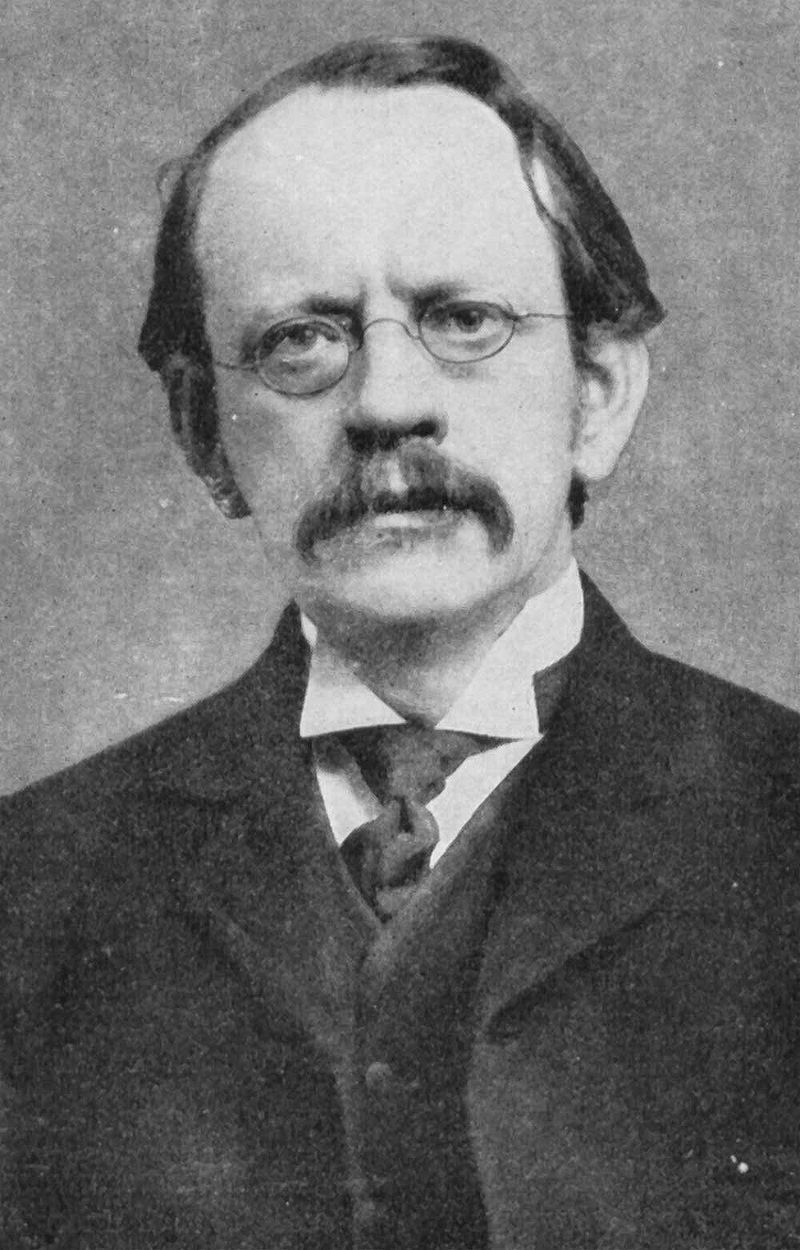
File:J.J_Thomson.jpg · Wikimedia Commons · See Wikimedia Commons
J. J. Thomson
Sign in to saveAlso known as Joseph John Thomson, Sir Joseph Thomson, John Thompson, Sir Joseph John Thomson
British physicist (1856-1940)
OverviewAI-generated
Joseph John Thomson was a British physicist, mathematician, and university teacher. He worked in the fields of physics, experimental physics, electron studies, and electrical conductance. Thomson was educated at the University of Manchester, Trinity College, the Victoria University of Manchester, and the University of Cambridge. He served as an employee of the University of Cambridge.
He received the Nobel Prize in Physics, the Copley Medal, the Royal Medal, and the title of Fellow of the Royal Society. Thomson was a member of the Royal Society, the Saint Petersburg Academy of Sciences, the Academy of Sciences of the USSR, and the Royal Swedish Academy of Sciences. His doctoral students included Ernest Rutherford, Theodore Lyman, John Sealy Townsend, and Władysław Natanson. He also taught J. Robert Oppenheimer, Charles Glover Barkla, Charles Thomson Rees Wilson, and Francis William Aston.
Thomson died in Cambridge on August 30, 1940. He is buried in Westminster Abbey. His doctoral advisor was John Strutt, 3rd Baron Rayleigh. He was an Anglican.
Synthesized by Vinony from 28 facts across 3 sources: Wikidata, Nobel Prize, Vinony collections. Generated from structured data (not the Wikipedia text) and checked against those facts — may still contain errors.
In the Vinony graph
J. J. Thomson is indexed among the 230 entries in Vinony's Nobel Prize in Physics collection. It also appears in Copley Medal.
Within Vinony's link graph, J. J. Thomson is referenced by 985 other articles, and connects out to anode ray, electron and Charles Thomson Rees Wilson.
It sits within the topics 1856 births, 1940 deaths and 20th-century British mathematicians.
Its subject is documented across 107 Wikipedia language editions.
Nobel Prize
- The Nobel Prize in Physics1906
“in recognition of the great merits of his theoretical and experimental investigations on the conduction of electricity by gases”
Wikidata facts
- Instance of
- human
- Given name
- John
- Family name
- Thomson
- Gender
- male
- Citizenship
- United Kingdom
- Place of birth
- Manchester
- Place of death
- Cambridge
- Occupation
- university teacher
- Educated at
- University of Cambridge
- Employer
- University of Cambridge
- Languages spoken
- English language
- Religion
- Anglicanism
- Notable work
- plum pudding model
- Doctoral advisor
- John Strutt, 3rd Baron Rayleigh
- Student of
- Osborne Reynolds
- Field of work
- electrical conductance
- Image
- J.J. Thomson LCCN2014715407.jpg
Show 18 more facts
- place of burial
- Westminster Abbey
- member of
- Accademia Nazionale dei Lincei
- Commons category
- Joseph John Thomson
- date of death
- 1940-08-30
- date of birth
- 1856-12-18
- Commons gallery
- Joseph John Thomson
- Commons Creator page
- Joseph John Thomson
- nominated for
- Nobel Prize in Physics
- birth name
- Joseph John Thomson.
- name in native language
- Joseph John Thomson
- writing language
- English language
- described at URL
- royalsocietypublishing.org/doi/pdf/10.1098/rsbm.1941.0024
- on focus list of Wikimedia project
- Wikipedia:Vital articles/Level/4
- contributed to creative work
- Popular Science
- maintained by WikiProject
- WikiProject Mathematics
- P12749
- Wolfgang Peukert
- interested in
- physics
via Wikidata · CC0
~25 min read
Encyclopedic overview
Sir Joseph John Thomson (18 December 1856 – 30 August 1940) was a British physicist. He received the 1906 Nobel Prize in Physics "in recognition of the great merits of his theoretical and experimental investigations on the conduction of electricity by gases." In 1897, he showed that cathode rays were composed of previously unknown negatively charged particles (now called electrons), which he calculated must have bodies much smaller than atoms and a very large charge-to-mass ratio. The electron was the first subatomic particle to be discovered.
Thomson is credited with finding the first evidence for isotopes of a stable (non-radioactive) element in 1912, as part of his exploration into the composition of canal rays (positive ions). His experiments to determine the nature of positively charged particles, with Francis William Aston, were the first use of mass spectrometry and led to the development of the mass spectrograph.
Excerpted from Wikipedia’s “J. J. Thomson” article, available under the CC BY-SA 4.0 licence.
Gallery (12)
Available in 107 languages
- Español
- Français
- Deutsch
- 中文
- 日本語
- Русский
- Português
- Italiano
- العربية
- हिन्दी
- Afrikaans
- Albanian
- Aragonese
- Armenian
- Assamese
- Asturian
- azb
- Azerbaijani
Show 88 more
- Bahasa Indonesia
- Balinese
- Bangla
- Basque
- be_x_old
- Belarusian
- Bosnian
- Breton
- Bulgarian
- Burmese
- Catalan
- Central Kurdish
- Croatian
- Czech
- Danish
- Egyptian Arabic
- Esperanto
- Estonian
- Filipino
- Finnish
- Galician
- Georgian
- Greek
- Haitian Creole
- Hakka Chinese
- Hebrew
- Hungarian
- Ido
- Iloko
- Interlingua
- Irish
- Javanese
- Kannada
- Kashmiri
- Kazakh
- Kurdish
- Latin
- Latvian
- Lithuanian
- Macedonian
- Malagasy
- Malay
- Malayalam
- Manipuri
- Marathi
- Mazanderani
- Mingrelian
- Nederlands
- Nepali
- Newari
- Norwegian
- Norwegian Nynorsk
- Occitan
- Pampanga
- Piedmontese
- Polski
- Punjabi
- Quechua
- Romanian
- Sanskrit
- Scots
- Scottish Gaelic
- Serbian
- Serbian (Latin)
- simple
- Sinhala
- skr
- Slovak
- Slovenian
- Svenska
- Swahili
- Tamil
- Tatar
- Telugu
- Tiếng Việt
- Türkçe
- Ukrainian
- Urdu
- Uzbek
- Waray
- Western Panjabi
- Wu Chinese
- Yoruba
- zh_min_nan
- zh_yue
- فارسی
- ไทย
- 한국어
via Wikidata sitelinks · CC0