
Mozambique
Sign in to saveAlso known as Moçambique, República de Moçambique, MZ, MOZ, mz, Republic of Mozambique
Mozambique, officially the Republic of Mozambique, is a country located in Southeast Africa bordered by the Indian Ocean to the east, Tanzania to the north, Malawi and Zambia to the northwest, Zimbabwe to the west, and Eswatini and South Africa to the south and southwest. The sovereign state is separated from the Comoros, Mayotte, and Madagascar through the Mozambique Channel to the east. The capital and largest city is Maputo.
OverviewAI-generated
Mozambique, officially the Republic of Mozambique, is a sovereign state and republic located in Eastern Africa. It is part of the Portuguese-speaking African countries and is situated in both Southern Africa and East Africa. The capital city is Maputo. The country is named after the Island of Mozambique. Its official top-level Internet domain is .mz, and its telephone country code is +258.
The population of Mozambique is recorded as 34,090,466 by REST Countries and 34,631,766 by the World Bank. The total area is 801,590. The highest point is Monte Binga. The country contains administrative territorial entities including Cabo Delgado Province, Gaza Province, Inhambane Province, and Manica Province. The ethnic groups include African people, European people, and White Africans of European ancestry. The marriageable age is 18.
Mozambique maintains diplomatic relations with Canada, Brazil, Germany, and Australia. The electrical plug types used are Europlug and Schuko. The time zone is UTC+02:00. The forest area percentage is 45.8130349195046, and the renewable energy percentage is 76.9. The life expectancy is 63.797 years, and the unemployment percentage is 6.628. The urban population percentage is 36.4332337447237, while the internet users percentage is 20.52729988.
Synthesized by Vinony from 67 facts across 9 sources: Wikidata, REST Countries, Openweathermap, Open Meteo, World Bank, OpenStreetMap, PubMed, Vinony graph, Geo. Generated from structured data (not the Wikipedia text) and checked against those facts — may still contain errors.
Weather now
7-day forecast
via Open-Meteo
Country
- Capital
- Maputo
- Population
- 34,090,466
- Region
- Africa · Eastern Africa
- Demonym
- Mozambican
- Currencies
- MZN (MT)
- Languages
- Portuguese
- Calling code
- +258
- Drives on
- Left
- Gini
- 54 (2014)
- FIFA code
- MOZ
- TLD
- .mz
- Timezones
- UTC+02:00
- Borders
- MWI, ZAF, SWZ, TZA, ZMB, ZWE
via REST Countries
Indicators · World Bank
- GDP
- $22.7B(2024)
- Population
- 34,631,766(2024)
- Life expectancy
- 63.8 yrs(2024)
- Unemployment
- 6.6 %(2025)
- Urban population
- 36.4 %(2024)
- Internet users
- 20.5 %(2024)
- Forest area
- 45.8 %(2023)
- Renewable energy
- 76.9 %(2021)
via World Bank Open Data · CC BY 4.0
Place details
- Region
- Sofala
- Country
- Moçambique
- Population
- 29,495,962
- Timezone
- Africa/Maputo
via OpenStreetMap · GeoNames
Wikipedia views (30d)
86,529 totalvia Wikimedia Pageviews API
Key facts
- Country.HDI_rank
- 183rd
- Country.conventional_long_name
- Republic of Mozambique
- Country.common_name
- Mozambique
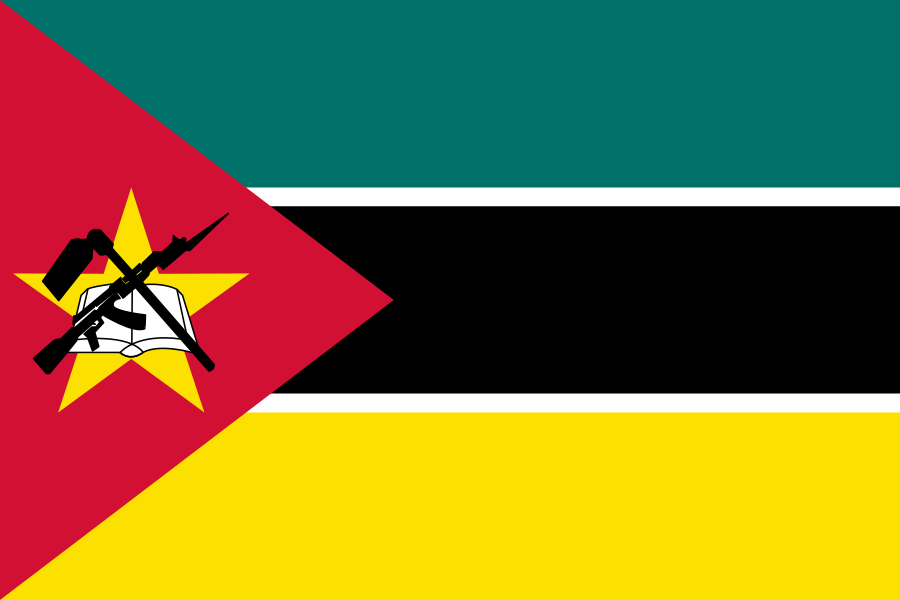
- Country.image_flag
- Flag of Mozambique.svg
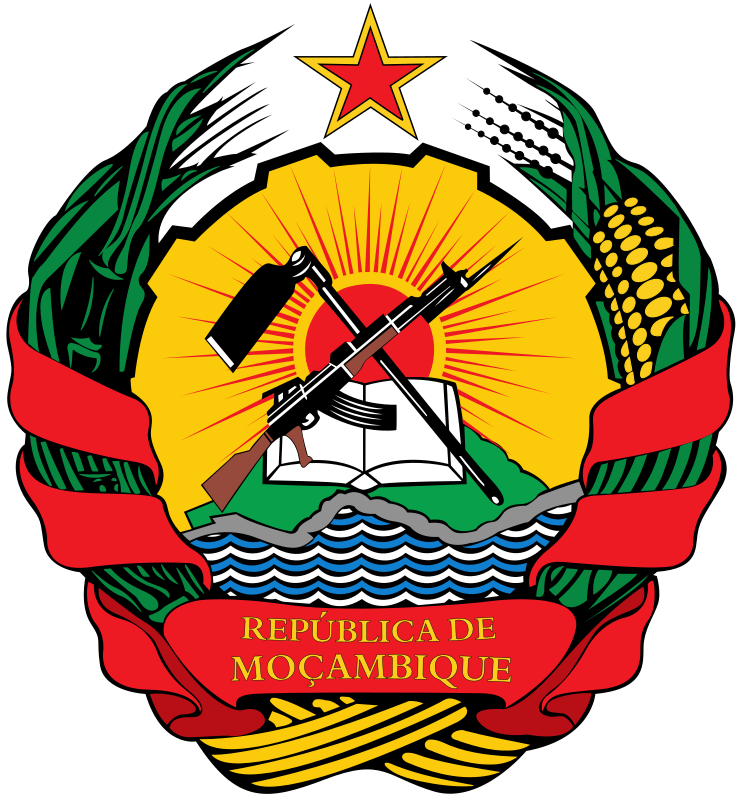
- Country.image_coat
- Emblem of Mozambique.svg
- Country.symbol_type
- Emblem
- Country.national_anthem
- "Beloved Homeland"
- Country.capital
- Maputo
- Country.largest_city
- capital
- Country.official_languages
- Portuguese
- Country.regional_languages
- Makhuwa, Sena, Tsonga, Lomwe, Swahili
- Country.languages2_type
- indigenous
- Country.ethnic_groups_year
- 2017
- Country.demonym
- Mozambican
- Country.government_type
- Unitary dominant-party semi-presidential republic under an authoritarian government
- Country.leader_title1
- President
- Country.leader_name1
- Daniel Chapo
- Country.leader_title2
- Prime Minister
via Wikipedia infobox
Research
8,484 papers- Mozambique takes on cancer burden challenges.The Lancet. Oncology · 2022Das MDOI: 10.1016/S1470-2045(22)00080-8
- Public health risks of humanitarian crises in Mozambique.ReviewJournal of global health · 2021Amimo F, Magit A, Sacarlal J et al.DOI: 10.7189/jogh.11.03054
- Tobacco industry presence and practices in Mozambique: a 'chaotic' but worthy market.ReviewTobacco control · 2023Nguenha N, Bialous S, Matavel J et al.DOI: 10.1136/tc-2022-057390
- Human toxoplasmosis in Mozambique: gaps in knowledge and research opportunities.ReviewParasites & vectors · 2020Manuel L, Santos-Gomes G, Noormahomed EVDOI: 10.1186/s13071-020-04441-3
- Mozambique Sample Vital Statistics System: Filling the Gaps for Mortality Data.The American journal of tropical medicine and hygiene · 2023Gudo ESDOI: 10.4269/ajtmh.23-0094
- Mozambique.Department of State publication. Background notes series · 1985United States. Department of State. Bureau of Public Affairs
- Mapping Antimalarial Drug Resistance in Mozambique: A Systematic Review of Plasmodium falciparum Genetic Markers Post-ACT Implementation.International journal of molecular sciences · 2024Chaves CRS, da Silva C, Salamandane A et al.DOI: 10.3390/ijms252413645
- Mozambique.Population policy compendium · 1982United Nations. Department of International Economic and Social Affairs. Population Division, United Nations Fund for Population Activities UNFPA
via PubMed
Wikidata facts
- Instance of
- country
- Named after
- Island of Mozambique
- Official name
- جَمْهُورِ يَ مْسُمْبِيجِ
- Demonym
- Mósaimbíceach
- Country
- Portuguese Empire
- Contains
- Zambezia Province
- Continent
- Africa
- Capital
- Maputo
- Official language
- Portuguese
- Currency
- Mozambican escudo
- Population
- 29668834
- Area
- 801590
- Head of government
- Maria Benvinda Levy
- Head of state
- Daniel Chapo
- Legislature
- Assembly of the Republic
- Anthem
- Pátria Amada
- Shares border with
- Comoros
- Highest point
- Monte Binga
- Headquarters
- Maputo
- Official website
- www.portaldogoverno.gov.mz
- Image
- Mozambique - Location Map (2013) - MOZ - UNOCHA.svg
- Life expectancy
- 58.311
- Nominal GDP
- 17851491428
Show 62 more facts
- Unemployment rate
- 23
- Calling code
- +258
- Licence plate code
- MOC
- Mains voltage
- 220
- Motto
- Dewch i'r fan lle cychwynwyd y cyfan
- Coat of arms
- Emblem of Mozambique
- economy of topic
- economy of Mozambique
- demographics of topic
- demographics of Mozambique
- geography of topic
- Geography of Mozambique
- category for people who died here
- Category:Deaths in Mozambique
- located in/on physical feature
- East Africa
- diplomatic relation
- North Korea
- marriageable age
- 18
- top-level Internet domain
- .mz
- category of associated people
- Category:Mozambican people
- office held by head of state
- President of Mozambique
- topic's main Wikimedia portal
- Portal:Mozambique
- driving side
- left
- maritime identification digits
- 650
- total fertility rate
- 5.359
- member of
- African Continental Free Trade Area
- number of out-of-school children
- 2911729
- category for people born here
- Category:Births in Mozambique
- mobile country code
- 643
- railway traffic side
- left
- age of majority
- 18
- topic's main category
- Category:Mozambique
- history of topic
- history of Mozambique
- Commons category
- Mozambique
- inception
- 1975-06-25
- Commons gallery
- Moçambique
- lowest point
- Mozambique Channel
- category for films shot at this location
- Category:Films shot in Mozambique
- Unicode character
- 🇲🇿
- central bank
- Bank of Mozambique
- language used
- Chuwabu
- culture
- culture of Mozambique
- VAT rate
- 17
- P6413
- Mozambique
- native label
- مْسُمْبِيجِ
- BTI Status Index
- 4.11
- BTI Governance Index
- 4.21
- URL
- teses.usp.br/teses/disponiveis/8/8136/tde-05082016-155420/publico/2016_JoaquimMirandaMaloa_VCorr.pdf
- Democracy Index
- 3.51
- Human Development Index
- 0.446
- P11012
- Claudius
- hashtag
- Mozambique
- on focus list of Wikimedia project
- Wikipedia:Vital articles/Level/4
- Happy Planet Index score
- 44.2
- Gini coefficient
- 54
- Inequality-adjusted Human Development Index
- 0.300
- P12749
- Javier Pérez de Cuéllar
- birth rate
- 36.598
- male population
- 15737224
- death rate
- 8.793
- rural population
- 20007111
- female population
- 16339849
- urban population
- 12069961
- P8168
- Durbaniopsis
- replaces
- People's Republic of Mozambique
- Commonwealth Sport country code
- MOZ
Sources (15)
via Wikidata · CC0
Travel guide
Get in
As it is impossible to exchange meticais outside of Mozambique it is advisable to change a small amount of currency if arriving at a land border in mid to late afternoon to cover taxis and meals for the first night, currency exchanges generally close at 18:00 and due to sporadic ATM failures access to currency is by no means guaranteed out of hours. When accepted by merchants foreign currency has an extremely poor exchange rate.
See
thumb|Maputo Ilha de Mozambique, i.e. Mozambique Island is the only UNESCO World Heritage Site in Mozambique. The island boasts colonial architecture including probably the oldest European building in the Southern Hemisphere and beaches. The historic town of Inhambane. Sites from the civil war all over the country and the Museum of Revolution in Maputo to learn more about recent events in the country's history Wildlife and nature in Gorongosa National Park.
Do
Dive, see Diving in Mozambique for details. Tours and Safaris, a number of tour operators can help you reach Mozambique's highlights. The most reputable as per guide books Lonely Planet and Bradt are Mozaic Travel and Dana Tours in the south, and Kaskazini in the north.
Eat
thumb|Lobsters! As a country the Portuguese occupation has a profound impact on local foods that has produced some of the most unique and interesting cuisine within Southern Africa. Towards the coast a great deal of seafood is used within even the most basic of dishes, however, in land the maize based partridges common throughout Africa becomes staple but with some Portuguese flair.
Piri-Piri, also known as the African bird's-eye chili this extremely strong chili is common in sauce form throughout the country. Pãozinho , also known as Portuguese rolls or Prego (beef) no pão and bifana (fried pork) . A floury and often semi-sweet bread roll, typically served with meat in the center. Matapa, a seafood (clam, crab or prawn) stew made with cassava leaves and generally served over rice. This is one of the Mozambique staples. Camarão National, are Mozambican prawns marinaded in a Piri-Piri, garlic, onion, lemon and vinegar. Cray fish and other seafood. These are caught off the beach throughout the country and will generally be prepared with a piri-piri marinade, served with rice and matapa. Kakana This is a bitter tasting local vegetable.
Drink
All tap water in Mozambique should be assumed to be unsafe to drink, even if it is not harmful it usually has some sediment that your stomach will not be used to. Most western oriented lodgings either provide a fresh water source or sell bottled water.
Sleep
Accommodation ranges from inexpensive guesthouses and backpacker-oriented accommodation through to some of the most expensive resort accommodation in the region. thumb|Bungalow
Stay safe
thumb|Lighthouse in Beira Risks are much the same as many other countries in Africa (and significantly less than some, including parts of South Africa). Nevertheless muggings, robberies, rape and murder do occur, so the normal precautions should be taken. Women absolutely should never walk alone on beaches. Attacks on women have grown in tourist areas. In particular it's worth checking with local hostels and other tourists as to where dangerous areas are.
But in general the Mozambican people are extremely warm and friendly and you will encounter far less hassle than in almost all of the countries surrounding it.
Stay healthy
Malarial prophylaxis is essential in all parts of Mozambique. Chloroquine/Paludrine are now as ineffective as in other parts of east Africa, and it's worth going to see your doctor to get decent protection. If you are in country and suspect you have malaria there are clinics in every town that will administer a test for approximately 50 MT, the treatment also costs 50 MT if you have malaria. Get all your vaccinations before arriving Medical facilities in Mozambique are now generally reasonably stocked, but it is always worth getting a range of vaccinations before you leave. Prevention is better than cure. It is worth considering carrying some clean needles/sterile set if you are visiting out of the way areas, purely as remote medical facilities may have problems getting hold of them. thumb|Mice, anyone? Mind what you eat. As common in most countries in the world, if you are concerned about the standards of hygiene in a place, don't eat there. Do not have unprotected sex. As in many parts of Sub-Saharan Africa, there is a very high HIV incidence, at 12.5% (National HIV Survey, 2021) Do not drink tap water or use any ice. South of the Zambezi river that divides the country, Mozambique is much more developed, especially around Maputo, tourist areas such as Inhambane and the industrial city of Beira. Here, especially in built-up areas, it is safe to drink the tap water, hence water in this area is marketed as "mineral water" and not "drinking water" and is sold at an inflated pri…
Travel guide from Wikivoyage (CC BY-SA 4.0)
~40 min read
Encyclopedic overview
42 sectionsContents
- Etymology
- History
- Bantu migrations
- Swahili Coast
- Portuguese Mozambique (1498–1960)
- Mozambican War of Independence (1961–1974)
- Independence (1975)
- Mozambican Civil War (1977–1992)
- Democratic era (1993–present)
- Geography
- Climate
- Wildlife
- Government and politics
- Administrative divisions
- Foreign relations
- Human rights
- Economy
- Rebounding growth
- Economic reforms
- Corruption
- Natural resources
- Tourism
- Transport
- Water supply and sanitation
- Demographics
- Largest cities
- Languages
- Religion
- Health
- Education
- Culture
- Arts
- Music
- Media
- Cuisine
- National holidays
- Sport
- See also
- Notes
- References
- Further reading
- External links
Mozambique, officially the Republic of Mozambique, is a country in Southeast Africa bordered by the Indian Ocean to the east, Tanzania to the north, Malawi and Zambia to the northwest, Zimbabwe to the west, and Eswatini and South Africa to the south and southwest. The sovereign state is separated from the Comoros, Mayotte, and Madagascar through the Mozambique Channel to the east. The capital and largest city is Maputo.
Between the 7th and 11th centuries, a series of Swahili port towns developed in the area, which contributed to the development of a distinct Swahili culture and dialect. In the late medieval period, these towns were frequented by traders from Somalia, Ethiopia, Egypt, Arabia, Persia, and India. The voyage of Vasco da Gama in 1498 marked the arrival of the Portuguese, who began a gradual process of colonisation and settlement in 1505. After over four centuries of Portuguese rule, Mozambique gained independence in 1975, becoming the People's Republic of Mozambique shortly thereafter. After only two years of independence, the country descended into an intense and protracted civil war lasting from 1977 to 1992. In 1994, Mozambique held its first multiparty elections and has since remained a relatively stable presidential republic, although it still faces a low-intensity insurgency mainly in the furthest regions from the southern capital and where Islam is dominant.
Excerpted from Wikipedia’s “Mozambique” article, available under the CC BY-SA 4.0 licence.
Gallery (59)
On the map
6 mapped locations
Available in 254 languages
- Español
- Français
- Deutsch
- 中文
- 日本語
- Русский
- Português
- Italiano
- العربية
- हिन्दी
- Abkhazian
- Achinese
- Adyghe
- Afrikaans
- Albanian
- Albanian
- Amharic
- ami
Show 235 more
- Angika
- Aragonese
- Armenian
- Arpitan
- Asturian
- Aymara
- azb
- Azerbaijani
- Bahasa Indonesia
- Balinese
- Bambara
- Bangla
- Banjar
- Bashkir
- Basque
- bat_smg
- Bavarian
- be_x_old
- Belarusian
- Betawi
- Bhojpuri
- Bikol
- Bishnupriya
- Bislama
- Bosnian
- Breton
- Bulgarian
- Buriat
- Burmese
- Catalan
- cbk_zam
- cdo
- Cebuano
- Central Kurdish
- Chechen
- Chuvash
- Cornish
- Corsican
- Crimean Tatar
- Croatian
- Czech
- dag
- Danish
- Divehi
- dty
- Dzongkha
- Egyptian Arabic
- Esperanto
- Estonian
- Ewe
- Extremaduran
- Faroese
- Fiji Hindi
- Filipino
- Finnish
- fiu_vro
- Frafra
- Fula
- Gagauz
- Galician
- Ganda
- gcr
- Georgian
- Gilaki
- gpe
- Greek
- Guarani
- Gujarati
- Haitian Creole
- Hakka Chinese
- Hausa
- Hawaiian
- Hebrew
- Hungarian
- Iban
- Icelandic
- Ido
- Igbo
- Iloko
- Inari Sami
- Interlingua
- Interlingue
- Irish
- Jamaican Creole English
- Javanese
- Kabyle
- kai
- Kannada
- Kanuri
- Kara-Kalpak
- Karachay-Balkar
- Kazakh
- kbp
- Khmer
- Kikuyu
- Kinyarwanda
- Kongo
- Kotava
- Kurdish
- Kyrgyz
- Ladino
- Latgalian
- Latin
- Latvian
- Ligurian
- Limburgish
- Lingala
- Lingua Franca Nova
- Lithuanian
- lld
- Lojban
- Lombard
- Low German
- Lower Sorbian
- Luxembourgish
- Macedonian
- Malagasy
- Malay
- Malayalam
- Maltese
- Manipuri
- Manx
- Māori
- Marathi
- Mazanderani
- Minangkabau
- Mingrelian
- Mirandese
- mnw
- Moksha
- Mongolian
- Moroccan Arabic
- Navajo
- nds_nl
- Nederlands
- Nepali
- Newari
- Northern Frisian
- Northern Sami
- Northern Sotho
- Norwegian
- Norwegian Nynorsk
- Novial
- Nyanja
- Obolo
- Occitan
- Old English
- olo
- Oromo
- Ossetic
- Pampanga
- Papiamento
- Pashto
- Pennsylvania German
- Piedmontese
- Polski
- Punjabi
- Quechua
- roa_rup
- Romanian
- Sango
- Sanskrit
- Sardinian
- Saterland Frisian
- Scots
- Scottish Gaelic
- Serbian
- Serbian (Latin)
- Shan
- Shona
- Sicilian
- Silesian
- simple
- Sindhi
- Sinhala
- Slovak
- Slovenian
- Somali
- South Ndebele
- Southern Sotho
- Standard Moroccan Tamazight
- Sundanese
- Svenska
- Swahili
- Swati
- szy
- Tajik
- Talysh
- Tamil
- Taroko
- Tatar
- tay
- Telugu
- Tetum
- Tibetan
- Tiếng Việt
- Tigrinya
- Toki Pona
- Tongan
- Tsonga
- Tswana
- Tumbuka
- Türkçe
- Turkmen
- Tyap
- Udmurt
- Ukrainian
- Upper Sorbian
- Urdu
- Uyghur
- Uzbek
- Venda
- Venetian
- Veps
- Volapük
- Waray
- Welsh
- Western Frisian
- Western Panjabi
- Wolof
- Wu Chinese
- Xhosa
- Yakut
- Yiddish
- Yoruba
- Zaza
- Zeelandic
- zh_classical
- zh_min_nan
- zh_yue
- Zhuang
- Zulu
- فارسی
- ไทย
- 한국어
via Wikidata sitelinks · CC0