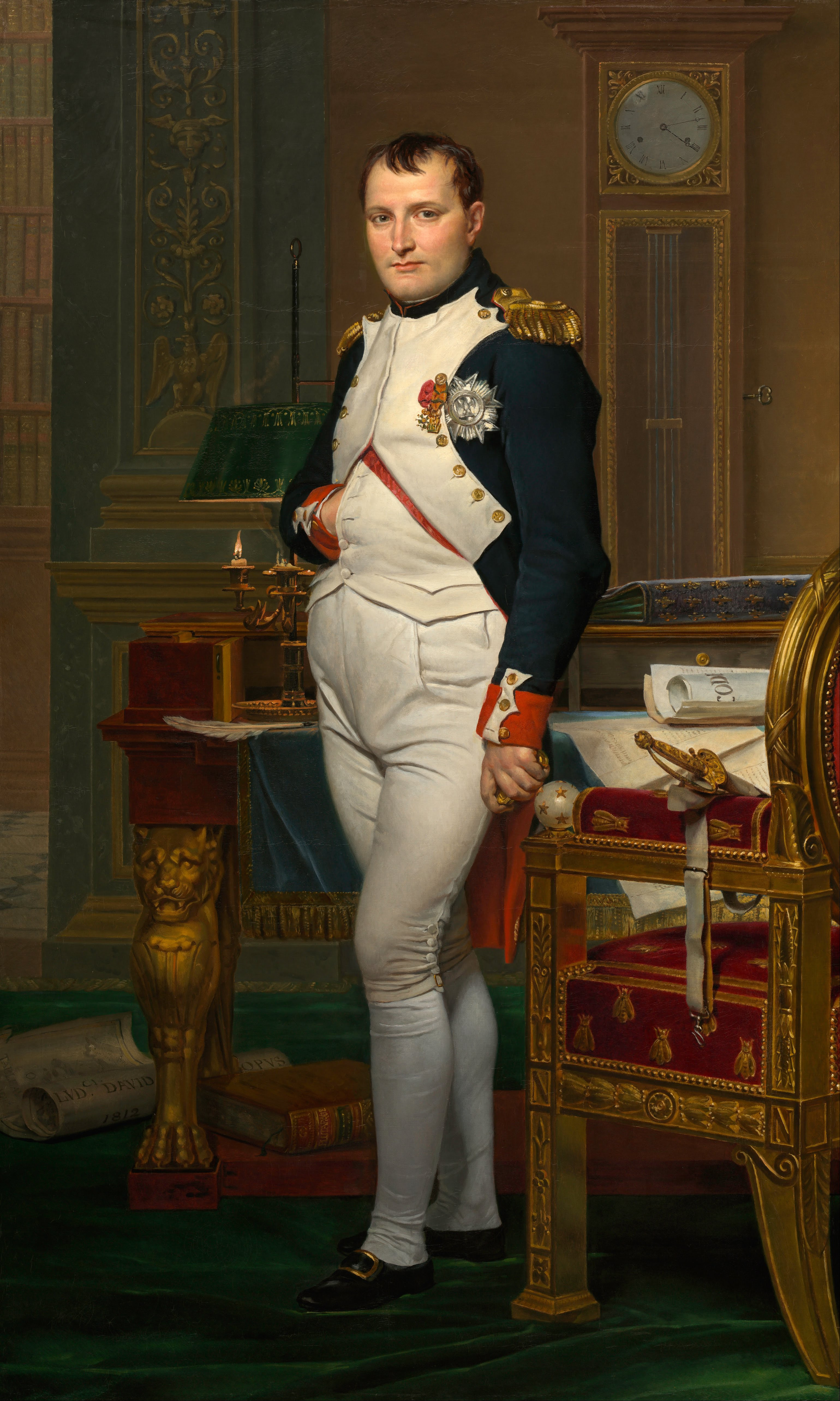
Napoleon
Sign in to saveAlso known as Napoléon Bonaparte, Napoleone di Buonaparte, Empereur des Français Napoléon I, Napoleon Buonaparte, Napoleone Bonaparte, Napoleone Buonaparte, Napoleon I, the Corsican Napolean
Napoleon Bonaparte (born Napoleone di Buonaparte; 15 August 1769 – 5 May 1821), later known by his regnal name Napoleon I, was Emperor of the French from 18 May 1804 until his first abdication in 1814, with a brief restoration during the Hundred Days in 1815. He rose to prominence as a general during the French Revolution and led a series of military campaigns across Europe and North Africa during the French Revolutionary and Napoleonic Wars. As a statesman, he implemented numerous legal and administrative reforms in France and Europe.
OverviewAI-generated
Napoleon was a French politician, statesperson, military officer, and art collector born in Ajaccio in 1769. He was a member of the House of Bonaparte, the son of Carlo Bonaparte and Maria-Letizia Bonaparte, and was educated at the École Militaire. He held the positions of Emperor of the French and monarch of Italy. His notable roles included participation in the Napoleonic Wars and the French Revolutionary Wars.
He was married to Joséphine de Beauharnais and Marie Louise, Duchess of Parma, and had children including Napoleon II, Charles Léon, Alexandre Colonna-Walewski, and Jules Barthélemy-Saint-Hilaire. He also had unmarried partners such as Marie Walewska and Pauline Fourès. Napoleon received awards including the Knight of the Order of the Elephant and the Order of the White Eagle. He died of stomach cancer at Longwood House on Saint Helena in 1821 and is buried at the Cathédrale Saint-Louis-des-Invalides.
Synthesized by Vinony from 33 facts across 3 sources: Wikidata, Firecrawl, VIAF. Generated from structured data (not the Wikipedia text) and checked against those facts — may still contain errors.
Authority record · VIAF
- Lifespan
- 1769–1821
- Nationality
- FR, FRA, AD
- Role / Field
- Emperor, Politycy, Militares, Emperors, Emperadores, France politics and government 1799 1815
- Language
- fre, fra, cos
- Gender
- Male
Recorded by 45 libraries
via VIAF · OCLC
Wikipedia views (30d)
392,612 totalvia Wikimedia Pageviews API
Key facts
- Royalty.name
- Napoleon
- Royalty.image
- Jacques-Louis David - The Emperor Napoleon in His Study at the Tuileries - Google Art Project.jpg
- Royalty.alt
- Portrait of Napoleon in his late thirties, in white and dark blue military dress uniform. His hair is cropped close but with a short fringe in front, and his right hand is tucked in his waistcoat.
- Royalty.caption
- The Emperor Napoleon in His Study at the Tuileries (1812)
- Royalty.succession
- Emperor of the French
- Royalty.reign
- 18 May 1804 –
- Royalty.reign type
- 1st reign
- Royalty.reign type1
- 2nd reign
- Royalty.birth_name
- Napoleone di Buonaparte
- Royalty.birth_place
- Ajaccio, Corsica, France
- Royalty.death_place
- Longwood, Saint Helena
- Royalty.burial_date
- 15 December 1840
- Royalty.burial_place
- , Paris, France
- Royalty.issue link
- Children
- Royalty.issue pipe
- more...
- Royalty.full name
- Napoléon Bonaparte
- Royalty.house
- Bonaparte
- Royalty.signature
- File:Firma Napoleón Bonaparte.svg
via Wikipedia infobox
Described at

Ontdek meer over Napoleon Bonaparte - Canon van Nederland
Vanaf 1806 waren de Fransen de baas in bijna heel Europa en ook in Nederland. Keizer Napoleon benoemde zijn broer Lodewijk Napoleon tot koning van Nederland.
canonvannederland.nl →De vrijheid onder de Fransen valt tegen. Frankrijk trekt steeds meer macht naar zich toe. Keizer Napoleon benoemt eerst zijn broer Lodewijk Napoleon tot koning en lijft daarna Nederland bij Frankrijk in. In 1813 verliest Napoleon de strijd van zijn tegenstanders en wordt Nederland weer onafhankelijk. Keizer Napoleon Napoleon speelt een hoofdrol in de Europese geschiedenis. In 1799 pleegt hij een militaire staatsgreep in Frankrijk. Hij streeft een groot rijk na en voert verschillende oorlogen. Als generaal leidt hij zijn troepen in de veldtochten tegen de keizer van Oostenrijk, de Russische tsaar, de sultan van het Ottomaanse Rijk en de Engelse koning. In 1804 kroont Napoleon zichzelf tot keizer. Hij heerst vanaf 1806 over bijna heel Europa, dat hij bestuurt als ‘verlicht despoot’: een alleenheerser die zich laat leiden door de ideeën van de Verlichting zolang het hem uitkomt. Van Nederland maakt hij een Franse vazalstaat. Het Koninkrijk Holland Met hulp van Franse troepen brengen de patriotten in 1795 de regering van de oude Republiek ten val en richten in plaats daarvan de Bataafse Republiek op. Tot 1806 blijft de Bataafse Republiek formeel onafhankelijk van Frankrijk, maar op den duur gebeurt er maar weinig zonder goedkeuring van de Fransen. In 1806 benoemt Napoleon zijn broer Lodewijk Napoleon tot koning van Holland. Voor het eerst is Nederland een koninkrijk, dat de basis vormt voor de latere monarchie. Lodewijk Napoleon legt tijdens zijn koningschap onder andere het fundament voor de Koninklijke Nederlandse Akademie van Wetenschappen (KNAW) en het Rijksmuseum. Ook roept hij Amsterdam uit tot hoofdstad van Nederland. Het Amsterdamse stadhuis op de Dam neemt hij in gebruik als paleis. Lodewijk Napoleon neemt zijn koningschap serieus maar komt daardoor in conflict met Napoleon, die liever een marionettenkoning heeft die precies doet wat hij wil. In 1810 zet Napoleon zijn broer af en lijft hij Nederland in bij het Franse Keizerrijk. Code Napoléon De modernisering van het bestuur en de rechtspraak in de door hem bezette gebieden zijn van grote betekenis geweest. Hij wil in alle landen dezelfde eenheden en maten hanteren, en zo komt Nederland aan het metrische stelsel met de meter en de kilo. Hij introduceert de burgerlijke stand, waarvoor iedereen een vaste achternaam moet aannemen. Ook initieert hij een grote juridische hervorming met de invoering van de Code Napoléon, het Franse burgerlijk recht. Sommigen zien dit als een enorme verbetering ten opzichte van het eigen lokale recht. Het nieuwe wetboek schept immers een rechtsstaat waarin alle onderdanen gelijk zijn voor de wet en waarin de rechtspraak openbaar is. Tegenstanders hebben als kritiek dat de Code Napoléon geen rekening houdt met de zo verschillende lokale gewoonten en afspraken. De invoering van de dienstplicht roept eveneens weerstand op, zeker als de vraag naar soldaten door de almaar voortdurende oorlogen toeneemt. Waterloo In 1813 wordt Napoleon verslagen door de coalitielegers van Rusland, Pruisen, Oostenrijk en Zweden, en vervolgens naar Elba verbannen. Nederland is weer onafhankelijk. De zoon van de voormalige stadhouder Willem V, Willem Frederik, wordt uitgeroepen tot koning Willem I. Napoleon komt in 1815 nog even aan de macht in Frankrijk, maar lijdt zijn definitieve nederlaag bij Waterloo. Na de val van Napoleon denkt niemand erover om de napoleontische hervormingen weer ongedaan te maken. Zo blijft de Code Napoléon bestaan, net als veel andere moderniseringen. In de winter van 1795 valt het Franse leger Nederland binnen. Het is een koude winter en de rivieren zijn bevroren. De Fransen veroveren met ons gemak ons land. De 'Franse Tijd' duurt achttien jaar, van 1795 tot 1813. Bekijk de clip over de Franse Tijd! Napoleon Bonaparte is een generaal in het Franse leger. In 1799 zet hij de Franse regering aan de kant. Napoleon neemt de macht over in Frankrijk en in alle gebieden die Frankrijk had veroverd, dus ook in Nederland. In 1804 kroont hij zichze
Excerpt from a page describing this subject · 40,000 chars · not written by Vinony
Wikidata facts
- Instance of
- human
- Gender
- male
- Citizenship
- France
- Place of birth
- Ajaccio
- Place of death
- Longwood House
- Father
- Carlo Bonaparte
- Mother
- Maria-Letizia Bonaparte
- Educated at
- École Militaire
- Languages spoken
- Corsican
- Native language
- Corsican
- Religion
- deism
- Participant in
- French Revolution
- Family
- House of Bonaparte
- Conflict
- French Revolutionary Wars
- Military rank
- divisional general
- Image
- Jacques-Louis David - The Emperor Napoleon in His Study at the Tuileries - Google Art Project.jpg
- Height
- 168
- Residence
- Elba
- Significant event
- coronation of Napoleon I
Show 30 more facts
- place of burial
- Cathédrale Saint-Louis-des-Invalides
- Commons category
- Napoleon I of France
- unmarried partner
- Albine de Montholon
- date of birth
- 1769-01-01
- date of death
- 1821-01-01
- topic's main category
- Category:Napoleon
- Commons gallery
- Napoléon Bonaparte
- medical condition
- epilepsy
- cause of death
- stomach cancer
- member of
- French Academy of Sciences
- relative
- Napoleon III
- manner of death
- natural causes
- birth name
- Napoleone di Buonaparte
- Commons Creator page
- Napoleon I of France
- topic has template
- Template:Napoleon
- P6482
- Napoleon
- writing language
- French
- archives at
- Defence Historical Service
- has works in the collection
- Archives nationales
- start of work period
- 1789-00-00
- end of work period
- 1821-00-00
- P8168
- Protambulyx
- different from
- Napoleon
- related category
- Category:Cultural depictions of Napoleon
- present in work
- Civilization V
- handedness
- left-handedness
- name in native language
- Napulione Buonaparte
- maintained by WikiProject
- WikiProject Mathematics
- described at URL
- www.canonvannederland.nl/napoleon
Sources (15)
via Wikidata · CC0
~40 min read
Encyclopedic overview
53 sectionsContents
- Early life
- Early career
- Return to Corsica
- Siege of Toulon
- 13 Vendémiaire
- First Italian campaign
- Egyptian expedition
- Ruler of France
- ''18 Brumaire''
- French Consulate
- Temporary peace in Europe
- French Empire
- Bonaparte becomes Napoleon I
- War of the Third Coalition
- Middle-Eastern alliances
- War of the Fourth Coalition and Tilsit
- Peninsular War and Erfurt
- War of the Fifth Coalition
- Consolidation of the empire
- Invasion of Russia
- War of the Sixth Coalition
- Exile to Elba
- Hundred Days
- Exile on Saint Helena
- Death
- Religion
- Religious beliefs
- Concordat
- Arrest of Pope Pius VII
- Religious emancipation
- Personality
- Appearance and image
- Reforms
- Administration
- Napoleonic Code
- Warfare
- Education
- Nobility and honours
- Memory and evaluation
- Criticism
- Propaganda and memory
- Long-term influence outside France
- Children
- Arms
- References
- Notes
- Citations
- Works cited
- Biographical studies
- Historiography and memory
- Specialty studies
- Further reading
- External links
BornNapoleone di Buonaparte (1769-08-15)15 August 1769 Ajaccio, Corsica, France Died5 May 1821(1821-05-05) (aged 51) Longwood, Saint Helena Burial15 December 1840 Les Invalides, Paris, France
Spouses
Excerpted from Wikipedia’s “Napoleon” article, available under the CC BY-SA 4.0 licence.
Gallery (53)
On the map
60 mapped locations
Available in 219 languages
- Español
- Français
- Deutsch
- 中文
- 日本語
- Русский
- Português
- Italiano
- العربية
- हिन्दी
- Abkhazian
- abstract
- Achinese
- Afrikaans
- Akan
- Albanian
- Albanian
- Amharic
Show 200 more
- Angika
- Aragonese
- Aramaic
- Armenian
- Arpitan
- Assamese
- Asturian
- Avaric
- Awadhi
- azb
- Azerbaijani
- Bahasa Indonesia
- Balinese
- Bambara
- Bangla
- Bashkir
- Basque
- bat_smg
- Bavarian
- be_x_old
- Belarusian
- Betawi
- Bhojpuri
- Bikol
- Bosnian
- Breton
- btm
- Bulgarian
- Buriat
- Burmese
- Catalan
- cdo
- Cebuano
- Central Kurdish
- Chechen
- Chuvash
- Colognian
- Cornish
- Corsican
- Crimean Tatar
- Croatian
- Czech
- Danish
- dty
- Egyptian Arabic
- eml
- Esperanto
- Estonian
- Extremaduran
- Faroese
- Fiji Hindi
- Filipino
- Finnish
- fiu_vro
- Friulian
- Galician
- Gan Chinese
- Ganda
- gcr
- Georgian
- Greek
- Guarani
- Gujarati
- Haitian Creole
- Hakka Chinese
- Hausa
- Hebrew
- Hungarian
- Iban
- Icelandic
- Ido
- Iloko
- Interlingua
- Irish
- Jamaican Creole English
- Javanese
- Kabyle
- Kannada
- Kanuri
- Kara-Kalpak
- Kazakh
- kbp
- Khmer
- Kikuyu
- Kurdish
- Kyrgyz
- Lao
- Latgalian
- Latin
- Latvian
- Lezghian
- Ligurian
- Limburgish
- Lingua Franca Nova
- Lithuanian
- lld
- Lojban
- Lombard
- Low German
- Luxembourgish
- Macedonian
- Madurese
- Maithili
- Malagasy
- Malay
- Malayalam
- Maltese
- Manx
- Marathi
- Mazanderani
- Mingrelian
- Mirandese
- Mongolian
- Moroccan Arabic
- N’Ko
- nds_nl
- Neapolitan
- Nederlands
- Nepali
- Newari
- Northern Frisian
- Norwegian
- Norwegian Nynorsk
- Nyanja
- Obolo
- Occitan
- Odia
- Old English
- olo
- Oromo
- Pampanga
- Papiamento
- Pashto
- Picard
- Piedmontese
- Polski
- Punjabi
- Quechua
- rki
- Romanian
- Romansh
- Rundi
- Rusyn
- Samoan
- Sanskrit
- Santali
- Sardinian
- Saterland Frisian
- Scots
- Scottish Gaelic
- Serbian
- Serbian (Latin)
- Shan
- Sicilian
- Silesian
- simple
- Sindhi
- Sinhala
- Slovak
- Slovenian
- Somali
- Sundanese
- Svenska
- Swahili
- szy
- Talysh
- Tamil
- Tatar
- Telugu
- Tiếng Việt
- Toki Pona
- Türkçe
- Tuvinian
- Udmurt
- Ukrainian
- Urdu
- Uyghur
- Uzbek
- Venetian
- Veps
- Walloon
- Waray
- Welsh
- West Flemish
- Western Frisian
- Western Panjabi
- Wu Chinese
- Yakut
- Yiddish
- Yoruba
- Zaza
- Zeelandic
- zh_classical
- zh_min_nan
- zh_yue
- Zhuang
- Zulu
- فارسی
- ไทย
- 한국어
via Wikidata sitelinks · CC0