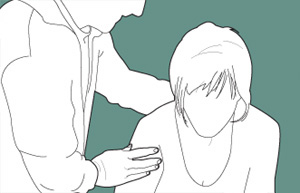
File:Panic_attack.jpg · Wikimedia Commons · See Wikimedia Commons
trouble panique
Sign in to saveAlso known as panic anxiety syndrome, PD
trouble anxieux caractérisé par des attaques de panique récurrentes et sévères
Key facts
- Specialty
- Psychiatry , clinical psychology
- Symptoms
- Sudden periods of intense fear , palpitations , sweating, shaking, shortness of breath , numbness
- Usual onset
- Sudden and recurrent
- Causes
- Unknown
- Risk factors
- Family history, smoking , psychological stress , history of child abuse
- Diagnostic method
- Based on symptoms after ruling out other potential causes
- Differential diagnosis
- Heart disease , hyperthyroidism , drug use
- Treatment
- Counselling , medications
- Medication
- Antidepressants , benzodiazepines , beta blockers
- Frequency
- 2.5% of people at some point
via Wikipedia infobox
Research
14,479 papers- Brain Mechanisms Underlying Panic Attack and Panic Disorder.Neuroscience bulletin · 2024
- Panic disorder.Lancet (London, England) · 2006
- Panic disorder.Current psychiatry reports · 2001
- Panic disorder.American family physician · 1995
- [Panic disorder and agoraphobia: understanding and therapy].Fortschritte der Neurologie-Psychiatrie · 2025
via PubMed
Wikidata facts
- Instance of
- mental disorder
- Subclass of
- disease
- Image
- Panic attack.jpg
Show 11 more facts
- NCI Thesaurus ID
- C34890
- health specialty
- psychiatry
- ICPC 2 ID
- P74
- drug or therapy used for treatment
- nordazepam
- exact match
- purl.obolibrary.org/obo/DOID_594
- genetic association
- TNFRSF21
- Commons category
- Panic disorder
- on focus list of Wikimedia project
- WikiProject Medicine
- symptoms and signs
- panic attack
- possible treatment
- cognitive behavioral therapy
- short name
- PD
Sources (11)
via Wikidata · CC0
Article · Français
Le trouble panique est un trouble anxieux caractérisé par des attaques de panique récurrentes et sévères. Il peut inclure une peur des conséquences ou des inquiétudes d'avoir d'autres attaques (attaques dites anticipatoires). Une attaque de panique est un évènement court et intense, déclenché par une cause soudaine, inopinée et intense pendant laquelle on peut avoir une peur de mourir. Il ne peut être prédit, mais on en identifie parfois des facteurs déclenchants. Le DSM-IV-TR différencie l'attaque de panique et l'anxiété qui résulte un stress chronique créant une réaction durant quelques jours à quelques mois. L'attaque de panique peut toucher des enfants comme des adultes. Dans le DSM-IV, le « trouble panique » pouvait être accompagné d'agoraphobie, mais dans la dernière version du DSM-V, le trouble anxieux d'agoraphobie, est identifié comme étant un trouble anxieux particulier (comme le trouble panique ou la phobie sociale). Le trouble panique peut être handicapant, et une attaque de panique peut être confondue avec une maladie engageant le pronostic vital (comme un infarctus du myocarde, une embolie pulmonaire ou une autre maladie).
Abstract from DBpedia / Wikipedia · CC BY-SA