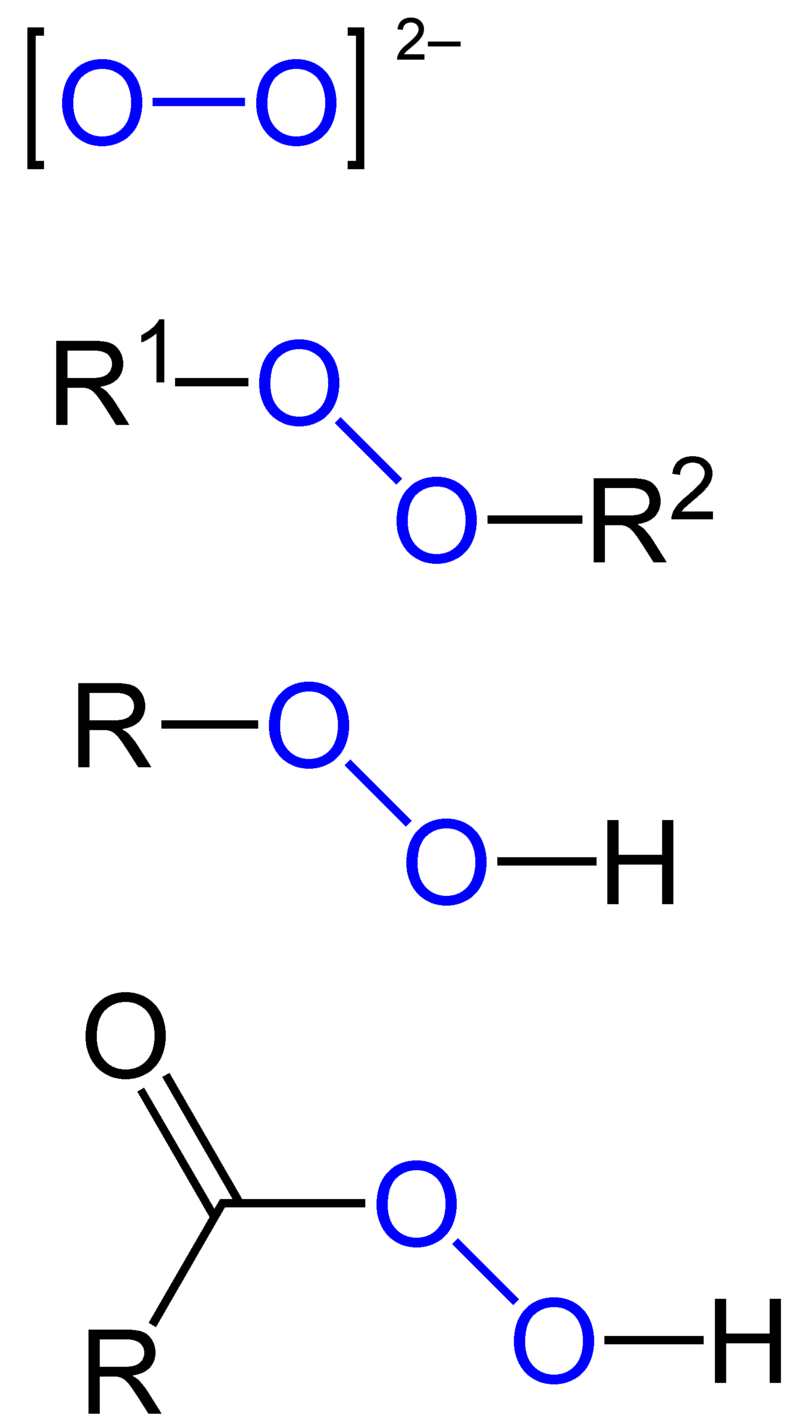
File:Peroxide_group_v.2.png · Wikimedia Commons · See Wikimedia Commons
peroxide
Sign in to saveAlso known as peroxides, peroxide compound
Peroxides are a group of molecules with the structure , where each R represents a radical (a portion of a complete molecule; not a free radical) and the O's are single oxygen atoms. Oxygen atoms are joined to each other and to adjacent elements through single covalent bonds, denoted by dashes or lines. The group in a peroxide is often called the peroxide group, though some nomenclature discrepancies exist. This linkage is recognized as a common polyatomic ion, and exists in many molecules.
Peroxides are molecules containing two oxygen atoms bonded to each other and to other parts of the molecule, and this oxygen-oxygen connection appears in many different chemical compounds. This particular arrangement of atoms is important enough that scientists recognize it as a distinct structural feature they call the peroxide group.
AI-generated from the Wikipedia summary — may contain errors.
Research
265,633 papers- Synthetic Strategies for Peroxide Ring Construction in Artemisinin.ReviewMolecules (Basel, Switzerland) · 2017Vil' VA, Yaremenko IA, Ilovaisky AI et al.DOI: 10.3390/molecules22010117
- [Selenium in peroxide metabolism].ReviewMedizinische Klinik (Munich, Germany : 1983) · 1997Flohé LDOI: 10.1007/BF03041948
- Regulation of enzymatic lipid peroxidation: the interplay of peroxidizing and peroxide reducing enzymes.ReviewFree radical biology & medicine · 2002Kühn H, Borchert ADOI: 10.1016/s0891-5849(02)00855-9
- Intestinal glutathione: determinant of mucosal peroxide transport, metabolism, and oxidative susceptibility.ReviewToxicology and applied pharmacology · 2005Aw TYDOI: 10.1016/j.taap.2004.11.016
- Lipid peroxide formation in microsomes. The role of non-haem iron.The Biochemical journal · 1969Wills EDDOI: 10.1042/bj1130325
- Comparison of peroxide value methods used for semihard cheeses.Journal of agricultural and food chemistry · 2002Mortensen G, Sørensen J, Stapelfeldt HDOI: 10.1021/jf0200220
- Lipid peroxide formation in microsomes. General considerations.The Biochemical journal · 1969Wills EDDOI: 10.1042/bj1130315
- Peroxide-induced membrane damage in human erythrocytes.Biochimica et biophysica acta · 1985van der Zee J, Dubbelman TM, van Steveninck JDOI: 10.1016/0005-2736(85)90135-x
via PubMed
Wikidata facts
- Subclass of
- oxygen compound
- Image
- Peroxide group v.2.png
Show 7 more facts
- topic's main category
- Category:Peroxides
- Commons category
- Peroxides
- MCN code
- 2909.60.20
- different from
- hydrogen peroxide
- canonical SMILES
- [*]OO[*]
- CXSMILES
- [*]OO[*] |$R1;;;R2$|
- on focus list of Wikimedia project
- Wikipedia:Vital articles/Level/4
via Wikidata · CC0
~3 min read
Encyclopedic overview
4 sectionsContents
- General structure
- Common forms
- Nomenclature
- References
Peroxides are a group of molecules with the structure , where each R represents a radical (a portion of a complete molecule; not a free radical) and the O's are single oxygen atoms. Oxygen atoms are joined to each other and to adjacent elements through single covalent bonds, denoted by dashes or lines. The group in a peroxide is often called the peroxide group, though some nomenclature discrepancies exist. This linkage is recognized as a common polyatomic ion, and exists in many molecules.
== General structure == The characteristic structure of any regular peroxide is the oxygen–oxygen covalent single bond, which connects the two main atoms together. Each oxygen atom has a oxidation state of negative one, as 5 of its valence electrons remain in the outermost orbital shell whilst one is occupied in the covalent bond. Because of the nature of the covalent bond, this arrangement results in each atom having the equivalent of 7 valence electrons, reducing the oxygens and giving them a negative charge. This charge is affected by the addition of other elements, with the properties and structure changing depending on the added group(s).
Excerpted from Wikipedia’s “peroxide” article, available under the CC BY-SA 4.0 licence.
Gallery (4)
Available in 60 languages
- Español
- Français
- Deutsch
- 中文
- 日本語
- Русский
- Português
- Italiano
- العربية
- हिन्दी
- Armenian
- Asturian
- Azerbaijani
- Bahasa Indonesia
- Bangla
- Basque
- Belarusian
- Bosnian
Show 41 more
- Bulgarian
- Catalan
- Croatian
- Czech
- Danish
- Esperanto
- Estonian
- Finnish
- Galician
- Georgian
- Hebrew
- Hungarian
- Kazakh
- Kyrgyz
- Latvian
- Lithuanian
- Low German
- Macedonian
- Malay
- Malayalam
- Moksha
- Nederlands
- Norwegian
- Occitan
- Oromo
- Polski
- Romanian
- Serbian
- Serbian (Latin)
- simple
- Slovak
- Slovenian
- Svenska
- Tamil
- Tiếng Việt
- Türkçe
- Ukrainian
- zh_classical
- zh_yue
- فارسی
- 한국어
via Wikidata sitelinks · CC0