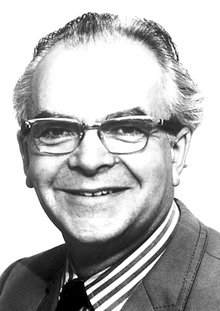
File:Peter_Dennis_Mitchell.jpg · Wikimedia Commons · See Wikimedia Commons
OverviewAI-generated
Peter Dennis Mitchell was a British biochemist, chemist, and university teacher. He was educated at Jesus College, University of Cambridge, and worked at the University of Cambridge and the University of Edinburgh. His professional interests included biochemistry, bioenergetics, and molecular biology. Mitchell was a member of the Royal Society, the American Academy of Arts and Sciences, the French Academy of Sciences, and the National Academy of Sciences.
He received the Copley Medal, the Rosenstiel Award, and the Nobel Prize in Chemistry. Mitchell was also recognized in the Royal Society collection, the Nobel Laureates collection, the Nobel Chemistry collection, and the American Academy Arts Sciences collection. Born in Surrey, he died in Bodmin in 1992. He was deaf and spoke English.
Synthesized by Vinony from 26 facts across 3 sources: Wikidata, Nobel Prize, Vinony collections. Generated from structured data (not the Wikipedia text) and checked against those facts — may still contain errors.
Nobel Prize
- The Nobel Prize in Chemistry1978
“for his contribution to the understanding of biological energy transfer through the formulation of the chemiosmotic theory”
Wikidata facts
- Instance of
- human
- Given name
- Peter
- Family name
- Mitchell
- Gender
- male
- Citizenship
- United Kingdom
- Place of birth
- Surrey
- Place of death
- Bodmin
- Occupation
- university teacher
- Languages spoken
- English language
- Field of work
- biochemistry
- Image
- 36. Tagung 1986 Chemiker; Pressekonferenz Peter D. Mitchell - W134Nr.125218c - Willy Pragher (cropped).jpg
Show 8 more facts
- date of death
- 1992-04-10
- date of birth
- 1920-09-29
- name in native language
- Peter Dennis Mitchell
- different from
- Peter Mitchell
- Commons category
- Peter D. Mitchell
- medical condition
- deafness
- P8168
- Q1182087
- interested in
- biochemistry
via Wikidata · CC0
~4 min read
Encyclopedic overview
Peter Dennis Mitchell FRS (29 September 1920 – 10 April 1992) was a British biochemist who was awarded the 1978 Nobel Prize for Chemistry for his theory of the chemiosmotic mechanism of ATP synthesis.
Early life and education
Excerpted from Wikipedia’s “Peter D. Mitchell” article, available under the CC BY-SA 4.0 licence.