File:Collage_of_printing.png · Wikimedia Commons · See Wikimedia Commons
printing
Sign in to saveAlso known as machine printing
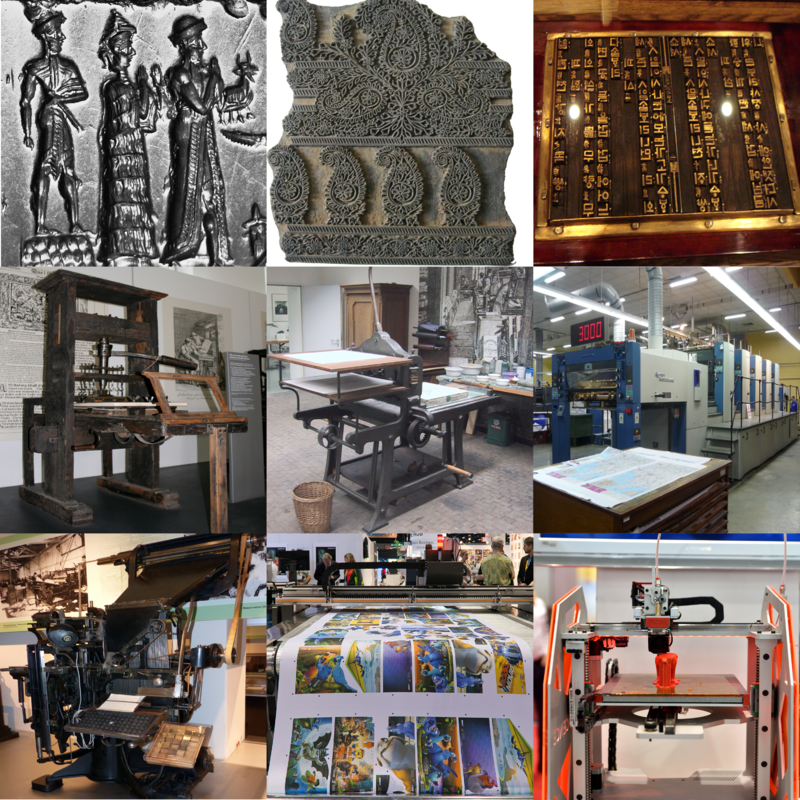
upright=1.5|thumb|From top to bottom, left to right: cylinder seal of a scene, block used for [[woodblock printing, movable type, printing press, lithograph press, offset press used for modern lithographic printing, linotype machine for hot metal typesetting, digital printer, 3D printer in action.]]
Printing is the process of transferring text, images, or designs onto surfaces like paper or other materials using various tools and machines. Throughout history, printing methods have evolved from simple hand-carved blocks to modern digital and 3D printers, making it possible to mass-produce written and visual content efficiently.
AI-generated from the Wikipedia summary — may contain errors.
Research
102,608 papers- 4D printing for biomedical applications.ReviewJournal of materials chemistry. B · 2024Mandal A, Chatterjee KDOI: 10.1039/d4tb00006d
- Printing conducting polymers.ReviewThe Analyst · 2010Weng B, Shepherd RL, Crowley K et al.DOI: 10.1039/c0an00302f
- Controllable printing droplets for high-resolution patterns.ReviewAdvanced materials (Deerfield Beach, Fla.) · 2014Kuang M, Wang L, Song YDOI: 10.1002/adma.201305416
- Acoustic printing of conductive polymers.Proceedings of the National Academy of Sciences of the United States of America · 2025Trepka E, Cooper L, Brinson K Jr et al.DOI: 10.1073/pnas.2509652122
- Biofabrication: an overview of the approaches used for printing of living cells.ReviewApplied microbiology and biotechnology · 2013Ferris CJ, Gilmore KG, Wallace GG et al.DOI: 10.1007/s00253-013-4853-6
- 4D Printing of Overall Radiopaque Customized Bionic Occlusion Devices.Advanced healthcare materials · 2023Lin C, Huang Z, Wang Q et al.DOI: 10.1002/adhm.202201999
- Pharmaceutical applications and requirements of resins for printing by digital light processing (DLP).ReviewPharmaceutical development and technology · 2024Uchida DT, Bruschi MLDOI: 10.1080/10837450.2024.2345144
- Aerosol jet printing of biological inks by ultrasonic delivery.Biofabrication · 2020Williams NX, Watson N, Joh DY et al.DOI: 10.1088/1758-5090/ab5cf5
via PubMed
Wikidata facts
- Instance of
- service
- Subclass of
- printing technique
- Industry
- poligraphy
- Image
- Close up of Block Printing at Halasur village, Karnataka.jpg
Show 9 more facts
- on focus list of Wikimedia project
- Wikipedia:List of articles all languages should have
- practiced by
- book printer
- topic's main category
- Category:Printing
- Commons category
- Letterpress printing
- described by source
- New International Encyclopedia
- uses
- printing machine
- product or material produced
- printed matter
- used by
- Protestant Reformation
- history of topic
- history of printing
Sources (1)
via Wikidata · CC0
~32 min read
Encyclopedic overview
32 sectionsContents
- History
- Woodblock printing
- In East Asia
- In the Islamic World
- In Europe
- Movable-type printing
- The printing press
- Rotary printing press
- Printing capacity
- Conventional printing technology
- Crop marks
- Letterpress
- Offset
- Gravure
- Flexography
- Other printing techniques
- Impact of German movable type printing press
- Quantitative aspects
- Religious impact
- Social impact
- Educational impact
- The language of scholarship
- Curriculum
- Comparison of printing methods
- Digital printing
- 3D printing
- Notes
- References
- Major sources
- Further reading
- Early printers manuals
- External links
upright=1.5|thumb|From top to bottom, left to right: cylinder seal of a scene, block used for [[woodblock printing, movable type, printing press, lithograph press, offset press used for modern lithographic printing, linotype machine for hot metal typesetting, digital printer, 3D printer in action.]]
Printing is a process for mass reproducing text and images using a master form or template. The earliest non-paper products involving printing include cylinder seals and objects such as the Cyrus Cylinder and the Cylinders of Nabonidus. The earliest known form of printing evolved from ink rubbings made on paper or cloth from texts on stone tablets, used during the sixth century. Printing by pressing an inked image onto paper (using woodblock printing) appeared later that century. Later developments in printing technology include the movable type invented by Bi Sheng around 1040 and the printing press invented by Johannes Gutenberg in the 15th century. The technology of printing played a key role in the development of the Renaissance and the Scientific Revolution and laid the material basis for the modern knowledge-based economy and the spread of learning to the masses.
Excerpted from Wikipedia’s “printing” article, available under the CC BY-SA 4.0 licence.
Gallery (46)
Available in 120 languages
- Español
- Français
- Deutsch
- 中文
- 日本語
- Русский
- Português
- Italiano
- العربية
- हिन्दी
- Afrikaans
- Albanian
- Albanian
- Aragonese
- Armenian
- Assamese
- Asturian
- Azerbaijani
Show 101 more
- Bahasa Indonesia
- Bangla
- Bashkir
- Basque
- Batak Toba
- Bavarian
- be_x_old
- Belarusian
- Bikol
- Bosnian
- Breton
- Bulgarian
- Buriat
- Burmese
- Catalan
- Central Kurdish
- Chechen
- Crimean Tatar
- Croatian
- Czech
- Danish
- Esperanto
- Estonian
- Fiji Hindi
- Filipino
- Finnish
- Galician
- Gan Chinese
- gcr
- Georgian
- Greek
- Guarani
- Hausa
- Hebrew
- Hungarian
- hyw
- Icelandic
- Ido
- Irish
- Jamaican Creole English
- Kannada
- Kazakh
- kbp
- Latin
- Latvian
- Ligurian
- Limburgish
- Lithuanian
- Low German
- Macedonian
- Malay
- Malayalam
- Marathi
- nds_nl
- Nederlands
- Newari
- Norwegian
- Norwegian Nynorsk
- Occitan
- Ossetic
- Pashto
- Piedmontese
- Polski
- Punjabi
- Quechua
- Romanian
- Rusyn
- Scots
- Scottish Gaelic
- Serbian
- Serbian (Latin)
- Shona
- simple
- Sindhi
- Sinhala
- Slovak
- Slovenian
- Svenska
- Swahili
- Tamil
- Tatar
- Telugu
- Tiếng Việt
- Toki Pona
- Türkçe
- Ukrainian
- Urdu
- Uzbek
- Walloon
- Waray
- Welsh
- Western Frisian
- Western Panjabi
- Wu Chinese
- Yiddish
- zh_min_nan
- zh_yue
- Zhuang
- فارسی
- ไทย
- 한국어
via Wikidata sitelinks · CC0