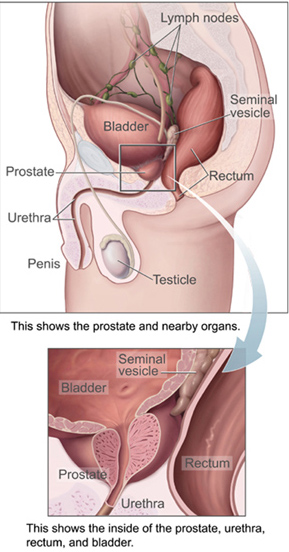
File:Prostatelead.jpg · Wikimedia Commons · See Wikimedia Commons
prostate
Sign in to saveAlso known as prostate gland
The prostate is an accessory gland of the male reproductive system and a muscle-driven mechanical switch between urination and ejaculation. It is found in all male mammals. It differs between species anatomically, chemically, and physiologically. Anatomically, the prostate is found below the bladder, with the urethra passing through it. It is described in gross anatomy as consisting of lobes and in microanatomy by zone. It is surrounded by an elastic, fibromuscular capsule and contains glandular and connective tissue.
The prostate is a gland in the male reproductive system located below the bladder that acts as a mechanical switch controlling whether urine or ejaculate passes through the urethra. It's made up of glandular and connective tissue surrounded by a fibrous capsule, and its structure varies across different male mammal species.
AI-generated from the Wikipedia summary — may contain errors.
Key facts
- Anatomy.Name
- Prostate
- Anatomy.Latin
- prostata
- Anatomy.Greek
- προστάτης
- Anatomy.Image
- Prostatelead.jpg
- Anatomy.Precursor
- Endodermic evaginations of the urethra, urogenital sinus
- Anatomy.System
- Male reproductive system
- Anatomy.Artery
- Internal pudendal artery, inferior vesical artery, and middle rectal artery
- Anatomy.Vein
- Prostatic venous plexus, pudendal plexus, vesical plexus, internal iliac vein
- Anatomy.Nerve
- Inferior hypogastric plexus
- Anatomy.Lymph
- Internal iliac lymph nodes
via Wikipedia infobox
Research
306,945 papers- The role of the prostate in male fertility, health and disease.ReviewNature reviews. Urology · 2016Verze P, Cai T, Lorenzetti SDOI: 10.1038/nrurol.2016.89
- Nutritional and surgical aspects in prostate disorders.ReviewCritical reviews in food science and nutrition · 2023Gasmi A, Bjørklund G, Noor S et al.DOI: 10.1080/10408398.2021.2013158
- Implications of prostate inflammation on male fertility.ReviewAndrologia · 2018Motrich RD, Salazar FC, Breser ML et al.DOI: 10.1111/and.13093
- Prostate ultrasonography.ReviewSeminars in roentgenology · 1993Hamper UM, Sheth SDOI: 10.1016/s0037-198x(05)80113-0
- The microbiome in prostate inflammation and prostate cancer.ReviewProstate cancer and prostatic diseases · 2018Porter CM, Shrestha E, Peiffer LB et al.DOI: 10.1038/s41391-018-0041-1
- Influence of microbiome in intraprostatic inflammation and prostate cancer.ReviewThe Prostate · 2024Prakash P, Verma S, Gupta SDOI: 10.1002/pros.24756
- Chronic inflammation in benign prostatic hyperplasia: Pathophysiology and treatment options.ReviewInternational journal of urology : official journal of the Japanese Urological Association · 2024Inamura S, Terada NDOI: 10.1111/iju.15518
- Prostate growth and inflammation.ReviewThe Journal of steroid biochemistry and molecular biology · 2008Sciarra A, Mariotti G, Salciccia S et al.DOI: 10.1016/j.jsbmb.2007.09.013
via PubMed
Wikidata facts
- Part of
- male reproductive system
- Image
- Prostate - Gray1153.png
Show 7 more facts
- venous drainage
- prostatic venous plexus
- Commons category
- Prostate
- topic's main category
- Category:Prostate
- arterial supply
- internal pudendal artery
- anatomical location
- pelvic cavity
- sexually homologous with
- Skene's gland
- NCI Thesaurus ID
- C12410
Sources (9)
via Wikidata · CC0
~28 min read
Encyclopedic overview
24 sectionsContents
- Structure
- Blood and lymphatic vessels
- Microanatomy
- Gene and protein expression
- Development
- Function
- In ejaculation
- In urination
- In stimulation
- Clinical significance
- Inflammation
- Prostate enlargement
- Cancer
- Surgery
- Transmasculine individuals
- History
- Other animals
- Skene's gland
- See also
- References
- Citations
- Sources
- Attribution
- External links
The prostate is an accessory gland of the male reproductive system and a muscle-driven mechanical switch between urination and ejaculation. It is found in all male mammals. It differs between species anatomically, chemically, and physiologically. Anatomically, the prostate is found below the bladder, with the urethra passing through it. It is described in gross anatomy as consisting of lobes and in microanatomy by zone. It is surrounded by an elastic, fibromuscular capsule and contains glandular and connective tissue.
The prostate produces and contains fluid that forms part of semen, the substance emitted during ejaculation as part of the male sexual response. This prostatic fluid is slightly alkaline, and milky or white in appearance. The alkalinity of semen helps neutralize the acidity of the vaginal tract, prolonging the lifespan of sperm. The prostatic fluid is expelled in the first part of ejaculate, together with most of the sperm, because of the action of smooth muscle tissue within the prostate. In comparison with the few spermatozoa expelled together with mainly seminal vesicular fluid, those in prostatic fluid have better motility, longer survival, and better protection of genetic material.
Excerpted from Wikipedia’s “prostate” article, available under the CC BY-SA 4.0 licence.
Gallery (16)
Available in 88 languages
- Español
- Français
- Deutsch
- 中文
- 日本語
- Русский
- Português
- Italiano
- العربية
- हिन्दी
- Afrikaans
- Albanian
- Aragonese
- Armenian
- Asturian
- Azerbaijani
- Bahasa Indonesia
- Bangla
Show 69 more
- Basque
- be_x_old
- Belarusian
- Bikol
- Bosnian
- Bulgarian
- Catalan
- Central Kurdish
- Croatian
- Czech
- Danish
- Divehi
- Egyptian Arabic
- Esperanto
- Estonian
- Filipino
- Finnish
- Galician
- Georgian
- Greek
- Hebrew
- Hungarian
- Icelandic
- Ido
- Interlingue
- Irish
- Javanese
- Kashmiri
- Kazakh
- Kurdish
- Kyrgyz
- Latin
- Latvian
- Limburgish
- Lithuanian
- Luxembourgish
- Macedonian
- Malay
- Malayalam
- Mongolian
- Nederlands
- Nepali
- Newari
- Norwegian
- Norwegian Nynorsk
- Papiamento
- Polski
- Romanian
- Serbian
- Serbian (Latin)
- simple
- Slovak
- Slovenian
- Svenska
- Tamil
- Tatar
- Telugu
- Tiếng Việt
- Türkçe
- Ukrainian
- Urdu
- Uzbek
- Waray
- Welsh
- Wu Chinese
- zh_yue
- فارسی
- ไทย
- 한국어
via Wikidata sitelinks · CC0