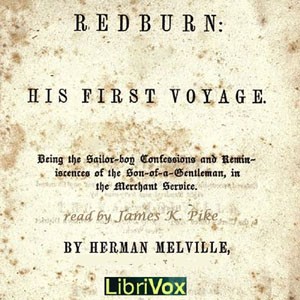
Cover via Open Library · Open Library
Redburn
Sign in to saveAlso known as Redburn: His First Voyage
Redburn: His First Voyage is the fourth book by the American writer Herman Melville, first published in London in 1849. The book is semi-autobiographical and recounts the adventures of a refined youth among coarse and brutal sailors and the seedier areas of Liverpool. Melville wrote Redburn in less than ten weeks. While one scholar describes it as "arguably his funniest work", scholar F. O. Matthiessen calls it "the most moving of its author's books before Moby-Dick".
Book · Open Library
- Author
- Herman Melville
- First published
- 1849
- Editions
- 68
- Subjects
- Sailors, Seafaring life, Fiction, Americans, Young men, Classic Literature, Merchant mariners, American fiction (fictional works by one author)
via Open Library
Wikidata facts
- Read free · Project Gutenberg
- #8118
- Instance of
- literary work
- Author
- Herman Melville
- Country of origin
- United States
- Followed by
- White-Jacket
- Follows
- Mardi
- Narrative location
- Liverpool
- Image
- Redburn His First Voyage.jpg
Show 7 more facts
- copyright status
- public domain
- publication date
- 1849-00-00
- title
- Redburn
- subtitle
- His First Voyage
- language of work or name
- English language
- form of creative work
- novel
- Commons category
- Redburn
Sources (2)
via Wikidata · CC0
~10 min read
Encyclopedic overview
9 sectionsContents
- Plot
- Character List
- Composition and publication history
- Reception
- Assessments
- References
- Sources
- Further reading
- External links
Redburn: His First Voyage is the fourth book by the American writer Herman Melville, first published in London in 1849. The book is semi-autobiographical and recounts the adventures of a refined youth among coarse and brutal sailors and the seedier areas of Liverpool. Melville wrote Redburn in less than ten weeks. While one scholar describes it as "arguably his funniest work", scholar F. O. Matthiessen calls it "the most moving of its author's books before Moby-Dick".
==Plot== Unable to find employment at home, young Wellingborough Redburn signs on the Highlander, a merchantman out of New York City bound for Liverpool, England. Representing himself as the "son of a gentleman" and expecting to be treated as such, he discovers that he is just a green hand, a "boy", the lowest rank on the ship, assigned all the duties no other sailor wants, like cleaning out the "pigpen", a longboat that serves as a shipboard sty. The first mate promptly nicknames him "Buttons" for the shiny ones on his impractical jacket. Redburn quickly grasps the workings of social relations aboard ship. As a common seaman he can have no contact with those "behind the mast" where the officers command the ship. Before the mast, where the common seaman work and live, a bully named Jackson, the best seaman aboard, rules through fear with an iron fist. Uneducated yet cunning, with broken nose and squinting eye, he is described as "a Cain afloat, branded on his yellow brow with some inscrutable curse and going about corrupting and searing every heart that beat near him." Redburn soon experiences all the trials of a greenhorn: seasickness, scrubbing decks, climbing masts in the dead of night to unfurl sails, cramped quarters, and bad food. thumb|Launcelott's Hey, 1843 When the ship lands in Liverpool he is given liberty ashore. He rents a room and walks the city every day. One day in a street called Launcelott's Hey he hears "a feeble wail" from a cellar beneath an old warehouse and looking into it sees "the figure of what had been a woman. Her blue arms folded to her livid bosom two shrunken things like children, that leaned toward her, one on each side. At first, I knew not whether they were alive or dead. They made no sign; they did not move or stir; but from the vault came that soul-sickening wail." He runs for help but is met with indifference by a ragpicker, a porter, his landlady, even by a policeman who tells him to mind his own business. He returns with some bread and cheese and drops them into the vault to the mother and children, but they are too weak to lift it to their mouths. The mother whispers "water" so he runs and fills his tarpaulin hat at an open hydrant. The girls drink and revive enough to nibble some cheese. He clasps the mother's arms and pulls them aside to see "a meager babe, the lower part of its body thrust into an old bonnet. Its face was dazzlingly white, even in its squalor; but the closed eyes looked like balls of indigo. It must have been dead for some hours." Judging them beyond the point at which medicine could help, he returns to his room. A few days later he revisits the street and finds the vault empty: "In place of the woman and children, a heap of quick lime was glistening."
Excerpted from Wikipedia’s “Redburn” article, available under the CC BY-SA 4.0 licence.