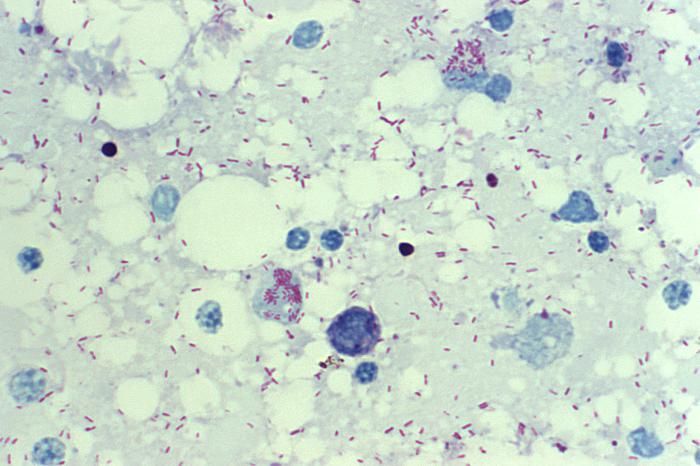
Encyclopedia of Life · EOL (see source)
Rickettsia
Sign in to saveRickettsia is a genus of nonmotile, gram-negative, nonspore-forming, highly pleomorphic bacteria that may occur in the forms of cocci (0.1 μm in diameter), bacilli (1–4 μm long), or threads (up to about 10 μm long). The genus was named after Howard Taylor Ricketts in honor of his pioneering work on tick-borne spotted fever.
OverviewAI-generated
Rickettsia is a genus of gram-negative bacteria within the family Rickettsiaceae. It belongs to the order Rickettsiales, class Alphaproteobacteria, and phylum Proteobacteria in the kingdom Bacteria. The genus was named after Howard Taylor Ricketts, with Rickettsia prowazekii serving as the taxonomic type. Its scientific name was established by da Rocha-Lima in 1916, and the taxon is currently accepted.
Infections caused by this organism include typhus, rickettsialpox, and rickettsiosis. Records of the genus have been documented in the United States, United Arab Emirates, Mauritius, South Africa, and New Zealand. The name Rickettsia is referenced by 257 other encyclopedia articles.
Synthesized by Vinony from 34 facts across 7 sources: Wikidata, GBIF, PubMed, Gbif Occ, WoRMS, iDigBio, Vinony graph. Generated from structured data (not the Wikipedia text) and checked against those facts — may still contain errors.
Species
GENUS
- KingdomBacteria
- PhylumProteobacteria
- ClassAlphaproteobacteria
- OrderRickettsiales
- FamilyRickettsiaceae
立克次体(学名:Rickettsia),或者称立克次氏体,是一类细菌,但许多特征和病毒一样,如不能在培养基上培养,可以通过瓷濾器过滤,只能在动物细胞内寄生繁殖等。直径只有0.3-1μm,小于绝大多数细菌。立克次体有细胞形态,除恙虫病立克次体外,细胞壁含有细菌特有的肽聚糖。细胞壁为双层结构,其中脂类含量高于一般细菌,无鞭毛。同时有DNA和RNA两种核酸,但没有核仁及核膜,属于适应了寄生生活的α-变形菌,經研究粒線體的祖先可能是由立克次體演化而來。革兰染色呈阴性,效果不明显。立克次体取名是为了纪念美国病理学家霍華德·泰勒·立克次(Howard Taylor Ricketts,1871年2月9日 - 1910年5月3日),立克次在芝加哥大学工作期间发现了落磯山斑點熱和鼠型斑疹伤寒的病原体(立克次体)和传播方式,由于工作原因,他自己也死于斑疹伤寒。他所发现的病原体被命名为立克次体属。
via GBIF
Museum specimens
- Specimen records
- 67
- Family
- Rickettsiaceae
- Collections
- USNM, QM
- Recorded in
- United States, United Arab Emirates, Mauritius, South Africa, New Zealand, Spain, United Kingdom, Saudi Arabia
Research
22,835 papers- Rickettsia Species: Genetic Variability, Vectors, and Rickettsiosis-A Review.Pathogens (Basel, Switzerland) · 2024
- Unpacking the intricacies of Rickettsia-vector interactions.Trends in parasitology · 2021
- Rickettsia tillamookensis (Rickettsiales: Rickettsiaceae) in Ixodes scapularis (Acari: Ixodidae) in Oklahoma.Journal of medical entomology · 2024
- Guidelines for the Detection of Rickettsia spp.Vector borne and zoonotic diseases (Larchmont, N.Y.) · 2017
- Lipid A Structural Divergence in Rickettsia Pathogens.mSphere · 2021
via PubMed
Wikidata facts
- Instance of
- taxon
- Parent taxon
- Rickettsiaceae
- Named after
- Howard Taylor Ricketts
- Image
- Rickettsia rickettsii.jpg
Show 8 more facts
- taxon name
- Rickettsia
- taxon rank
- genus
- Commons category
- Rickettsia
- has effect
- typhus
- topic's main category
- Category:Rickettsia
- Gram staining
- gram-negative bacteria
- LPSN URL
- lpsn.dsmz.de/genus/rickettsia
- taxonomic type
- Rickettsia prowazekii
via Wikidata · CC0
~9 min read
Encyclopedic overview
10 sectionsContents
- Classification
- Spotted fever group
- Typhus group
- Scrub typhus group
- Flora and fauna pathogenesis
- Pathophysiology
- Genomics
- Naming
- References
- External links
Rickettsia is a genus of nonmotile, gram-negative, nonspore-forming, highly pleomorphic bacteria that may occur in the forms of cocci (0.1 μm in diameter), bacilli (1–4 μm long), or threads (up to about 10 μm long). The genus was named after Howard Taylor Ricketts in honor of his pioneering work on tick-borne spotted fever.
Properly, Rickettsia is the name of a single genus, but the informal term "rickettsia", plural "rickettsias", usually not capitalised, commonly applies to any members of the order Rickettsiales. Being obligate intracellular bacteria, rickettsias depend on entry, growth, and replication within the cytoplasm of living eukaryotic host cells (typically endothelial cells). Accordingly, Rickettsia species cannot grow in artificial nutrient culture; they must be grown either in tissue or embryo cultures. Mostly chicken embryos are used, following a method developed by Ernest William Goodpasture and his colleagues at Vanderbilt University in the early 1930s. Many new strains or species of Rickettsia are described each year. Some Rickettsia species are pathogens of medical and veterinary interest, but many Rickettsia are non-pathogenic to vertebrates, including humans, and infect only arthropods, often non-hematophagous, such as aphids or whiteflies. Many Rickettsia species are thus arthropod-specific symbionts, but are often confused with pathogenic Rickettsia (especially in medical literature), showing that the current view in rickettsiology has a strong anthropocentric bias.
Excerpted from Wikipedia’s “Rickettsia” article, available under the CC BY-SA 4.0 licence.