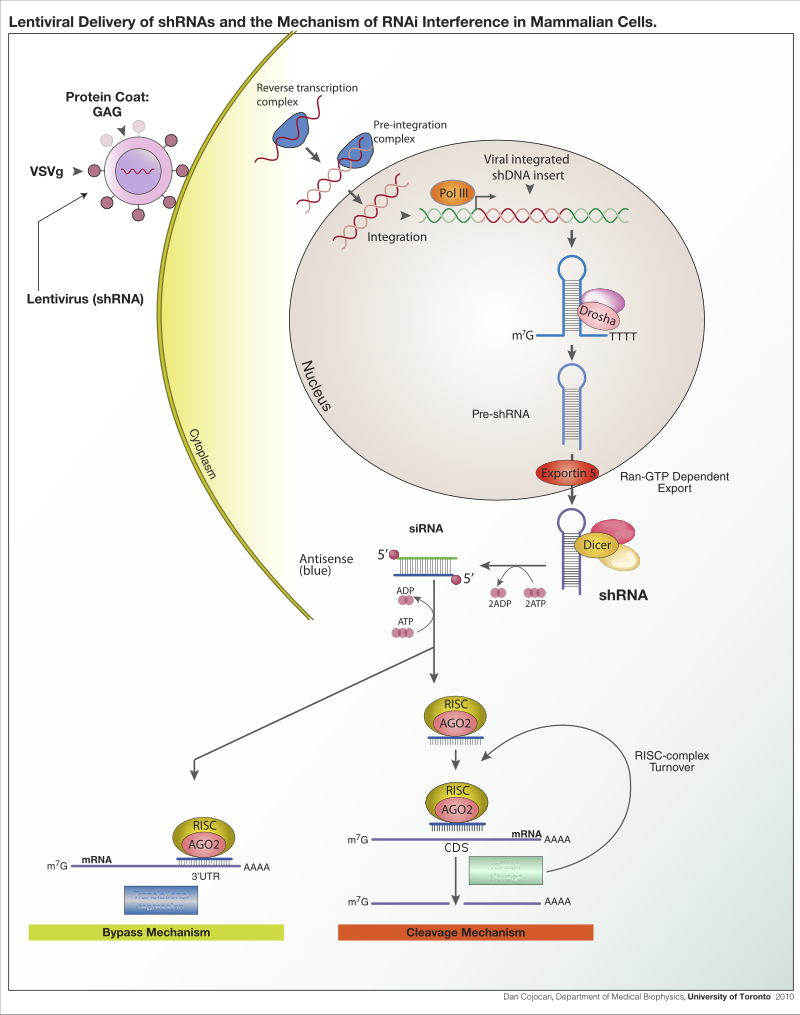
File:ShRNA_Lentivirus.svg · Wikimedia Commons · See Wikimedia Commons
RNA interference
Sign in to saveAlso known as post transcriptional gene silencing, RNAi, posttranscriptional gene silencing by siRNA, post-transcriptional gene silencing by RNA, RNA-mediated posttranscriptional gene silencing, posttranscriptional gene silencing by RNA, GO:0035194
any process of posttranscriptional gene inactivation mediated by small RNA molecules that may trigger mRNA degradation or down-regulate translation
Wikidata facts
- Instance of
- biological process
- Subclass of
- gene silencing
- Image
- RNAi.png
Show 4 more facts
- Commons category
- RNA interference
- topic's main category
- Category:RNA interference
- facet of
- molecular genetics
- exact match
- purl.obolibrary.org/obo/GO_0035194
via Wikidata · CC0
~40 min read
Encyclopedic overview
Lentiviral delivery of designed shRNAs and the mechanism of RNA interference in mammalian cells RNA interference (RNAi) is a biological process in which RNA molecules are involved in sequence-specific suppression of gene expression by double-stranded RNA, through translational or transcriptional repression. Historically, RNAi was known by other names, including co-suppression, post-transcriptional gene silencing (PTGS), and quelling. The detailed study of each of these seemingly different processes elucidated that the identity of these phenomena were all actually RNAi. Andrew Fire and Craig Mello shared the 2006 Nobel Prize in Physiology or Medicine for their work on RNAi in the nematode worm Caenorhabditis elegans, which they published in 1998. Since the discovery of RNAi and its regulatory potentials, it has become evident that RNAi has immense potential in suppression of desired genes. RNAi is now known as precise, efficient, stable and better than antisense therapy for gene suppression. Antisense RNA produced intracellularly by an expression vector may be developed and find utility as novel therapeutic agents.
Two types of small ribonucleic acid (RNA) molecules, microRNA (miRNA) and small interfering RNA (siRNA), are central to components to the RNAi pathway. Once mRNA is degraded, post-transcriptional silencing occurs as protein translation is prevented. Transcription can be inhibited via the pre-transcriptional silencing mechanism of RNAi, through which an enzyme complex catalyzes DNA methylation at genomic positions complementary to complexed siRNA or miRNA. RNAi has an important role in defending cells against parasitic nucleotide sequences (e.g., viruses or transposons) and also influences development of organisms.
Excerpted from Wikipedia’s “RNA interference” article, available under the CC BY-SA 4.0 licence.