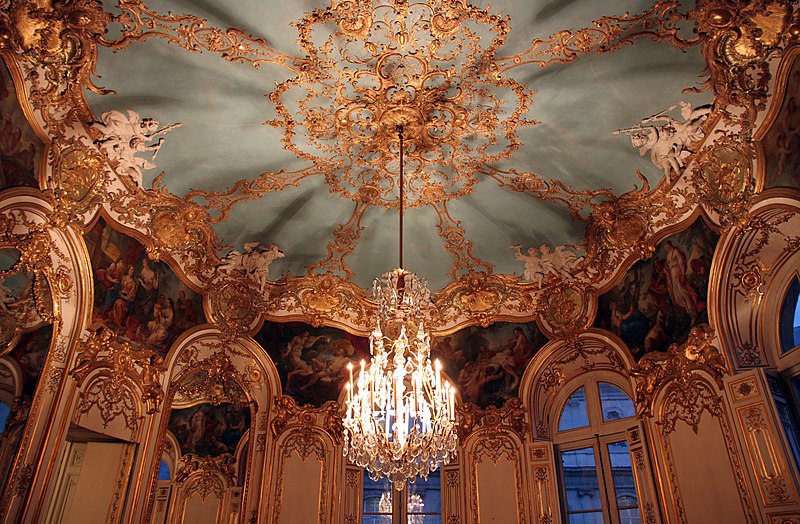
File:Salon_de_la_princesse_hotel_de_soubise.jpg · Wikimedia Commons · See Wikimedia Commons
Rococo
Sign in to saveRococo, less commonly Roccoco ( , ; or ), also known as Late Baroque, is an exceptionally ornamental and dramatic style of architecture, art, and decoration which combines asymmetry, scrolling curves, gilding, white and pastel colours, sculpted moulding, and ''trompe-l'œil'' frescoes to create surprise and the illusion of motion and drama. It is often described as the final expression of the Baroque movement.
Rococo is an ornamental style of architecture, art, and decoration that emerged in the late Baroque period, characterized by asymmetrical designs, curved forms, gilding, pastel colors, and decorative elements meant to create surprise and visual drama. It matters as a significant artistic movement that represents the final and most elaborate expression of the Baroque era.
AI-generated from the Wikipedia summary — may contain errors.
Key facts
- Art movement.caption
- Ballroom ceiling of the Ca Rezzonico in Venice with illusionistic quadratura painting by Giovanni Battista Crosato (1753); Chest of drawers by Charles Cressent (1730); Kaisersaal of Würzburg Residence by Balthasar Neumann (1749–1751)
- Art movement.yearsactive
- 1730s to 1760s
- Art movement.country
- France, Italy, Central Europe
- Art movement.commons
- yes
- Art movement.name
- Rococo
via Wikipedia infobox
Wikidata facts
- Field of work
- costume
- Image
- JAMeissonnierTable.jpg
Show 12 more facts
- described by source
- Encyclopædia Britannica 11th edition
- Commons category
- Rococo art
- topic's main category
- Category:Rococo art
- Commons gallery
- Rococo
- OpenStreetMap tag
- building:architecture=rococo
- manner of
- color
- on focus list of Wikimedia project
- Wikipedia:Vital articles/Level/4
- start time
- 1730-00-00
- end time
- 1780-00-00
- subject named as
- Rokoko
- influenced by
- Classicism
- significant person
- François Boucher
via Wikidata · CC0
~45 min read
Encyclopedic overview
27 sectionsContents
- Etymology
- Characteristics
- Differences between Baroque and Rococo
- France
- Italy
- Southern Germany
- England
- Russia
- Frederician Rococo
- Decline and end
- Furniture and decoration
- Painting
- Sculpture
- Porcelain
- Music
- Fashion
- Literature
- Gallery
- Architecture
- Engravings
- Painting
- Rococo era painting
- See also
- Notes and citations
- Bibliography
- Further reading
- External links
Rococo, less commonly Roccoco ( , ; or ), also known as Late Baroque, is an exceptionally ornamental and dramatic style of architecture, art, and decoration which combines asymmetry, scrolling curves, gilding, white and pastel colours, sculpted moulding, and ''trompe-l'œil frescoes to create surprise and the illusion of motion and drama. It is often described as the final expression of the Baroque movement.
Originally known as the “style Rocaille," Rococo began in France in the 1730s as a reaction against the more formal and geometric Louis XIV style. It soon spread to other parts of Europe, particularly northern Italy, Austria, southern Germany, Central Europe and Russia. It also came to influence other arts, particularly sculpture, furniture, silverware, glassware, painting, music, theatre, and literature. Although originally a secular style primarily used for interiors of private residences, the Rococo had a spiritual aspect to it which led to its widespread use in church interiors, particularly in Central Europe, Portugal, and South America.
Excerpted from Wikipedia’s “Rococo” article, available under the CC BY-SA 4.0 licence.
Gallery (22)
Available in 80 languages
- Español
- Français
- Deutsch
- 中文
- 日本語
- Русский
- Português
- Italiano
- العربية
- Afrikaans
- Albanian
- Armenian
- Arpitan
- Asturian
- Azerbaijani
- Bahasa Indonesia
- Basque
- be_x_old
Show 61 more
- Belarusian
- Bosnian
- Bulgarian
- Catalan
- Chuvash
- Croatian
- Czech
- Danish
- Egyptian Arabic
- Esperanto
- Estonian
- Filipino
- Finnish
- Galician
- Georgian
- Goan Konkani
- Greek
- Hebrew
- Hungarian
- hyw
- Icelandic
- Ido
- Irish
- Javanese
- Kazakh
- Kyrgyz
- Latgalian
- Latin
- Latvian
- Limburgish
- Lithuanian
- Luxembourgish
- Macedonian
- nds_nl
- Nederlands
- Norwegian
- Norwegian Nynorsk
- Occitan
- Pashto
- Polski
- Punjabi
- Romanian
- Saterland Frisian
- Serbian
- Serbian (Latin)
- simple
- Slovak
- Slovenian
- Svenska
- Tiếng Việt
- Türkçe
- Ukrainian
- Walloon
- Waray
- Western Frisian
- Western Panjabi
- Wu Chinese
- zh_yue
- فارسی
- ไทย
- 한국어
via Wikidata sitelinks · CC0