File:Plateau_van_zeevruchten.jpg · Wikimedia Commons · See Wikimedia Commons
seafood
Sign in to saveAlso known as marine product, blue foods, blue food
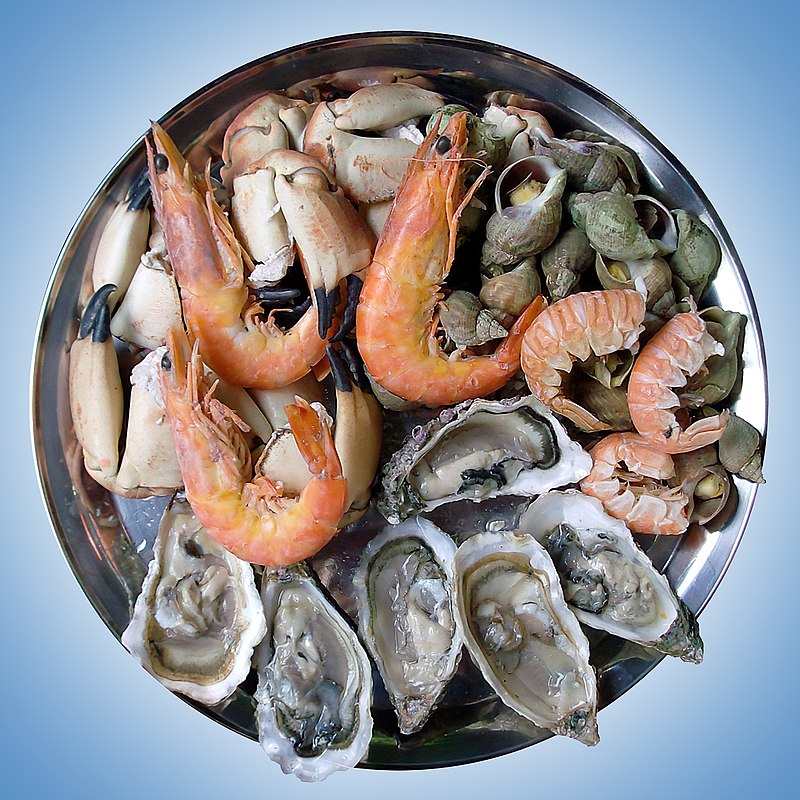
thumb| |alt=A seafood platter composed of shrimp, oyster, snail and crab.
OverviewAI-generated
Seafood is a culinary category identified by the OpenStreetMap tag "cuisine=seafood". It is associated with the Commons category and gallery titled "Seafood". In the Openfoodfacts database, seafood is listed as a category containing 12,198 products.
Nutritional data for seafood in this database indicates an energy value of 140 kcal. The composition includes 5.6 grams of fat, with 1.1 grams being saturated fat. It contains 4 grams of carbohydrates, 0.9 grams of sugars, and 0.4 grams of fiber. The protein content is 18 grams, and the salt content is 4.13 grams. The item carries a nutriscore of "a" and a nova classification of 4.
The subject is referenced by 2,405 other encyclopedia articles. A PubMed query for seafood yields a count of 32,220 results.
Synthesized by Vinony from 19 facts across 4 sources: Wikidata, PubMed, Openfoodfacts, Vinony graph. Generated from structured data (not the Wikipedia text) and checked against those facts — may still contain errors.
Nutrition · Open Food Facts
Typical values per 100 g · averaged across 12,198 products
- Energy
- 140 kcal
- Fat
- 5.6 g
- — of which saturates
- 1.1 g
- Carbohydrates
- 4 g
- — of which sugars
- 0.9 g
- Fibre
- 0.4 g
- Protein
- 18 g
- Salt
- 4.13 g
via Open Food Facts · ODbL
Research
32,220 papers- Seafood allergy: Allergen, epitope mapping and immunotherapy strategy.Critical reviews in food science and nutrition · 2023
- Plant-Based Seafood Analogs.Molecules (Basel, Switzerland) · 2021
- Seafood allergy.Current opinion in allergy and clinical immunology · 2004
- Seafood pathogens and information on antimicrobial resistance: A review.Food microbiology · 2018
- Seafood allergy: tropomyosins and beyond.Journal of microbiology, immunology, and infection = Wei mian yu gan ran za zhi · 1999
via PubMed
Wikidata facts
- Subclass of
- food ingredient
- Image
- Plateau van zeevruchten.jpg
Show 8 more facts
- topic's main category
- Category:Seafood
- Commons category
- Seafood
- Commons gallery
- Seafood
- topic has template
- Template:Seafood
- history of topic
- history of seafood
- OpenStreetMap tag
- cuisine=seafood
- on focus list of Wikimedia project
- Wikipedia:Vital articles/Level/4
- exact match
- purl.obolibrary.org/obo/ENVO_00003073
Sources (2)
via Wikidata · CC0
~44 min read
Encyclopedic overview
16 sectionsContents
- History
- Types of seafood
- Processing
- Consumption
- Texture and taste
- Health benefits
- Health hazards
- Mislabelling
- Sustainability
- In religion
- See also
- References
- Citations
- Sources
- Further reading
- External links
thumb| |alt=A seafood platter composed of shrimp, oyster, snail and crab.
Seafood is any form of sea life regarded as food by humans, prominently including fish and shellfish. Shellfish include various species of molluscs (e.g., bivalve molluscs such as clams, oysters, and mussels, and cephalopods such as octopus and squid), crustaceans (e.g. shrimp, crabs, and lobster), and echinoderms (e.g. sea cucumbers and sea urchins). Historically, marine mammals such as cetaceans (whales and dolphins) as well as seals have been eaten as food, though that happens to a lesser extent in modern times. Edible sea plants such as some seaweeds and microalgae are widely eaten as sea vegetables around the world, especially in Asia.
Excerpted from Wikipedia’s “seafood” article, available under the CC BY-SA 4.0 licence.