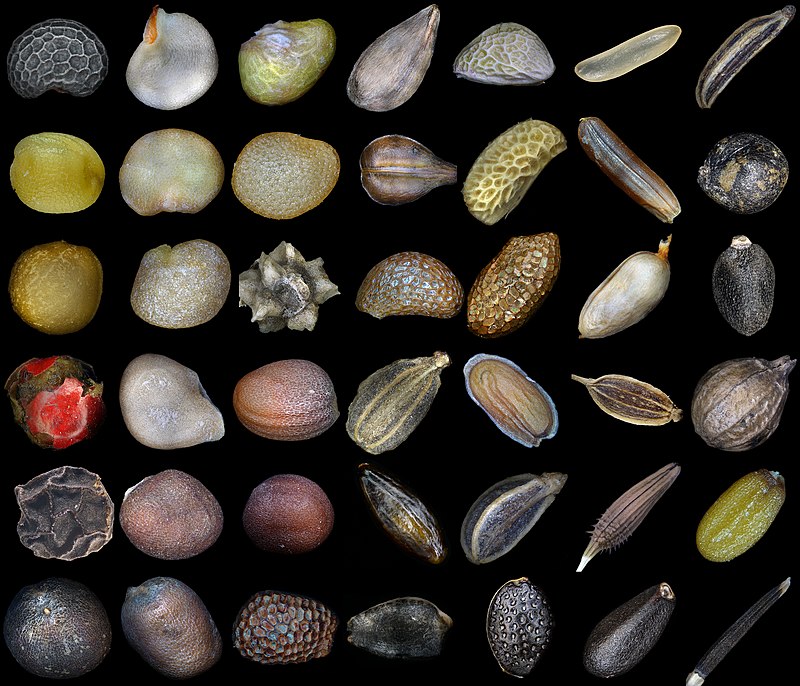
File:Разнообразие_семян.jpg · Wikimedia Commons · See Wikimedia Commons
OverviewAI-generated
Seeds are categorized under the Commons category and gallery titled "Seeds." In the Openfoodfacts database, they constitute a product category containing 8101 items. The nutritional profile for this category lists an energy content of 341 kcal.
The composition includes 10.1 fat, with 1.2 being saturated fat. Carbohydrates account for 51.9, while sugars make up 2.1. Fiber is present at 8.4, and proteins total 11.6. Salt content is recorded at 0.47.
Seeds receive a NutriScore of b and a Nova classification of 1. In terms of academic referencing, the subject is cited by 3,122 other encyclopedia articles.
Synthesized by Vinony from 15 facts across 3 sources: Wikidata, Openfoodfacts, Vinony graph. Generated from structured data (not the Wikipedia text) and checked against those facts — may still contain errors.
Nutrition · Open Food Facts
Typical values per 100 g · averaged across 8,101 products
- Energy
- 341 kcal
- Fat
- 10.1 g
- — of which saturates
- 1.2 g
- Carbohydrates
- 51.9 g
- — of which sugars
- 2.1 g
- Fibre
- 8.4 g
- Protein
- 11.6 g
- Salt
- 0.47 g
via Open Food Facts · ODbL
Wikidata facts
Show 5 more facts
- Commons category
- Seeds
- topic's main category
- Category:Seeds
- Commons gallery
- Seeds
- develops from
- ovule
- on focus list of Wikimedia project
- Wikipedia:Vital articles/Level/4
Sources (2)
via Wikidata · CC0
~50 min read
Encyclopedic overview
42 sectionsContents
- History
- Development
- Ovule
- Embryo
- {{anchor|Seed coat}}Seed coat
- Gymnosperms
- Shape and appearance
- Terms to describe shape
- Structure
- Seed types
- Embryo
- Nutrient storage
- Seed coat
- Size and seed set
- Functions
- Embryo nourishment
- Dispersal
- By wind (anemochory)
- By water (hydrochory)
- By animals (zoochory)
- Dormancy
- Persistence and seed banks
- Germination
- Repair of DNA damage
- Inducing germination
- Sterile seeds
- Evolution and origin of seeds
- True to the seed
- Seed microbiome
- Economic importance
- Seed market
- Seed production
- Edible seeds
- Poison and food safety
- Other uses
- Seed records
- Seed laws
- In religion
- See also
- References
- Bibliography
- External links
thumb|350px| Micrograph|Photomicrograph of various seeds
In botany, a seed is a plant structure containing an embryo and stored nutrients in a protective coat called a testa. More generally, the term seed means anything that can be sown, which may include seed and husk or tuber. Seeds are the product of the ripened ovule, after the embryo sac is fertilized by sperm from pollen, forming a zygote. The embryo within a seed develops from the zygote and grows within the mother plant to a certain size before growth is halted.
Excerpted from Wikipedia’s “seed” article, available under the CC BY-SA 4.0 licence.
Gallery (46)
Available in 125 languages
- Español
- Français
- Deutsch
- 中文
- 日本語
- Русский
- Português
- Italiano
- العربية
- हिन्दी
- Afrikaans
- Albanian
- Aragonese
- Armenian
- Asturian
- Aymara
- azb
- Azerbaijani
Show 106 more
- Bahasa Indonesia
- Bangla
- Banjar
- Bashkir
- Basque
- bat_smg
- Bavarian
- be_x_old
- Belarusian
- Bhojpuri
- Bikol
- Bosnian
- Bulgarian
- Burmese
- Catalan
- cdo
- Chuvash
- Croatian
- Czech
- Danish
- Esperanto
- Estonian
- Fijian
- Filipino
- Finnish
- Galician
- gcr
- Greek
- Guarani
- Haitian Creole
- Hebrew
- Hungarian
- Icelandic
- Ido
- Interlingua
- Irish
- Javanese
- Kabyle
- Kannada
- Kazakh
- kge
- Kurdish
- Kyrgyz
- Latin
- Latvian
- Lingala
- Lithuanian
- Luxembourgish
- Macedonian
- Malagasy
- Malay
- Malayalam
- Manipuri
- Marathi
- nds_nl
- Neapolitan
- Nederlands
- Nepali
- Norwegian
- Norwegian Nynorsk
- Occitan
- Oromo
- Pashto
- Polski
- Punjabi
- Quechua
- roa_rup
- Romanian
- Sanskrit
- Santali
- Scots
- Serbian
- Serbian (Latin)
- Shona
- Sicilian
- simple
- Sindhi
- Slovak
- Slovenian
- Somali
- Sundanese
- Svenska
- Swahili
- szy
- Tamil
- Telugu
- Tiếng Việt
- Tsonga
- Türkçe
- Ukrainian
- Urdu
- Uyghur
- Uzbek
- Venetian
- Walloon
- Waray
- Western Frisian
- Western Panjabi
- Wu Chinese
- zh_min_nan
- zh_yue
- Zhuang
- Zulu
- فارسی
- ไทย
- 한국어
via Wikidata sitelinks · CC0