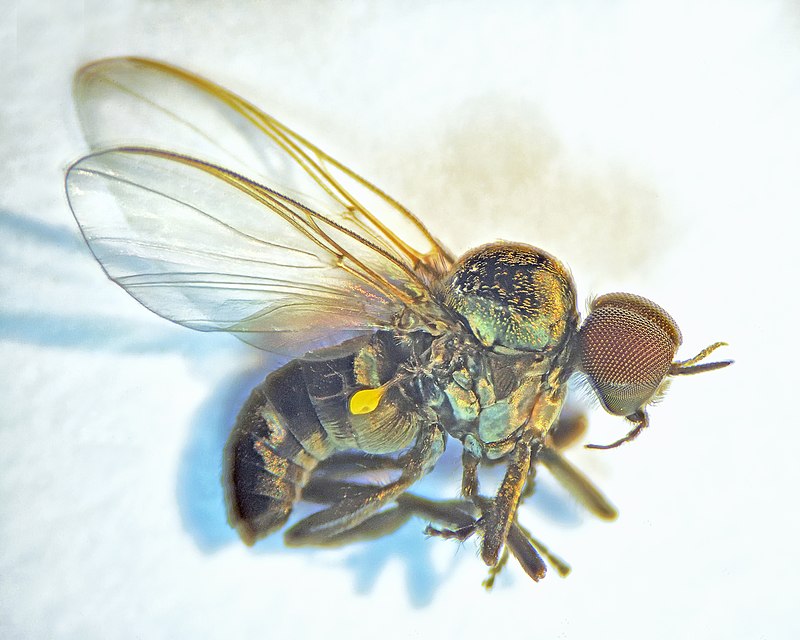
File:Blackfly.jpg · Wikimedia Commons · See Wikimedia Commons
Simuliidae is a family of small flies commonly known as blackflies or buffalo gnats. These insects are important because their larvae live in flowing freshwater streams and rivers, and adult females bite humans and animals to feed on blood, sometimes transmitting diseases like onchocerciasis (river blindness) in tropical regions.
AI-generated from the Wikipedia summary — may contain errors.
Species
blackflies
Simuliidae
FAMILY
- KingdomAnimalia
- PhylumArthropoda
- ClassInsecta
- OrderDiptera
- FamilySimuliidae
via GBIF
Museum specimens
- Specimen records
- 10,289
- With media
- 188
- Family
- Simuliidae
- Collections
- YPM, MHNCA, USNM, UAM
- Recorded in
- United States, Mexico
Research
2,245 papers- FAMILY SIMULIIDAE.Zootaxa · 2016
- The biodiversity of black flies (Diptera: Simuliidae) in Indonesia.Acta tropica · 2018
- Evolution, epidemiology, and population genetics of black flies (Diptera: Simuliidae).Infection, genetics and evolution : journal of molecular epidemiology and evolutionary genetics in infectious diseases · 2010
- Blackflies (Diptera: Simuliidae) of Southern Guyana with keys for the identification of adults and pupae--a review.Memorias do Instituto Oswaldo Cruz · 2004
- Revision of Simulium rufibasis (Diptera: Simuliidae) in Japan and Korea: Chromosomes, DNA, and Morphology.Journal of medical entomology · 2020
via PubMed
Wikidata facts
- Instance of
- taxon
- Parent taxon
- Chironomoidea
- Image
- Black Fly.png
Show 6 more facts
- Commons category
- Simuliidae
- taxon rank
- family
- taxon name
- Simuliidae
- topic's main category
- Category:Simuliidae
- taxon common name
- knott
- different from
- midge
via Wikidata · CC0
~11 min read
Encyclopedic overview
Black flies or blackflies (sometimes called buffalo gnats, turkey gnats, or white socks) are flies in the family Simuliidae of the Culicomorpha infraorder. Simuliidae are related to the Ceratopogonidae, Chironomidae, and Thaumaleidae. Over 2,200 species of black flies have been formally named, of which 15 are extinct. They are divided into two subfamilies: Parasimuliinae contains only one genus and four species; Simuliinae contains all the rest. Over 1,800 of the species belong to the genus Simulium.
Black flies are usually small, black or gray, with short legs and antennae. They feed mainly on nectar for flight energy, and the females of most species also gain nourishment for egg production by feeding on the blood of birds or mammals, including humans. They are a common nuisance for humans, and many U.S. states have programs to suppress the black fly population. They spread several diseases, including river blindness in Africa (Simulium damnosum and S. neavei) and the Americas (S. callidum and S. metallicum in Central America, S. ochraceum in Central and South America).
Excerpted from Wikipedia’s “Simuliidae” article, available under the CC BY-SA 4.0 licence.