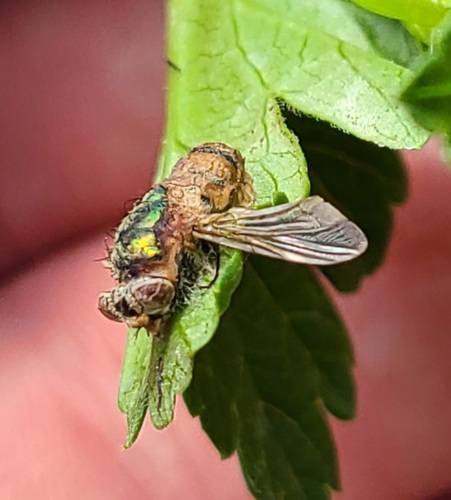
(c) Darin Wiseman, some rights reserved (CC BY-NC-ND), uploaded by Darin Wiseman · cc-by-nc-nd
Schizophora
Sign in to saveAlso known as schizophorans
The Schizophora are a section of true flies containing 78 families, which are collectively referred to as muscoids, although technically the term "muscoid" should be limited to flies in the superfamily Muscoidea; this is an example of informal, historical usage persisting in the vernacular. The section is divided into two subsections, the Acalyptratae and Calyptratae, which are commonly referred to as acalyptrate muscoids and calyptrate muscoids, respectively.
Species
GENUS
- KingdomChromista
- PhylumForaminifera
- ClassGlobothalamea
- OrderLituolida
- FamilySpiroplectamminidae
Schizophora es una sección taxonómica de moscas con 78 familias, a veces llamadas muscoides, aunque este término es más adecuado para la superfamilia Muscoidea. La sección se subdivide en dos subsecciones, Acalyptratae y Calyptratae.[1] El rasgo más característico es la presencia de una estructura especializada usada cuando el adulto emerge del pupario. Es un saco membranoso inflable llamado ptilinio en la cabeza, encima de la base de las antenas. El ptilinio se infla al llenarse de hemolinfa que crea presión y permite romper el pupario a lo largo de una línea más débil. Así el adulto puede salir. Después de la emergencia, el líquido es reabsorbido, el ptilinio se colapsa y el exoesqueleto se cierra. Referencias ↑ Jacobs, C.G.; Rezende, G.L.; Lamers, G.E.; van der Zee, M. (2013). «The extraembryonic serosa protects the insect egg against desiccation». Proceedings of the Royal Society of London B: Biological Sciences 280 (1764): 20131082. PMC 3712428. PMID 23782888. doi:10.1098/rspb.2013.1082.
via GBIF
Museum specimens
- Specimen records
- 624
- With media
- 4
- Family
- Spiroplectamminidae
- Collections
- UAM
- Recorded in
- United States
Wikidata facts
- Instance of
- taxon
- Parent taxon
- Cyclorrhapha
- Image
- Muscid fly - USGS Bee Inventory and Monitoring Laboratory.jpg
Show 5 more facts
- taxon name
- Schizophora
- taxon common name
- 분열이마무리
- topic's main category
- Category:Schizophora
- diel cycle
- diurnality
- Commons category
- Schizophora
Sources (1)
via Wikidata · CC0
~2 min read
Encyclopedic overview
2 sectionsContents
- References
- External links
The Schizophora are a section of true flies containing 78 families, which are collectively referred to as muscoids, although technically the term "muscoid" should be limited to flies in the superfamily Muscoidea; this is an example of informal, historical usage persisting in the vernacular. The section is divided into two subsections, the Acalyptratae and Calyptratae, which are commonly referred to as acalyptrate muscoids and calyptrate muscoids, respectively.
The defining feature of the Schizophora is the presence of a special structure used to help the emerging adult fly break free of the puparium; this structure is an inflatable membranous sac called the ptilinum that protrudes from the face, above the antennae. The inflation of the ptilinum (using fluid hemolymph rather than air) creates pressure along the line of weakness in the puparium, which then bursts open along the seam to allow the adult to escape. When the adult emerges, the fluid is withdrawn, the ptilinum collapses, and the membrane retracts entirely back inside the head. The large, inverted, U-shaped suture in the face through which it came, however, is still quite visible, and the name "Schizophora" ("split-bearers") is derived from this ptilinal or frontal suture. The term was first used by Eduard Becher.
Excerpted from Wikipedia’s “Schizophora” article, available under the CC BY-SA 4.0 licence.