File:Obstruction_ventilation_apnée_sommeil.svg · Wikimedia Commons · See Wikimedia Commons
snoring
Sign in to saveAlso known as zzz
Snoring (or stertor, ) is an abnormal breath sound caused by partially obstructed, turbulent airflow and vibration of tissues in the upper respiratory tract (e.g., uvula, soft palate, base of tongue) which occurs during sleep. It usually happens during inhalations (breathing in).
Snoring is a sound that occurs during sleep when air flows turbulently through a partially blocked upper airway, causing tissues like the soft palate and uvula to vibrate. It typically happens when you breathe in and can indicate that airflow through your respiratory tract is being partially obstructed.
AI-generated from the Wikipedia summary — may contain errors.
Key facts
- Medical condition.caption
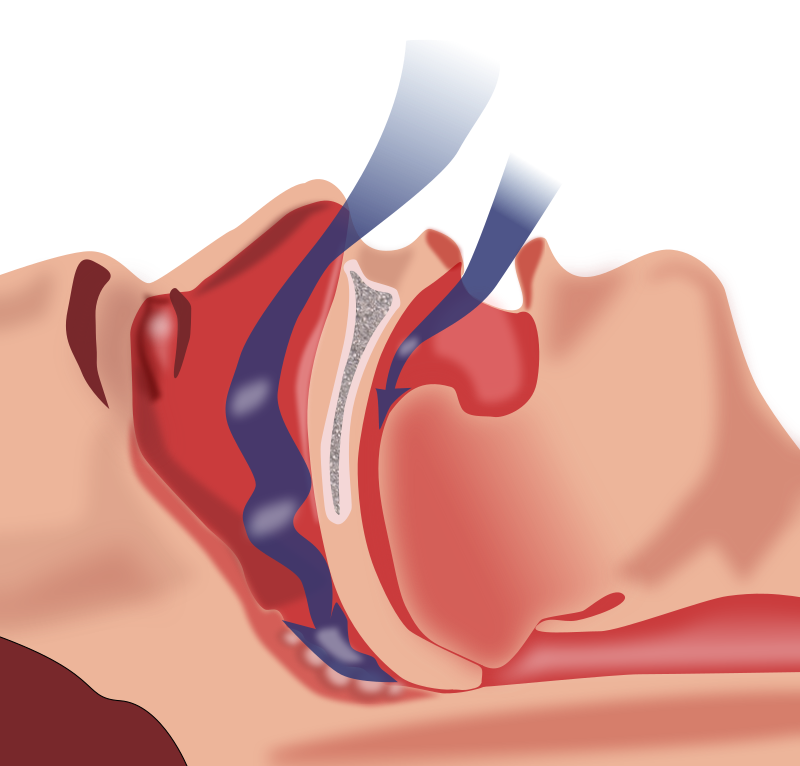
- The soft palate and the base of tongue obstruct the airway in a person sleeping on their back. Snoring is one of the major symptoms of obstructive sleep apnea, although it may occur without any sleep apnea or other medical conditions.
- Medical condition.field
- Otorhinolaryngology, sleep medicine
- Medical condition.name
- Snoring
- Medical condition.image
- File:Obstruction ventilation apnée sommeil.svg
via Wikipedia infobox
Research
10,217 papers- Why and When to Treat Snoring.ReviewOtolaryngologic clinics of North America · 2020Yaremchuk KDOI: 10.1016/j.otc.2020.02.011
- [Snoring analysis methods].ReviewMedicina clinica · 2011Fiz Fernández JA, Solà Soler J, Jané Campos RDOI: 10.1016/j.medcli.2010.04.004
- Biomechanics of snoring.ReviewEndeavour · 1995Huang L, Quinn SJ, Ellis PD et al.DOI: 10.1016/0160-9327(95)97493-r
- [Acoustic information in snoring noises].ReviewHNO · 2017Janott C, Schuller B, Heiser CDOI: 10.1007/s00106-016-0331-7
- Snoring: is a reliable assessment possible?European archives of oto-rhino-laryngology : official journal of the European Federation of Oto-Rhino-Laryngological Societies (EUFOS) : affiliated with the German Society for Oto-Rhino-Laryngology - Head and Neck Surgery · 2020Fischer R, Kuehnel TS, Vielsmeier V et al.DOI: 10.1007/s00405-020-05813-2
- Validation of snoring detection using a smartphone app.Sleep & breathing = Schlaf & Atmung · 2022Chiang JK, Lin YC, Lin CW et al.DOI: 10.1007/s11325-021-02359-3
- Snoring: a source of noise pollution and sleep apnea predictor.Sleep · 2020Sowho M, Sgambati F, Guzman M et al.DOI: 10.1093/sleep/zsz305
- The effects of rapid maxillary expansion on persistent pediatric snoring post-tonsillectomy.ReviewSleep & breathing = Schlaf & Atmung · 2023Bariani RCB, Bigliazzi R, de Moura Guimarães T et al.DOI: 10.1007/s11325-022-02724-w
via PubMed
Wikidata facts
- Instance of
- symptom or sign
- Subclass of
- sound
Show 5 more facts
- ICPC 2 ID
- R04
- Commons category
- Snore
- NCI Thesaurus ID
- C116315
- health specialty
- otolaryngology
via Wikidata · CC0
~34 min read
Encyclopedic overview
43 sectionsContents
- Classification
- Distinguishing stertor and stridor
- Mechanism
- Causes
- Nasal cavity
- Adenotonsillar hypertrophy
- Mouth
- Mouth breathing
- Retrognathia
- Pharynx
- Tongue
- Larynx and laryngopharynx
- Obstructive sleep apnea
- Obesity
- Alcohol
- Muscle relaxants
- Diet
- Pregnancy
- Hereditary factors
- Possible consequences
- For sleeping partner
- Cognitive and psychological
- Cardiovascular disease
- Headaches
- Gastroesophageal reflux disease
- Sleep bruxism
- Dry mouth
- Other
- Diagnosis
- Treatment
- Lifestyle modification
- Nasal strips and dilators
- Orthopedic pillows
- Medications
- Myofunctional therapy (oropharyngeal exercises)
- Dental appliances
- Orthodontic treatment
- Positive airway pressure
- Surgery
- Epidemiology
- Society and culture
- References
- External links
Snoring (or stertor, ) is an abnormal breath sound caused by partially obstructed, turbulent airflow and vibration of tissues in the upper respiratory tract (e.g., uvula, soft palate, base of tongue) which occurs during sleep. It usually happens during inhalations (breathing in).
Primary snoring is snoring without any associated sleep disorders and usually without any serious health effects. It is usually defined as apnea–hypopnea index score or respiratory disturbance index score less than 5 events per hour (as diagnosed with polysomnography or home sleep apnea test) and lack of daytime sleepiness.
Excerpted from Wikipedia’s “snoring” article, available under the CC BY-SA 4.0 licence.