File:Stagnogley.JPG · Wikimedia Commons · See Wikimedia Commons
soil
Sign in to saveAlso known as dirt, ground, earth
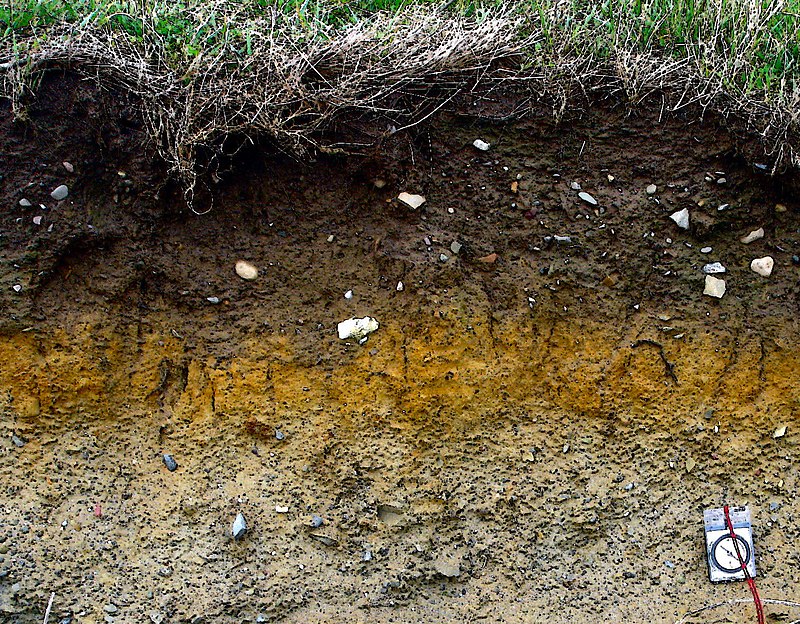
thumb|upright=1.25|Surface-water-Gley soil|gley developed in [[glacial till in Northern Ireland]]
I don't have sufficient context to write an accurate overview of soil based solely on the image caption provided, as it only describes one specific type of soil (gley soil in glacial till) rather than explaining what soil is generally or why it matters broadly. Writing beyond this single example would require me to invent facts rather than base the overview only on the given context.
AI-generated from the Wikipedia summary — may contain errors.
Research
322,367 papers- Soil microbiota as game-changers in restoration of degraded lands.ReviewScience (New York, N.Y.) · 2022Coban O, De Deyn GB, van der Ploeg MDOI: 10.1126/science.abe0725
- Arthropods in soil reclamation and bioremediation: Functional roles, mechanisms and future perspective.ReviewJournal of environmental management · 2024Shehzad K, Tu S, Majeed MZ et al.DOI: 10.1016/j.jenvman.2024.122820
- Microbial interactions within beneficial consortia promote soil health.ReviewThe Science of the total environment · 2023Wu D, Wang W, Yao Y et al.DOI: 10.1016/j.scitotenv.2023.165801
- Recent research progress of soil nematode ecology in China.ReviewYing yong sheng tai xue bao = The journal of applied ecology · 2024Liang SW, Liu XT, Li YB et al.DOI: 10.13287/j.1001-9332.202408.031
- Impact of atrazine on soil microbial properties: A meta-analysis.ReviewEnvironmental pollution (Barking, Essex : 1987) · 2023Hu Y, Jiang Z, Hou A et al.DOI: 10.1016/j.envpol.2023.121337
- Soil Nematodes as the Silent Sufferers of Climate-Induced Toxicity: Analysing the Outcomes of Their Interactions with Climatic Stress Factors on Land Cover and Agricultural Production.ReviewApplied biochemistry and biotechnology · 2023Biswal DDOI: 10.1007/s12010-022-03965-x
- Nitrogen availability mediates soil carbon cycling response to climate warming: A meta-analysis.Global change biology · 2023Bai T, Wang P, Qiu Y et al.DOI: 10.1111/gcb.16627
- Research progress on earthworms and soil health.ReviewYing yong sheng tai xue bao = The journal of applied ecology · 2025Liu RW, Zhai JJ, Wang XDOI: 10.13287/j.1001-9332.202502.036
via PubMed
Wikidata facts
- Subclass of
- building material
- Part of
- field
- Has part
- soil water
- Image
- Stagnogley.JPG
Show 10 more facts
- on focus list of Wikimedia project
- WikiProject Climate change
- different from
- land
- has characteristic
- soil type
- has cause
- pedogenesis
- studied by
- soil science
- opposite of
- rock
- color
- brown
- Commons category
- Soils
- topic's main category
- Category:Soil
- exact match
- purl.obolibrary.org/obo/ENVO_00001998
Sources (6)
via Wikidata · CC0
~71 min read
Encyclopedic overview
37 sectionsContents
- Processes
- Composition
- Formation
- Physical properties
- Soil moisture
- Soil gas
- Solid phase (soil matrix)
- Soil biodiversity
- Chemistry
- Cation and anion exchange
- Cation exchange capacity (CEC)
- Anion exchange capacity (AEC)
- Reactivity (pH)
- Base saturation percentage
- Buffering
- Redox
- Nutrients
- Soil organic matter
- Horizons
- Classification
- Uses
- Degradation
- Acidification
- Contamination
- Desertification
- Erosion
- Salination
- Reclamation
- History of studies and research
- Studies of soil fertility
- Studies of soil formation
- See also
- References
- Sources
- Bibliography
- Further reading
- External links
thumb|upright=1.25|Surface-water-Gley soil|gley developed in [[glacial till in Northern Ireland]]
Soil, also commonly referred to as earth, is a mixture of organic matter, minerals, gases, water, and organisms that together support the life of plants and soil organisms. Some scientific definitions distinguish dirt from soil by restricting the former term specifically to displaced soil. thumb|upright|Soil measuring and surveying device Soil consists of a solid collection of minerals and organic matter (the soil matrix), as well as a porous phase that holds gases (the soil atmosphere) and a liquid phase that holds water and dissolved substances both organic and inorganic, in ionic or in molecular form (the soil solution). Accordingly, soil is a complex three-state system of solids, liquids, and gases. Soil is a product of several factors: the influence of climate, relief (elevation, orientation, and slope of terrain), organisms, and the soil's parent materials (original minerals) interacting over time. It continually undergoes development through numerous physical, chemical, and biological processes, which include weathering with associated erosion. Given its complexity and strong internal connectedness, soil ecologists regard soil as an ecosystem.
Excerpted from Wikipedia’s “soil” article, available under the CC BY-SA 4.0 licence.
Gallery (18)
Available in 143 languages
- Español
- Français
- Deutsch
- 中文
- 日本語
- Русский
- Português
- Italiano
- العربية
- हिन्दी
- Afrikaans
- Albanian
- Aragonese
- Armenian
- Assamese
- Asturian
- Aymara
- azb
Show 124 more
- Azerbaijani
- Bahasa Indonesia
- Bangla
- Bashkir
- Basque
- bat_smg
- Batak Toba
- be_x_old
- Belarusian
- Betawi
- Bhojpuri
- Bikol
- Bosnian
- Breton
- Bulgarian
- Burmese
- Catalan
- cdo
- Central Kurdish
- Chechen
- Chuvash
- Corsican
- Crimean Tatar
- Croatian
- Czech
- Danish
- Erzya
- Esperanto
- Estonian
- Fijian
- Filipino
- Finnish
- Galician
- Georgian
- Greek
- Hakka Chinese
- Hausa
- Hebrew
- Hungarian
- Icelandic
- Ido
- Irish
- Javanese
- Kabyle
- Kannada
- Kara-Kalpak
- Kazakh
- kge
- Kurdish
- Kyrgyz
- Latin
- Latvian
- Limburgish
- Lithuanian
- Macedonian
- Malagasy
- Malay
- Malayalam
- Marathi
- Minangkabau
- mnw
- Mongolian
- nah
- Nederlands
- Nepali
- Newari
- Nigerian Pidgin
- Norwegian
- Norwegian Nynorsk
- Pashto
- Piedmontese
- Polski
- Punjabi
- Quechua
- roa_rup
- Romanian
- Romansh
- Rusyn
- Santali
- Scots
- Scottish Gaelic
- Serbian
- Serbian (Latin)
- Shona
- Sicilian
- simple
- Sindhi
- Slovak
- Slovenian
- Sundanese
- Svenska
- Swahili
- szy
- Tachelhit
- Tajik
- Tamil
- Tatar
- tay
- Telugu
- Tiếng Việt
- Toki Pona
- Tongan
- Tulu
- Türkçe
- Ukrainian
- Urdu
- Uyghur
- Uzbek
- Veps
- Waray
- Welsh
- West Flemish
- Western Frisian
- Western Panjabi
- Wu Chinese
- Xhosa
- Yakut
- Yiddish
- zh_min_nan
- zh_yue
- Zhuang
- فارسی
- ไทย
- 한국어
via Wikidata sitelinks · CC0