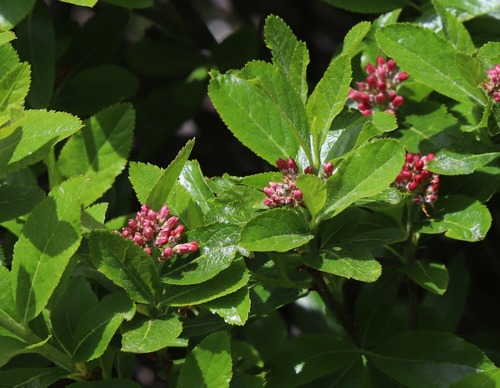
(c) Luca Boscain, some rights reserved (CC BY-NC), uploaded by Luca Boscain · cc-by-nc
Sorbus chamaemespilus
Sign in to saveAlso known as false medlar, dwarf whitebeam
Chamaemespilus is a genus of shrubs in the family Rosaceae. It is monotypic, being represented by the single species Chamaemespilus alpina, commonly known as false medlar or dwarf whitebeam. It is native to the mountains of central and southern Europe, from the Pyrenees east through the Alps to the Carpathians and the Balkans, growing at elevations of up to 2500 m.
In the Vinony graph
Within Vinony's link graph, Sorbus chamaemespilus is referenced by 24 other articles, and connects out to plant, flower and Alps.
Vinony files it under Flora of France, Flora of the Alps and Flora of the Carpathians.
Its subject is documented across 24 Wikipedia language editions.
Species
Least ConcernFalse Medlar
SPECIES
- KingdomPlantae
- PhylumTracheophyta
- ClassMagnoliopsida
- OrderRosales
- FamilyRosaceae
Multimedia w Wikimedia Commons Jarząb nieszpułkowy[3] (Sorbus chamaemespilus (L.) Crantz) – gatunek rośliny z rodziny różowatych (Rosaceae). Spis treści 1 Rozmieszczenie geograficzne 2 Morfologia 3 Biologia i ekologia 4 Zagrożenia 5 Przypisy Rozmieszczenie geograficzne Występuje w południowej, środkowej i wschodniej Europie[4]. Rośnie tam głównie w górach, sięgając do wysokości 2000 m[5]. W Polsce jest bardzo rzadki, występuje wyłącznie w Tatrach[6]. Podany tutaj został z 5 stanowisk w Tatrach Wysokich i 13 w Tatrach Zachodnich: Furkaska, Wielkie Koryciska, Małe Koryciska, Kominiarski Wierch, okolice Iwaniackiej Przełęczy, Jasiowe Turnie, Jatki nad Doliną Strążyską, Dolina Strążyska, grzbiet nad Końskim Żlebem, Suchy Wierch, Sarnia Skała, Krokiew, Dolina Olczyska, Jarząbczy Wierch, Mała Koszysta, powyżej Doliny Roztoki („ku Krzyżnemu”), Dolina Pięciu Stawów Polskich, powyżej wodospadu Siklawa, Niżnia Kopa, Urwany Żleb nad Morskim Okiem[6]. Morfologia Pokrój Średnio rozgałęziony krzew o wysokości do 2 m, wyjątkowo do 3 m[5]. Młode pędy są zazwyczaj owłosione. Zwykle wytwarza odrosty. Liście Eliptyczne do podługowatych, skórzaste i sztywne, o piłkowanych brzegach. Mają długość 3-7 cm
via GBIF · IUCN · Kew POWO
Museum specimens
- Specimen records
- 353
- With media
- 315
- Family
- Rosaceae
- Collections
- CAS, MNHN, MOR, MWI
- Recorded in
- Switzerland, France, Italy, Spain, United States, Netherlands, Yugoslavia (Former), Austria
Wikidata facts
Show 8 more facts
- taxon rank
- species
- taxon name
- Sorbus chamaemespilus
- taxon common name
- Zwerg-Mehlbeere
- Commons gallery
- Chamaemespilus alpina
- IUCN conservation status
- Least Concern
- short name
- S. chamaemespilus
- Commons category
- Chamaemespilus alpina
Sources (2)
via Wikidata · CC0
~2 min read
Encyclopedic overview
5 sectionsContents
- Description
- Taxonomy
- Gallery
- References
- External links
Chamaemespilus is a genus of shrubs in the family Rosaceae. It is monotypic, being represented by the single species Chamaemespilus alpina, commonly known as false medlar or dwarf whitebeam. It is native to the mountains of central and southern Europe, from the Pyrenees east through the Alps to the Carpathians and the Balkans, growing at elevations of up to 2500 m.
==Description== Chamaemespilus alpina is a deciduous shrub growing to 2–3 m tall. The leaves are spirally arranged, oval-elliptic, 3–7 cm long, with an acute apex and a serrated margin; they are green on both sides, without the white felting found on most whitebeams. The flowers are pink, with five forward-pointing petals 5–7 mm long; they are produced in corymbs 3–4 cm diameter. The fruit is an oval red pome 10–13 mm diameter.
Excerpted from Wikipedia’s “Sorbus chamaemespilus” article, available under the CC BY-SA 4.0 licence.