
Sudan
Sign in to saveAlso known as Republic of the Sudan, as-Sūdān, sd, North Sudan, the Sudan, Republic of Sudan, SUD, Soudan
Sudan, officially the Republic of the Sudan, is a country in Northeast Africa. It borders the Central African Republic to the southwest, Chad to the west, Libya to the northwest, Egypt to the north, the Red Sea to the east, Eritrea and Ethiopia to the southeast, and South Sudan to the south. Sudan has a population of 51.8 million people as of 2025 and occupies 1,886,068 square kilometres (728,215 square miles), making it Africa's third-largest country by area. Sudan's capital and most populous city is Khartoum.
OverviewAI-generated
Sudan, officially the Republic of the Sudan, is a sovereign state and federal republic located in Northern Africa. Its capital is Khartoum, and it shares borders with South Sudan, Chad, Central African Republic, and Ethiopia. The country’s highest point is Deriba Caldera. It is a member of the United Nations, African Union, League of Arab States, and Organisation of Islamic Cooperation.
The official languages are Arabic and English. The currency consists of the Sudanese pound and Sudanese dinar, and its top-level Internet domain is .sd. Sudan is located in the UTC+03:00 and UTC+02:00 time zones. Its population is recorded at 51,662,000 and 50,448,963, with an area of 1,886,068. The head of state has included Omar al-Bashir, Ahmed Awad Ibn Auf, and Abdel Fattah al-Burhan.
Synthesized by Vinony from 67 facts across 9 sources: Wikidata, REST Countries, Openweathermap, Open Meteo, World Bank, OpenStreetMap, PubMed, Vinony graph, Geo. Generated from structured data (not the Wikipedia text) and checked against those facts — may still contain errors.
In the Vinony graph
Vinony catalogs Sudan in its Countries collection (215 entries).
Vinony's link graph records 15,085 inbound references to Sudan, and connects out to Sennar Sultanate, Sudanese transition to democracy and Abyei.
The entry is geolocated on the map in city, across 6 mapped points.
Vinony files it under 1956 establishments in Africa, Countries and territories where Arabic is an official language and Countries and territories where English is an official language.
Weather now
cached 20h ago7-day forecast
via Open-Meteo
Country
- Capital
- Khartoum
- Population
- 51,662,000
- Region
- Africa · Northern Africa
- Demonym
- Sudanese
- Currencies
- SDG (ج.س)
- Languages
- Arabic, English
- Calling code
- +249
- Drives on
- Right
- Gini
- 34.2 (2014)
- FIFA code
- SDN
- TLD
- .sd
- Timezones
- UTC+03:00
- Borders
- CAF, TCD, EGY, ERI, ETH, LBY, SSD
via REST Countries
Indicators · World Bank
- GDP
- $49.7B(2024)
- Population
- 50,448,963(2024)
- Life expectancy
- 66.5 yrs(2024)
- Unemployment
- 7.5 %(2022)
- Urban population
- 34.9 %(2024)
- Internet users
- 18.6 %(2017)
- Forest area
- 9.6 %(2023)
- Renewable energy
- 61 %(2021)
via World Bank Open Data · CC BY 4.0
Wikipedia views (30d)
120,021 totalvia Wikimedia Pageviews API
Key facts
- Country.conventional_long_name
- Republic of the Sudan
- Country.common_name
- Sudan
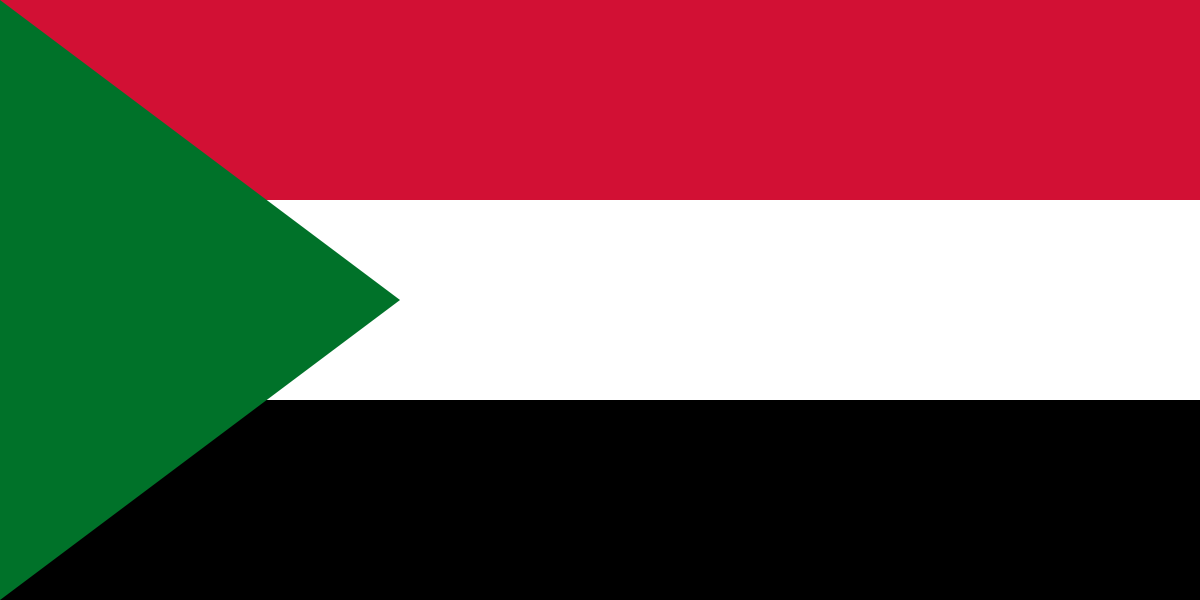
- Country.image_flag
- Flag of Sudan.svg
- Country.flag_type
- Flag
- Country.religion_year
- 2022
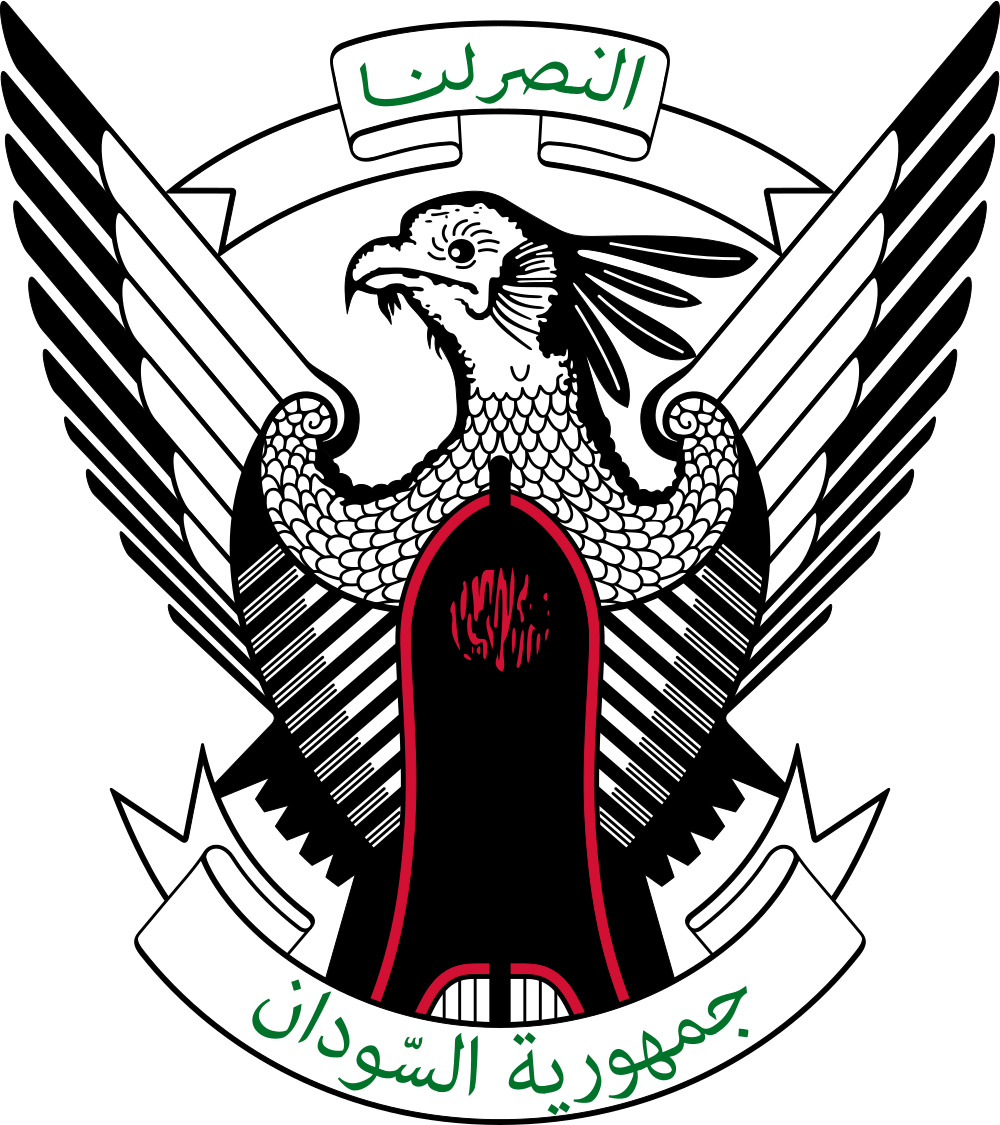
- Country.image_coat
- Emblem of Sudan (gold).svg
- Country.symbol_type
- Emblem
- Country.national_motto
- "Victory is ours"
- Country.national_anthem
- "We are Soldiers of God, Soldiers of the Homeland"
- Country.image_map
- File:Sudan (orthographic projection) highlighted.svg
- Country.capital
- Khartoum
- Country.largest_city
- Khartoum
- Country.government_type
- Federal republic under a military junta
- Country.leader_title1
- President of the Transitional Sovereignty Council
- Country.leader_name1
- Abdel Fattah al-Burhan
- Country.leader_title2
- Vice-President of the Transitional Sovereignty Council
- Country.leader_name2
- Malik Agar
- Country.leader_title3
- Prime Minister
via Wikipedia infobox
Research
21,108 papers- Lung Cancer in Sudan.Journal of thoracic oncology : official publication of the International Association for the Study of Lung Cancer · 2022Elhassan MMA, Mohamedani AA, Mohamed SAH et al.DOI: 10.1016/j.jtho.2021.12.002
- Cholera in Sudan.The Lancet. Infectious diseases · 2023Samarasekera UDOI: 10.1016/S1473-3099(23)00699-0
- COVID-19 in Sudan.Journal of infection in developing countries · 2021Ahmed A, Mohamed NS, El-Sadig SM et al.DOI: 10.3855/jidc.14520
- Cancer initiatives in Sudan.ReviewAnnals of oncology : official journal of the European Society for Medical Oncology · 2006Hamad HMDOI: 10.1093/annonc/mdl985
- Sudan's threatened health and humanitarian crisis.Lancet (London, England) · 2019The LancetDOI: 10.1016/S0140-6736(19)30074-1
- Famine threatens Sudan.BMJ (Clinical research ed.) · 2024Shepherd ADOI: 10.1136/bmj.q255
- Progress and challenges in implementing non-communicable disease policies in Sudan.ReviewHealth research policy and systems · 2023Elhadi YAMDOI: 10.1186/s12961-023-01079-2
- Sudan.Department of State publication. Background notes series · 1985United States. Department of State. Bureau of Public Affairs
via PubMed
Wikidata facts
- Instance of
- human settlement
- Part of
- Middle East and North Africa
- Official name
- Republic of the Sudan
- Demonym
- Súdánach
- Country
- Sudan
- Contains
- River Nile
- Continent
- Africa
- Capital
- Khartoum
- Official language
- English language
- Currency
- Sudanese dinar
- Population
- 48945000
- Area
- 1840687
- Head of government
- Mohamed Tahir Ayala
- Head of state
- Abdel Fattah al-Burhan
- Form of government
- federal republic
- Legislature
- National Legislature
- Shares border with
- Middle East
- Highest point
- Deriba Caldera
- Official website
- www.sudan.gov.sd
- Image
- Western Deffufa - Kerma.jpg
- Life expectancy
- 66
- Nominal GDP
- 51662241775
- Unemployment rate
- 15
Show 56 more facts
- Calling code
- +249
- Mains voltage
- 230
- Motto
- النصر لنا
- Flag
- flag of Sudan
- Coat of arms
- Emblem of Sudan
- top-level Internet domain
- .sd
- Commons category
- Sudan
- topic's main category
- Category:Sudan
- category for people who died here
- Category:Deaths in Sudan
- category for people born here
- Category:Births in Sudan
- diplomatic relation
- North Korea
- topic's main Wikimedia portal
- Portal:Sudan
- lowest point
- Red Sea
- mobile country code
- 634
- driving side
- right
- geography of topic
- Geography of Sudan
- emergency phone number
- 999
- age of majority
- 18
- trunk prefix
- 0
- Commons gallery
- السودان / Sudan
- ethnic group
- Fulbe people
- located in/on physical feature
- North Africa
- total fertility rate
- 4.353
- maritime identification digits
- 662
- on focus list of Wikimedia project
- Wikipedia:Vital articles/Level/4
- native label
- السودان
- inception
- 1956-01-01
- central bank
- Bank of Sudan
- category for films shot at this location
- Category:Films shot in Sudan
- language used
- El Hugeirat
- literacy rate
- 60.7
- culture
- culture of Sudan
- VAT rate
- 17
- BTI Status Index
- 2.45
- BTI Governance Index
- 3.05
- economy of topic
- economy of Sudan
- demographics of topic
- demographics of Sudan
- madhhab
- Malikism
- Democracy Index
- 2.54
- replaces
- Anglo-Egyptian Sudan
- P8168
- Red Baron
- Human Development Index
- 0.508
- P11012
- barcode
- hashtag
- Sudan
- Happy Planet Index score
- 39.6
- Gini coefficient
- 34.2
- Inequality-adjusted Human Development Index
- 0.336
- P12749
- leet
- birth rate
- 33.027
- male population
- 23420005
- death rate
- 6.677
- rural population
- 30020115
- female population
- 23454198
- urban population
- 16854089
- Unicode character
- 🇸🇩
Sources (15)
via Wikidata · CC0
Travel guide
See
thumb|The ruined ancient city of Musawwarat is one of the country's most important archaeological sites. In Khartoum/Omdurman you must see the Sufi ritual of drumming and trance dancing, about one hour before sunset and Friday prayer. These rituals take place northwest of the Nile river in Omdurman. Very welcoming, festive atmosphere.
A walk around Tuti Island, situated in the middle of the confluence of the two branches of the Nile, can take about four hours. The less populated northern section is pretty, with its shady lanes, and irrigated fields, and there is a great little coffee stall under a tree on the western side.
The pyramids of Meroe are 2.5 hours north of Khartoum (leave early to avoid Khartoum traffic). On the same route visit the sites of Naqa and Musawarat. Permits are required before visiting the sites. You pay at each site (which may depend on how well your driver gets along with the guards). Naqa and Musawarat are signposted beside the Nile Petrol station (about 1 hour 15 minutes north of Khartoum) and the track is fairly clear but sandy. It is probably good to carry a GPS to avoid getting lost in the bush.
After 16:00 take a good coffee at the Burj Al-Fatih - also known as Corinthia hotel -, with high altitude view over Khartoum, the Nile, and Omdurman, and stay to watch the sunset. Worthwhile.
About 1½ hours south of Khartoum visit the dam. Just north of the dam (downstream) the Nile is also very wide; on Friday/Saturday the area is popular is day visi…
Drink
thumbnail|Traditional Sudanese coffee jug Islam is the official religion of the country, and alcohol has been banned since sharia was imposed in the 1980s. Sudanese people frequently drink tea, usually sweet and black. Sudan also has some refreshing drinks such as karkade (hibiscus) which can be served hot or chilled, aradeeb (tamarind) and gongleiz (made with the baobab fruit). The local energy drink is a carbohydrate-laden drink known as madeeda. There are several types of madeeda, made with dates, dukhun (millet) or other ingredients blended with fresh milk, and usually heavily sweetened with sugar, though reduced-sugar versions may be available if you ask. Sudanese coffee is available in most souks and is similar to Turkish style coffee; thick and strong, sometimes flavoured with cardamom or ginger with a powerful kick and altogether delicious. Not to be taken before bed though if you want an undisturbed night's sleep!
However, while alcohol is strictly illegal in the Muslim north, locally-brewed alcohol is widely available in various forms and at various degrees of potency. A local beer (merissa) brewed from sorghum or millet is cloudy, sour and heavy and likely to be brewed with untreated water and will almost certainly lead to the 'Mahdi's revenge' (the Sudanese version of 'Delhi belly'). Aragi is a pure spirit distilled from sorghum or in its purest form, dates. It is potent and should be treated with respect, and beware that it is sometimes contaminated with the lik…
Stay safe
Safety in Sudan has many dimensions. On one hand, theft is almost unheard of, you'll never be robbed in the street and people will go to great lengths to ensure your well-being. On the other hand, Sudan has a long history of conflict, the government is not particularly open or accountable, and under the surface corruption is rife.
Sudan is an Islamic country and consumption of alcohol is illegal. Extra-marital relations, including having a guest in a hotel room, is illegal, with severe penalties.
Stay healthy
thumb|Somewhere in the Upper Nile region Sudan is a malarial region, so be especially cautious during the rainy season. Poisonous snakes, spiders and scorpions are common in the southern areas.
Be cautious when drinking water. Make sure you choose bottled water, or use purifying tablets. Also, avoid any fruit drinks, as they are obviously made with the local water. And remember, that any ice cubes (for example, in sodas) are only frozen local water.
On long trips (particularly during the hot season) on public transport it is often impossible - or would be expensive - to carry the amount of bottled water you need, and it may be scarce at certain remote stops. Therefore, keep plenty of your chosen means of purification close at hand (not in your luggage strapped to the roof!). Sanitation in some areas is nonexistent, so wash your hands frequently.
Food from streetside vendors is generally fine if it is being prepared and served frequently. Empty restaurants and street cafes often indicate that food is standing uncovered and unrefrigerated for hours at a time.
Sudanese currency is notoriously dirty, and even the Sudanese handle small bills as little as possible. A hint would be to carry antibacterial wipes or gel in your luggage to treat your hands after handling filthy currency notes or shaking too many unwashed hands.
Sudan reported Ebola outbreaks in 2004 and it is not advised to take local hospital treatments unless there is a real urgency. If you have malaria-like symp…
Respect
In general, the Sudanese are hospitable, sociable people. They consider it shameful to give someone a poor welcome, so you can expect to be treated with immense respect as a tourist.
Connect
Internet and telephone services remain unreliable and may be blocked or suspended at short notice (Apr 2022).
Travel guide from Wikivoyage (CC BY-SA 4.0)
~40 min read
Encyclopedic overview
75 sectionsContents
- Etymology
- History
- Prehistoric Sudan (before c. 8000 BC)
- Kerma culture (2500–1500 BC)
- Egyptian Nubia (1504–780 BC)
- Kingdom of Kush (c. 780 BC–350 AD)
- Medieval Christian Nubian kingdoms (c. 350–1500)
- Islamic kingdoms of Sennar and Darfur (c. 1500–1820)
- Turco-Egyptian Sudan (1820–1885)
- The Mahdist State and the Battle of Omdurman (1881–1898)
- Anglo-Egyptian Sudan (1899–1956)
- Republic of Sudan (1956–1969)
- Independence and the first democratic period
- The military regime of Ibrahim Abboud (1958–1964)
- The October Revolution and the Second Parliamentary Era (1964–1969)
- Democratic Republic of the Sudan (1969–1985)
- The 1969 coup and the crisis with the left
- The Addis Ababa Agreement and economic restructuring
- National Reconciliation and the September Laws
- Second civil war and the 1985 Intifada
- Third democratic period and the military coup (1985–1989)
- Transitional council and the 1986 elections
- Civilian failure and war escalation
- 1989 coup d'état
- A new coup and al-Bashir era (1989–2019)
- Consolidation of power and Islamic radicalism (1989–1999)
- Civil War resolution, Darfur, and regional conflicts (2000–2011)
- Partition, economic crisis, and the fall of Bashir (2011–2019)
- Fall of al-Bashir and ongoing political instability (2019–present)
- Revolution, transition, and the 2021 coup
- 2023–present: Civil war and humanitarian crisis
- Geography
- Climate
- Environmental issues
- Wildlife
- Government and politics
- Legal system and Islamic law
- Pre-colonial and colonial pluralism
- Post-independence and the September Laws
- Codification under al-Bashir
- Post-revolution secularization
- Administrative divisions
- Regional bodies
- Disputed areas and zones of conflict
- Foreign relations
- Independence and the Cold War (1956–1989)
- Islamist era and international isolation (1989–2019)
- Transition and recent conflicts (2019–present)
- International organisations in Sudan
- Military
- Human rights
- Darfur
- Freedom of speech
- Economy
- Science and research
- Demographics
- Ethnic groups
- Urban areas
- Languages
- Religion
- Health
- Education
- Culture
- Media
- Music
- Cinema
- Clothing
- Sport
- See also
- Notes
- Language notes
- General notes
- Citations
- Bibliography
- External links
Sudan, officially the Republic of the Sudan, is a country in Northeast Africa. It borders the Central African Republic to the southwest, Chad to the west, Libya to the northwest, Egypt to the north, the Red Sea to the east, Eritrea and Ethiopia to the southeast, and South Sudan to the south. Sudan has a population of 51.8 million people as of 2025 and occupies 1,886,068 square kilometres (728,215 square miles), making it Africa's third-largest country by area. Sudan's capital and most populous city is Khartoum.
The area that is now Sudan witnessed the Khormusan (c. 40000–16000 BC), Halfan culture (c. 20500–17000 BC), Sebilian (c. 13000–10000 BC), Qadan culture (c. 13000–9000 BC), the war of Jebel Sahaba, the earliest known war in the world, around 11500 BC, A-Group culture (c. 3800–3100 BC), Kingdom of Kerma (c. 2500–1500 BC), the Egyptian New Kingdom (c. 1500–1070 BC), and the Kingdom of Kush (c. 785 BC – 350 AD). After the fall of Kush, the Nubians formed the three Christian kingdoms of Nobatia, Makuria, and Alodia. Between the 14th and 15th centuries, most of Sudan was gradually settled by Arab nomads. From the 16th to the 19th centuries, central and eastern Sudan were dominated by the Funj sultanate, while Darfur ruled the west and the Ottomans the east.
Excerpted from Wikipedia’s “Sudan” article, available under the CC BY-SA 4.0 licence.
Gallery (59)
On the map
6 mapped locations
Available in 270 languages
- Español
- Français
- Deutsch
- 中文
- 日本語
- Русский
- Português
- Italiano
- العربية
- हिन्दी
- Abkhazian
- abstract
- Achinese
- Adyghe
- Afrikaans
- Albanian
- Albanian
- Amharic
Show 251 more
- ami
- Angika
- Aragonese
- Aramaic
- Armenian
- Arpitan
- Assamese
- Asturian
- Aymara
- azb
- Azerbaijani
- Bahasa Indonesia
- Balinese
- Bambara
- Bangla
- Banjar
- Bashkir
- Basque
- bat_smg
- Bavarian
- be_x_old
- Belarusian
- Betawi
- Bhojpuri
- Bikol
- Bishnupriya
- Bislama
- Bosnian
- Breton
- btm
- Bulgarian
- Buriat
- Burmese
- Catalan
- cbk_zam
- cdo
- Cebuano
- Central Kurdish
- Chechen
- Chuvash
- Cornish
- Corsican
- Crimean Tatar
- Croatian
- Czech
- dag
- Danish
- Dinka
- Divehi
- dty
- Dzongkha
- Egyptian Arabic
- Erzya
- Esperanto
- Estonian
- Ewe
- Extremaduran
- Faroese
- Fiji Hindi
- Filipino
- Finnish
- fiu_vro
- Frafra
- Fula
- Gagauz
- Galician
- Ganda
- gcr
- Georgian
- Gilaki
- Goan Konkani
- gpe
- Greek
- Guarani
- Gujarati
- Haitian Creole
- Hakka Chinese
- Hausa
- Hebrew
- Hungarian
- hyw
- Iban
- Icelandic
- Ido
- Igbo
- Iloko
- Inari Sami
- Ingush
- Interlingua
- Interlingue
- Irish
- Jamaican Creole English
- Javanese
- Kabardian
- Kabyle
- kai
- Kannada
- Kanuri
- Kara-Kalpak
- Karachay-Balkar
- Kashmiri
- Kashubian
- Kazakh
- kbp
- kge
- Khmer
- Kikuyu
- Kinyarwanda
- Kongo
- Kotava
- Kurdish
- Kyrgyz
- Ladino
- Latin
- Latvian
- Lezghian
- Ligurian
- Limburgish
- Lingala
- Lingua Franca Nova
- Lithuanian
- lld
- Lojban
- Lombard
- Low German
- Lower Sorbian
- Luxembourgish
- Macedonian
- Madurese
- Malagasy
- Malay
- Malayalam
- Maltese
- Manipuri
- Manx
- Māori
- Marathi
- Mazanderani
- Minangkabau
- Mingrelian
- Mirandese
- Moksha
- Mongolian
- Moroccan Arabic
- Navajo
- nds_nl
- Nederlands
- Nepali
- Newari
- Northern Frisian
- Northern Sami
- Northern Sotho
- Norwegian
- Norwegian Nynorsk
- Novial
- nup
- Nyanja
- Obolo
- Occitan
- Old English
- olo
- Oromo
- Ossetic
- Pampanga
- Papiamento
- Pashto
- Pennsylvania German
- Picard
- Piedmontese
- Polski
- Punjabi
- Quechua
- rki
- roa_tara
- Romanian
- Romansh
- Rusyn
- Samoan
- Sango
- Sanskrit
- Santali
- Sardinian
- Saterland Frisian
- Scots
- Scottish Gaelic
- Serbian
- Serbian (Latin)
- Shan
- Shona
- Sicilian
- Silesian
- simple
- Sindhi
- Sinhala
- skr
- Slovak
- Slovenian
- Somali
- Southern Sotho
- Standard Moroccan Tamazight
- Sundanese
- Svenska
- Swahili
- Swati
- szy
- Tajik
- Talysh
- Tamil
- Taroko
- Tatar
- tay
- Telugu
- Tibetan
- Tiếng Việt
- Tigrinya
- Toki Pona
- Tsonga
- Tumbuka
- Türkçe
- Turkmen
- Tyap
- Udmurt
- Ukrainian
- Upper Sorbian
- Urdu
- Uyghur
- Uzbek
- Venetian
- Veps
- Volapük
- Waray
- Welsh
- West Flemish
- Western Frisian
- Western Mari
- Western Panjabi
- Wolof
- Wu Chinese
- Yakut
- Yiddish
- Yoruba
- Zaza
- Zeelandic
- zh_classical
- zh_min_nan
- zh_yue
- Zhuang
- Zulu
- فارسی
- ไทย
- 한국어
via Wikidata sitelinks · CC0