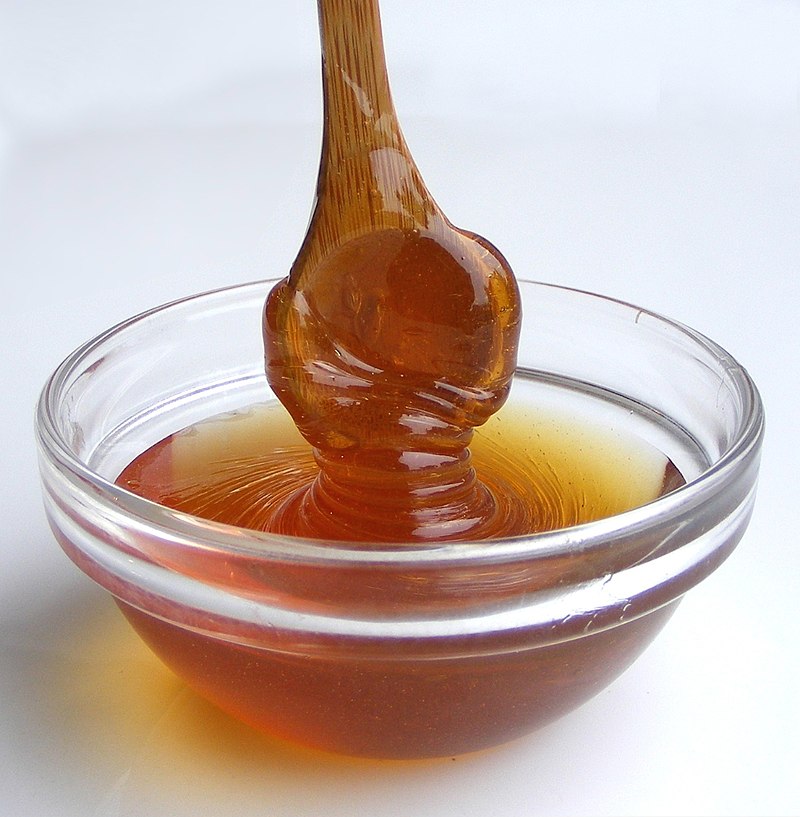
File:Maltose_syrup.jpg · Wikimedia Commons · See Wikimedia Commons
syrup
Sign in to saveAlso known as sirup, simple syrup, bartender's syrup
thumb|upright=1.35|Maltose syrup
I don't have sufficient context to write an accurate overview. The context provided only shows a caption referencing "Maltose syrup" with an image specification, but contains no descriptive information about what syrup is or why it matters. I cannot write the requested overview without inventing facts.
AI-generated from the Wikipedia summary — may contain errors.
Nutrition · Open Food Facts
Typical values per 100 g · averaged across 2,098 products
- Energy
- 269 kcal
- Fat
- 0.1 g
- — of which saturates
- 0.1 g
- Carbohydrates
- 68.4 g
- — of which sugars
- 58.3 g
- Fibre
- 1.7 g
- Protein
- 0.3 g
- Salt
- 0.18 g
via Open Food Facts · ODbL
Wikidata facts
- Subclass of
- condiment
- Has part
- aroma compound
- Material used
- drinking water
- Image
- Maltose syrup.jpg
Show 5 more facts
- Commons category
- Syrups
- topic's main category
- Category:Syrup
- described by source
- Explanatory Dictionary of the Living Great Russian Language
- has characteristic
- viscosity
- fabrication method
- dissolution
Sources (2)
via Wikidata · CC0
~4 min read
Encyclopedic overview
13 sectionsContents
- Types
- Uses
- For beverages
- Simple sugar syrups
- Simple syrup
- Demerara syrup
- Gomme syrup
- Flavored syrup
- Feedstock for fermentation
- Production
- See also
- References
- External links
thumb|upright=1.35|Maltose syrup
In cooking, syrup (less commonly sirup; from , from earlier ; , beverage, wine) is a thick, viscous, liquid condiment consisting primarily of a solution of sugar in water. It typically contains a large amount of dissolved sugars but shows little tendency to deposit crystals. In its concentrated form, its consistency is similar to that of molasses. The viscosity arises from the multiple hydrogen bonds between the dissolved sugar, which has many hydroxyl (OH) groups.
Excerpted from Wikipedia’s “syrup” article, available under the CC BY-SA 4.0 licence.
Gallery (9)
Available in 67 languages
- Español
- Français
- Deutsch
- 中文
- 日本語
- Русский
- Português
- Italiano
- العربية
- Afrikaans
- Albanian
- Armenian
- azb
- Azerbaijani
- Bahasa Indonesia
- Bangla
- Banjar
- Basque
Show 48 more
- be_x_old
- Belarusian
- Betawi
- Bosnian
- Breton
- Bulgarian
- Catalan
- Cheyenne
- Croatian
- Czech
- Danish
- Esperanto
- Estonian
- Finnish
- Galician
- Greek
- Hebrew
- Hungarian
- Ido
- Javanese
- Latin
- Latvian
- Limburgish
- Lithuanian
- Malay
- Mirandese
- Nederlands
- Norwegian
- Norwegian Nynorsk
- Polski
- Romanian
- Serbian
- Serbian (Latin)
- simple
- Somali
- Svenska
- Swahili
- Tiếng Việt
- Türkçe
- Ukrainian
- Welsh
- Western Frisian
- Wu Chinese
- zh_yue
- Zhuang
- فارسی
- ไทย
- 한국어
via Wikidata sitelinks · CC0