
Tanzania
Sign in to saveAlso known as United Republic of Tanzania, tz, United Republic of Tanganyika and Zanzibar, tza, Tanzania, United Republic of
Tanzania, officially the United Republic of Tanzania, is a country in East Africa within the African Great Lakes region. It is bordered by Uganda to the northwest; Kenya to the northeast; the Indian Ocean to the east; Mozambique and Malawi to the south; Zambia to the southwest; and Rwanda, Burundi, and the Democratic Republic of the Congo to the west. According to a 2024 estimate, Tanzania has a population of around 67.5 million, making it the most populous country located entirely south of the equator.
OverviewAI-generated
Tanzania, officially the United Republic of Tanzania, is a sovereign state and republic located in Eastern Africa. It shares borders with Kenya, Uganda, Rwanda, and Burundi. The country’s capital is Dodoma, while Dar es Salaam is also listed as a capital. Its highest point is Mount Kibo. The official languages are Swahili and English, and the currency is the Tanzanian shilling.
The nation has a population of approximately 68 million and covers an area of 947,303 square kilometers. It is a member of the United Nations, the Commonwealth of Nations, the African Union, and the World Trade Organization. Tanzania observes the UTC+03:00 time zone, also known as East Africa Time. Its top-level Internet domain is .tz.
The country contains administrative entities such as the Mwanza, Shinyanga, Dar es Salaam, and Mbeya regions. It is named after Tanganyika and the Zanzibar Islands. The national anthem is Mungu ibariki Afrika. Forest area comprises about 50 percent of the land, and renewable energy accounts for 78.3 percent of its energy mix.
Synthesized by Vinony from 68 facts across 9 sources: Wikidata, REST Countries, Open Meteo, Openweathermap, World Bank, OpenStreetMap, PubMed, Vinony graph, Geo. Generated from structured data (not the Wikipedia text) and checked against those facts — may still contain errors.
In the Vinony graph
Tanzania appears in Vinony's Countries collection — one of 215 entries.
Vinony's link graph records 22,577 inbound references to Tanzania, and connects out to African Union, Samia Suluhu Hassan and New York City.
The entry is geolocated on the map in city, across 9 mapped points.
It is catalogued under topics including 1964 establishments in Tanzania, Countries and territories where English is an official language and Countries and territories where Swahili is an official language.
Weather now
7-day forecast
via Open-Meteo
Country

- Capital
- Dodoma
- Population
- 68,153,004
- Region
- Africa · Eastern Africa
- Demonym
- Tanzanian
- Currencies
- TZS (Sh)
- Languages
- English, Swahili
- Calling code
- +255
- Drives on
- Left
- Gini
- 40.5 (2017)
- FIFA code
- TAN
- TLD
- .tz
- Timezones
- UTC+03:00
- Borders
- BDI, COD, KEN, MWI, MOZ, RWA, UGA, ZMB
via REST Countries
Indicators · World Bank
- GDP
- $78.8B(2024)
- Population
- 68,560,157(2024)
- Life expectancy
- 67.2 yrs(2024)
- Unemployment
- 1.6 %(2025)
- Urban population
- 36.2 %(2024)
- Internet users
- 31.2 %(2024)
- Forest area
- 50.1 %(2023)
- Renewable energy
- 78.3 %(2021)
via World Bank Open Data · CC BY 4.0
Wikipedia views (30d)
137,420 totalvia Wikimedia Pageviews API
Key facts
- Country.conventional_long_name
- United Republic of Tanzania
- Country.common_name
- Tanzania
- Country.image_flag
- Flag of Tanzania.svg
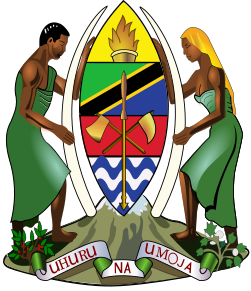
- Country.image_coat
- Coat of arms of Tanzania.svg
- Country.national_motto
- "Uhuru na Umoja"
- Country.englishmotto
- "Freedom and Unity"
- Country.national_anthem
- "Mungu ibariki Afrika""God bless Africa"
- Country.capital
- Dodoma
- Country.largest_city
- Dar es Salaam
- Country.languages_type
- National language
- Country.languages
- Swahili
- Country.languages2_type
- Other languages
- Country.languages2
- Over 100 languages, including (1m+):
- Country.religion_year
- 2020
- Country.demonym
- Tanzanian
- Country.government_type
- Unitary dominant-party presidential republic
- Country.leader_title1
- President
- Country.leader_name1
- Samia Suluhu Hassan
via Wikipedia infobox
Research
31,111 papers- Orthopaedic and trauma research in Tanzania: A scoping review.PloS one · 2024Blackman B, Barnett S, Premkumar A et al.DOI: 10.1371/journal.pone.0304218
- Tanzania.Department of State publication. Background notes series · 1986United States. Department of State. Bureau of Public Affairs
- Type 2 Diabetes Mellitus in Tanzania. A Narrative Review of Epidemiology and Disease Trend.ReviewCurrent diabetes reviews · 2024Chillo O, Mzokolo I, Peter E et al.DOI: 10.2174/0115733998267513231208100124
- Mycetoma in Moshi, Tanzania.Transactions of the Royal Society of Tropical Medicine and Hygiene · 2021Mavura D, Chapa P, Sabushimike D et al.DOI: 10.1093/trstmh/traa190
- Estimating Tanzania's National Met and Unmet Blood Demand From a Survey of a Representative Sample of Hospitals.ReviewTransfusion medicine reviews · 2018Drammeh B, De A, Bock N et al.DOI: 10.1016/j.tmrv.2017.07.004
- AI-IoT integration in Tanzania's primary healthcare system: a narrative review.ReviewJournal of health organization and management · 2025Mwogosi A, Simba RM, Kayya A et al.DOI: 10.1108/JHOM-01-2025-0013
- [Tanzania].Jeune Afrique (Paris, France : 1980) · 1996
- Curative options for sickle cell disease in Africa: Approach in Tanzania.ReviewHematology/oncology and stem cell therapy · 2020Makani J, Sickle Cell Programme, Muhimbili University of Health and Allied SciencesDOI: 10.1016/j.hemonc.2019.12.012
via PubMed
Wikidata facts
- Instance of
- country
- Named after
- Zanzibar Islands
- Official name
- République unie de Tanzanie
- Demonym
- Tansánach
- Participant in
- Uganda–Tanzania War
- Country
- Tanzania
- Contains
- Tabora Region
- Continent
- Africa
- Capital
- Dar es Salaam
- Official language
- English language
- Currency
- Tanzanian shilling
- Population
- 61741120
- Area
- 947303
- Head of government
- Samia Suluhu Hassan
- Head of state
- Samia Suluhu Hassan
- Legislature
- National Assembly
- Anthem
- Mungu ibariki Afrika
- Shares border with
- Seychelles
- Highest point
- Mount Kibo
- Official website
- www.tanzania.go.tz
- Image
- Tanzania - Location Map (2013) - TZA - UNOCHA.svg
- Life expectancy
- 65.675
- Nominal GDP
- 75709289056
- Unemployment rate
- 3
Show 62 more facts
- Calling code
- +255
- Licence plate code
- EAT
- Electrical plug type
- BS 1363
- Mains voltage
- 230
- Motto
- Azadlıq və Birlik
- Flag
- flag of Tanzania
- Coat of arms
- coat of arms of Tanzania
- top-level Internet domain
- .tz
- Commons category
- Tanzania
- member of
- African Continental Free Trade Area
- topic's main category
- Category:Tanzania
- Commons gallery
- Tanzania
- category for people born here
- Category:Births in Tanzania
- category for people who died here
- Category:Deaths in Tanzania
- category for films shot at this location
- Category:Films shot in Tanzania
- category of associated people
- Category:Tanzanian people
- diplomatic relation
- Kosovo
- topic's main Wikimedia portal
- Portal:Tanzania
- mobile country code
- 640
- lowest point
- Indian Ocean
- driving side
- left
- geography of topic
- Geography of Tanzania
- age of majority
- 18
- marriageable age
- 18
- office held by head of government
- President of Tanzania
- language used
- Kwere
- ethnic group
- Bantu people
- history of topic
- history of Tanzania
- office held by head of state
- President of Tanzania
- total fertility rate
- 5.145
- maritime identification digits
- 677
- on focus list of Wikimedia project
- Wikipedia:Vital articles/Level/4
- inception
- 1964-04-26
- Unicode character
- 🇹🇿
- replaces
- People's Republic of Zanzibar
- central bank
- Bank of Tanzania
- GS1 country code
- 620
- culture
- culture of Tanzania
- VAT rate
- 18
- BTI Status Index
- 4.88
- BTI Governance Index
- 4.43
- economy of topic
- economy of Tanzania
- native label
- Jamhuri ya Muungano wa Tanzania
- demographics of topic
- demographics of Tanzania
- different from
- Tanzania
- Democracy Index
- 5.10
- Human Development Index
- 0.549
- P11012
- terbium
- hashtag
- Tanzania
- Happy Planet Index score
- 37
- Gini coefficient
- 40.5
- Inequality-adjusted Human Development Index
- 0.418
- birth rate
- 35.811
- male population
- 32370931
- death rate
- 5.959
- rural population
- 41471864
- female population
- 33126817
- urban population
- 24025884
- most populous urban area
- Dar es Salaam
- Commonwealth Sport country code
- TAN
- located in/on physical feature
- East Africa
Sources (15)
via Wikidata · CC0
Travel guide
Get in
thumb|375px|A map showing the visa requirements of Tanzania, with countries in green having visa-free access
See
Safaris in Tanzania can be put into two categories, the Northern Circuit (Serengeti, Ngorongoro, Manyara and Tarangire) and the Southern Circuit (Selous, Mikumi and Ruaha). This is an oversimplification though and does not include other interesting, but harder to reach, parks such as Katavi and Gombe, to name just two. For tourists, the first two groupings are more accessible, as a variety of packages are offered by several tour companies.
Do
thumb|Dhow and anchor, [[Zanzibar]] There are loads of National Parks for those wanting to watch Tanzania's wildlife. You can gain entry for around US$100 and benefit from a tour (and perhaps a night's accommodation). The better parks, though packed with tourists, are found in the north of the country. Ruaha National Park is the best in the south (locals actually say this is the best park, especially if you want to see wild animals as opposed to semi-tame ones in the northern parks). Don't just be sucked into the tourist circuit in the north; the south offers great parks and towns (base yourself in Iringa), and you will feel less of a tourist and more of a guest if you travel this way. Scuba diving in and around Pemba and Zanzibar is another good experience. You can also visit numerous historical Slave Trade sites located in Bagamoyo, which could make for an interesting, if a little depressing, excursion. Beaches: Tanzania has some of the best, most unspoiled beaches in the world. They are stunning, with their white sand, palm trees, and cool Indian Ocean water! Kayak the beautiful coastal waters with a tour operator. Tanzania has two of the best Stone Age sites in the world: Isimila Gorge (near Iringa) and the earliest known examples of human art among the rock paintings, near Kolo, north of Kondoa, Dodoma -- some of which are reckoned to be around 30,000 years old. Kilimanjaro is one of Tanzania's main attractions. Kilimanjaro is the highest mountain in Africa. Many visitor…
Eat
thumb|Tanzanian (Dar es Salaam) [[street food]] Produce is often of very high quality. Meat and milk can prove difficult for western taste and diets, so be sure that all meat is cooked through. At hotels, you won't have any trouble, but if you venture into small villages, make sure that all water is filtered or boiled before drinking and all fruits and vegetables are peeled before eating. Local dishes include Mtori - cooked beef and bananas - and Mchicha, a vegetable stew with meat or fish in it. If there is anything that can be called Tanzania's national dish, then Ugali would most likely win out. A polenta-style dish made with corn flour, it accompanies cooked meat and a variety of stews, and it's eaten with your hands. Recipes vary from village to village, and everyone has their own way of making it. Many foreigners find it bland and unappealing, but it's worth a try, and some upscale establishments serve it. Street food is also cheap and plentiful. Barbecued corn on the cob is very nice, as are the chips (fries), cooked over a roaring fire. Mandazi is a sweet doughnut-styled food that is mostly made fresh each morning. Great with coffee in the morning, it makes an ideal snack. Tanzania's large South Asian community ensures that a great variety of restaurants offer cuisine from all parts of that region of the globe. All eateries near Hindu temples (particularly in Dar) are a good bet. Just watch where the local Indians go to eat, and you won't be disappointed. Most of the …
Drink
Konyagi is a wonderful gin-like beverage, sold only in Tanzania. Domestic beers are Kilimanjaro, Serengeti, Balimi, Pilsner, Kibo and Safari, which are western-style and very good. Imports include Tusker, Stella Artois, and Castle. Locally produced banana-beer is also available at times, but questionably safe to drink. Traditionally, you will drink this out of a hollowed gourd. First drink the guests, who then pass it to the elders. In some parts of Tanzania, fermented bamboo juice (Pombe) is the common tipple. Passion fruit, mango, and orange juices are available in many restaurants, and excellent when the fruits are in season. Soft drinks are widely available; Stoney Tangawizi (ginger ale - tangawizi means 'ginger', in Swahili) is one of the most popular besides Fanta and Co. Mbege, a locally made drink made up of ripe bananas and finger millet, commonly in the northern Tanzania from the chagga community in the Kilimanjaro region. Other popular beverages include lassi (a sweet or salty yogurt drink) and Chai Maziwa (chai with milk) which is well worth trying if you can handle the large amounts of sugar added to this drink. (Milk) tea is a much more common drink than coffee in Tanzania. Northern Tanzania has a number of great coffee plantations. Although coffee does not have the same popularity in Tanzania as it has in Ethiopia, with a bit of searching you can find a decent cup of java, instead of the instant "Africa" coffee that is served in most restaurants. All large hote…
Sleep
In bigger cities be sure to avoid touts. If you are travelling as a couple, a good idea is for one person to sit in a lobby or restaurant with the bags, while the other scopes out rooms. You are likely to get a cheaper price without the bags, and not be targeted by sneaky touts that will raise the price US$5-10 for you for their commission.
As of 2021 budget travelers will find guest houses to offer simple rooms in the TSh8,000-20,000 price range even in smaller towns or villages. They often come with a private bathroom, a fan and a condom hidden discretely somewhere in the room. Typically these accommodations cannot be booked online and it is rare to run into any Western tourists here.
Stay healthy
Bottled water is cheap and widely available throughout the country. You shouldn't drink the tap water unless you have no other option, and it must either be filtered with a high quality filter and purifier or brought to a boil before consumption. Tests on tap water have found it contaminated with e-coli bacteria.
Respect
In general, tourists should wear modest or conservative attire, especially in Zanzibar, which is a conservative Muslim society. Western women should not wear clothing that reveals too much skin. 'Kangas', brightly-colored wrap-around cloth, are affordable, available throughout the country, and can serve as a discreet covering.
The Masai people, with their colorful clothing, are tempting targets for any tourist with a camera. However, they expect to be paid for it, and you should always ask before taking pictures.
It is common practice among Swahili-speakers to use 'shikamoo' (pronounced 'she ka moe' and literally meaning, 'I hold your feet') when greeting elders or superiors. The usual response from an elder will be 'marahaba'. In Zanzibar, the equivalent of 'shikamoo' is 'chei chei'. The traveler will get along very well when using these verbal expressions of respect. In addition, a title after the 'shikamoo' is also a useful indicator that you are not just a dumb tourist -- 'shikamoo bwana' for the gents, and, when addressing a female elder, 'shikamoo mama'.
Tanzanians will also comment if you are doing any work while they are not, with the phrase "pole na kazi". It literally means "I'm sorry you have to work". A simple "asante", or "thanks", will suffice in reply.
Many Tanzanian sellers are persistent and, ordinarily, a simple head shake, accompanied by "asante sana", should settle it. However, as a last resort, a firm "hapana", meaning "no", will do the trick. Tanzani…
Connect
Keeping in touch while traveling in Tanzania is rarely a problem. You can get decent mobile phone reception even in some national parks.
Go next
The East African Islands including Madagascar, with nature and culture very different from the African mainland
Travel guide from Wikivoyage (CC BY-SA 4.0)
~40 min read
Encyclopedic overview
52 sectionsContents
- Etymology
- History
- Ancient
- Medieval
- Colonial
- Modern
- Geography
- Climate
- Wildlife and conservation
- Politics
- Constitution and elections
- Executive
- Legislature
- Judiciary
- Law enforcement
- Zanzibar
- Administrative subdivisions
- Foreign policies and partnerships
- International partnerships
- Military
- Human rights
- Economy and infrastructure
- Hunger and poverty
- Agriculture
- Industry, energy and construction
- Tourism
- Banking
- Transport
- Communications
- Economic statistics controversy
- Food and nutrition
- Programmes targeting hunger
- Science and technology
- Demographics
- Religion
- Languages
- Education and libraries
- Healthcare
- Women
- Culture
- Media
- Music
- National anthem
- Literature
- Painting and sculpture
- Sports
- Cinema
- See also
- Notes
- References
- Sources
- External links
Tanzania, officially the United Republic of Tanzania, is a country in East Africa within the African Great Lakes region. It is bordered by Uganda to the northwest, Kenya to the northeast, the Indian Ocean to the east, Mozambique and Malawi to the south, Zambia to the southwest, and Rwanda, Burundi, and the Democratic Republic of the Congo to the west. According to a 2024 estimate, Tanzania has a population of around 67.5 million, making it the most populous country located entirely south of the equator.
Many important hominid fossils have been found in Tanzania. In the Stone and Bronze Age, prehistoric migrations into Tanzania included Southern Cushitic speakers similar to modern day Iraqw people, who moved south from present-day Ethiopia; Eastern Cushitic people who moved into Tanzania from north of Lake Turkana about 2,000 and 4,000 years ago; and the Southern Nilotes, including the Datoog, who originated from the present-day South Sudan–Ethiopia border region between 2,900 and 2,400 years ago. These movements took place at about the same time as the settlement of the Mashariki Bantu from West Africa in the Lake Victoria and Lake Tanganyika areas. In the late 19th century, the mainland came under German rule as German East Africa. This was followed by British rule after World War I when it was governed as Tanganyika, with the Zanzibar Archipelago remaining a separate colonial jurisdiction. Following their gaining respective independence in 1961 and 1963, the two entities merged in 1964 to form the United Republic of Tanzania.
Excerpted from Wikipedia’s “Tanzania” article, available under the CC BY-SA 4.0 licence.
Gallery (59)
On the map
9 mapped locations
Available in 267 languages
- Español
- Français
- Deutsch
- 中文
- 日本語
- Русский
- Português
- Italiano
- العربية
- हिन्दी
- Abkhazian
- Achinese
- Adyghe
- Afrikaans
- Akan
- Albanian
- Albanian
- Amharic
Show 248 more
- ami
- Angika
- Aragonese
- Armenian
- Arpitan
- Assamese
- Asturian
- Aymara
- azb
- Azerbaijani
- Bahasa Indonesia
- Balinese
- Bambara
- Bangla
- Banjar
- Bashkir
- Basque
- bat_smg
- Bavarian
- be_x_old
- Belarusian
- Betawi
- Bhojpuri
- Bikol
- Bishnupriya
- Bislama
- Bosnian
- Breton
- btm
- Bulgarian
- Buriat
- Burmese
- Catalan
- cbk_zam
- cdo
- Cebuano
- Central Kurdish
- Chechen
- Cheyenne
- Chuvash
- Cornish
- Corsican
- Crimean Tatar
- Croatian
- Czech
- dag
- Danish
- Dinka
- Divehi
- dty
- Dzongkha
- Egyptian Arabic
- Erzya
- Esperanto
- Estonian
- Ewe
- Extremaduran
- Faroese
- Fiji Hindi
- Filipino
- Finnish
- fiu_vro
- Frafra
- Fula
- Gagauz
- Galician
- Ganda
- gcr
- Georgian
- Gilaki
- gpe
- Greek
- Guarani
- Gujarati
- Haitian Creole
- Hakka Chinese
- Hausa
- Hebrew
- Hungarian
- hyw
- Icelandic
- Ido
- Igbo
- Iloko
- Inari Sami
- Ingush
- Interlingua
- Interlingue
- Irish
- Jamaican Creole English
- Javanese
- Kabardian
- Kabyle
- kai
- Kannada
- Kanuri
- Kara-Kalpak
- Karachay-Balkar
- Kashubian
- Kazakh
- kbp
- kge
- Khmer
- Kikuyu
- Kinyarwanda
- Kongo
- Kotava
- Kurdish
- Kyrgyz
- Ladino
- Latgalian
- Latin
- Latvian
- Lezghian
- Ligurian
- Limburgish
- Lingala
- Lingua Franca Nova
- Lithuanian
- lld
- Lojban
- Lombard
- Low German
- Lower Sorbian
- Luxembourgish
- Macedonian
- Malagasy
- Malay
- Malayalam
- Maltese
- Manipuri
- Manx
- Māori
- map_bms
- Marathi
- Mazanderani
- Minangkabau
- Mingrelian
- Mirandese
- Moksha
- Mongolian
- Moroccan Arabic
- Navajo
- nds_nl
- Nederlands
- Nepali
- Newari
- Northern Frisian
- Northern Sami
- Northern Sotho
- Norwegian
- Norwegian Nynorsk
- Novial
- nup
- Nyanja
- Obolo
- Occitan
- Old English
- olo
- Oromo
- Ossetic
- Pampanga
- Papiamento
- Pashto
- Piedmontese
- Polski
- Punjabi
- Quechua
- roa_tara
- Romanian
- Romansh
- Rundi
- Rusyn
- Samoan
- Sango
- Sanskrit
- Santali
- Sardinian
- Saterland Frisian
- Scots
- Scottish Gaelic
- Serbian
- Serbian (Latin)
- Shan
- Shona
- Sicilian
- Silesian
- simple
- Sindhi
- Sinhala
- Slovak
- Slovenian
- Somali
- Southern Sotho
- Standard Moroccan Tamazight
- Sundanese
- Svenska
- Swahili
- Swati
- syl
- szy
- Tajik
- Talysh
- Tamil
- Taroko
- Tatar
- tay
- Telugu
- Tibetan
- Tiếng Việt
- Tigrinya
- Toki Pona
- Tsonga
- Tswana
- Tumbuka
- Türkçe
- Turkmen
- Tyap
- Udmurt
- Ukrainian
- Upper Sorbian
- Urdu
- Uyghur
- Uzbek
- Venetian
- Veps
- Volapük
- Waray
- Welsh
- Western Frisian
- Western Mari
- Western Panjabi
- Wolof
- Wu Chinese
- Xhosa
- Yakut
- Yiddish
- Yoruba
- Zaza
- Zeelandic
- zh_classical
- zh_min_nan
- zh_yue
- Zhuang
- Zulu
- فارسی
- ไทย
- 한국어
via Wikidata sitelinks · CC0