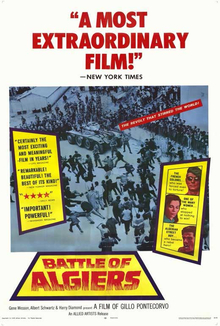
The Battle of Algiers
Also known as Battle of Algiers, La Bataille d'Alger
1966 film by Gillo Pontecorvo
Film · TMDB
7.9Paratrooper commander Colonel Mathieu, a former French Resistance fighter during World War II, is sent to Algeria to reinforce efforts to squelch the uprisings of the Algerian War. There he faces Ali la Pointe, a former petty criminal who, as the leader of the Algerian Front de Liberation Nationale, directs terror strategies against the colonial French government occupation. As each side resorts to ever-increasing brutality, no violent act is too unthinkable.
Released: 1966-09-08122 minDir: Gillo PontecorvoDrama, War, HistoryBudget: $800,000Box office: $964,028
Cast
- Brahim Hadjadj as Ali La Pointe
- Jean Martin as Colonel Philippe Mathieu
- Yacef Saâdi as El-Hadi Jaffar
- Fouzia El Kader as Halima
- Mohamed Ben Kassen as Petit Omar
~25 min read
Article
The Battle of Algiers (French: La Bataille d'Alger; Italian: La battaglia di Algeri; Arabic: معركة الجزائر, romanized: Maʿrakat al-Jazāʾir) is a 1966 Italian-Algerian war film co-written and directed by Gillo Pontecorvo. It is based on action undertaken by rebels during the Algerian War (1954–1962) against the French government in North Africa, the most prominent being the eponymous Battle of Algiers, the capital of Algeria. It was shot on location in a Roberto Rossellini-inspired newsreel style: in black and white with documentary-type editing to add to its sense of historical authenticity, with mostly non-professional actors who had lived through the real battle. The film's score was composed by Pontecorvo and Ennio Morricone. It is often associated with Italian neorealist cinema.
The film concentrates mainly on revolutionary fighter Ali La Pointe during the years between 1954 and 1957, when guerrilla fighters of the FLN went into Algiers. Their actions were met by French paratroopers attempting to regain territory. The highly dramatic film is about the organization of a guerrilla movement and the illegal methods, such as torture, used by the French to stop it. Despite the country's hardships, Algeria succeeded in gaining independence from the French, which Pontecorvo addresses in the film's epilogue.