
File:Soy_sauce_with_wasabi.jpg · Wikimedia Commons · See Wikimedia Commons
umami
Sign in to saveAlso known as savoriness
Umami ( from , ), or savoriness, is one of the five basic tastes. It is characteristic of broths and cooked meats.
Umami, also called savoriness, is one of the five basic tastes that you experience when eating food. It's the savory flavor you find in things like broths and cooked meats.
AI-generated from the Wikipedia summary — may contain errors.
Described at
Nuovi sapori. Dolce o salato? No, "umami" - Treccani
Nuovi sapori. Dolce o salato? No, "umami" di Carlo Passera. Leggi l'articolo del Magazine di Treccani.it, il portale del sapere.
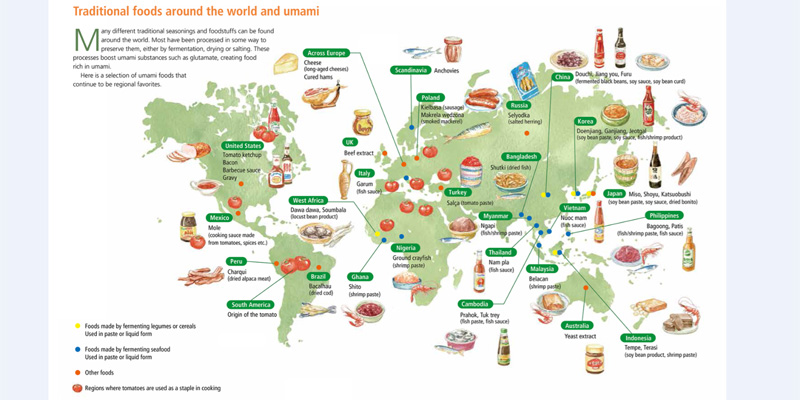
treccani.it →Vuoi navigare il sito Treccani senza limiti e pubblicità? Scarica l'APP e abbonati ora per accedere su tutti i tuoi dispositivi! Siamo nei primi anni del Novecento. Un giorno – la data precisa si è persa nel tempo – Kikunae Ikeda, professore di chimica dell'Università Imperiale di Tokyo, stava cenando con la sua famiglia quando improvvisamente si fermò. La sua zuppa di cetrioli gli pareva più deliziosa del solito; ci pensò un po’, da sempre era affascinato dalla ricerca sulle molecole del gusto. Alla fine realizzò come quel sapore particolare, che non sembrava catalogabile coi quattro marcatori comunemente conosciuti, derivasse dal dashi , un tradizionale brodo nipponico filtrato, ottenuto bollendo il kombu , un’alga commestibile, con l’aggiunta di fiocchi di katsuobushi , ossia tonno secco affumicato e fermentato. Com’è ovvio a questo punto, l’ umami c’è sempre stato: ne era ricco, ad esempio, il garum degli antichi romani, una salsa liquida di interiora di pesce e pesce salato che veniva usata come condimento (quasi) universale e dava origine a un commercio fiorente alla base di quella che può essere considerata la prima industria alimentare della storia.
Excerpt from a page describing this subject · 8,447 chars · not written by Vinony
Wikidata facts
- Subclass of
- taste
Show 4 more facts
- discoverer or inventor
- Kikunae Ikeda
- topic's main category
- Category:Umami enhancers
- has cause
- monosodium L-glutamate
via Wikidata · CC0
~14 min read
Encyclopedic overview
17 sectionsContents
- Etymology
- Background
- Discovery
- Properties
- Foods rich in umami components
- Taste receptors
- Downstream signaling
- TAS1R1 + TAS1R3
- mGluR1 and mGluR4
- Beyond the tongue
- In other animals
- Consumers and safety
- Background of other taste categories
- See also
- References
- Further reading
- External links
Umami ( from , ), or savoriness, is one of the five basic tastes. It is characteristic of broths and cooked meats.
People taste umami through taste receptors that typically respond to glutamates and nucleotides, which are widely present in meat broths and fermented products. Glutamates are commonly added to some foods in the form of monosodium glutamate (MSG), and nucleotides are commonly added in the form of disodium guanylate, inosine monophosphate (IMP) or guanosine monophosphate (GMP). Since umami has its own receptors rather than arising out of a combination of the traditionally recognized taste receptors, scientists now consider umami to be a distinct taste.
Excerpted from Wikipedia’s “umami” article, available under the CC BY-SA 4.0 licence.