
Vietnam War
Sign in to saveAlso known as American War, Second Indochina War, American War in Vietnam
The Vietnam War was an armed conflict in Vietnam, Laos, and Cambodia fought between North Vietnam and South Vietnam and their allies. North Vietnam was supported by the Soviet Union and China, while South Vietnam was supported by the United States and other anti-communist nations. The conflict was the second of the Indochina wars and a proxy war of the Cold War between the Soviet Union and US. The Vietnam War was one of the postcolonial wars of national liberation, a theater in the Cold War, and a civil war, with civil warfare a defining feature from the outset. Direct US military involvement escalated from 1965 until US forces were withdrawn in 1973. The fighting spilled into the Laotian and Cambodian civil wars, which ended with all three countries becoming communist in 1975.
OverviewAI-generated
The Vietnam War, also known as the Second Indochina War, was a proxy war that formed part of the Cold War. It began on November 1, 1955, and ended on April 30, 1975. The conflict took place in Vietnam, Laos, and Cambodia. Participants included South Vietnam, the United States, South Korea, and Thailand. The war resulted in 4,211,459 deaths.
Significant events during the conflict included the Tet Offensive, the Gulf of Tonkin Resolution, the My Lai Massacre, and the Battle of Ia Drang. The war included the Battle of Ap Bac and saw opposition to United States involvement. It is categorized under the topic of the Vietnam War and is referenced by 23,546 other encyclopedia articles.
Synthesized by Vinony from 24 facts across 4 sources: Wikidata, Firecrawl, PubMed, Vinony graph. Generated from structured data (not the Wikipedia text) and checked against those facts — may still contain errors.
Wikipedia views (30d)
405,128 totalvia Wikimedia Pageviews API
Research
1,908 papers- Mortality of Women Vietnam War-Era Veterans.Women's health issues : official publication of the Jacobs Institute of Women's Health · 2023Weitlauf JC, Cypel YS, Davey VJDOI: 10.1016/j.whi.2023.02.004
- [Chemical war in Vietnam: late effects].Orvosi hetilap · 2024Varga CDOI: 10.1556/650.2024.HO2796
- Risk of Dementia in Korean Vietnam War Veterans.The journal of prevention of Alzheimer's disease · 2024Lee W, Lee S, Kang SK et al.DOI: 10.14283/jpad.2024.84
- The Vietnam War and the ethics of combat psychiatry.ReviewThe American journal of psychiatry · 1993Camp NMDOI: 10.1176/ajp.150.7.1000
- Cohort Profile: The Korean Vietnam War Veterans' Health Study Cohort (KOVECO).International journal of environmental research and public health · 2022Lee W, Kim UJ, Ham S et al.DOI: 10.3390/ijerph19074211
- Cholangiocarcinoma (CCA) mortality in Vietnam war era veterans.Cancer epidemiology · 2025Bullman T, Culpepper WJ, Cypel YS et al.DOI: 10.1016/j.canep.2024.102721
- Suicide of Australians during the Vietnam War.Australasian psychiatry : bulletin of Royal Australian and New Zealand College of Psychiatrists · 2018Pridmore S, Ahmadi J, Pridmore WDOI: 10.1177/1039856217734740
- The effect of the Vietnam War on numbers of medical school applicants.ReviewAcademic medicine : journal of the Association of American Medical Colleges · 1989Singer ADOI: 10.1097/00001888-198910000-00001
via PubMed
Described at
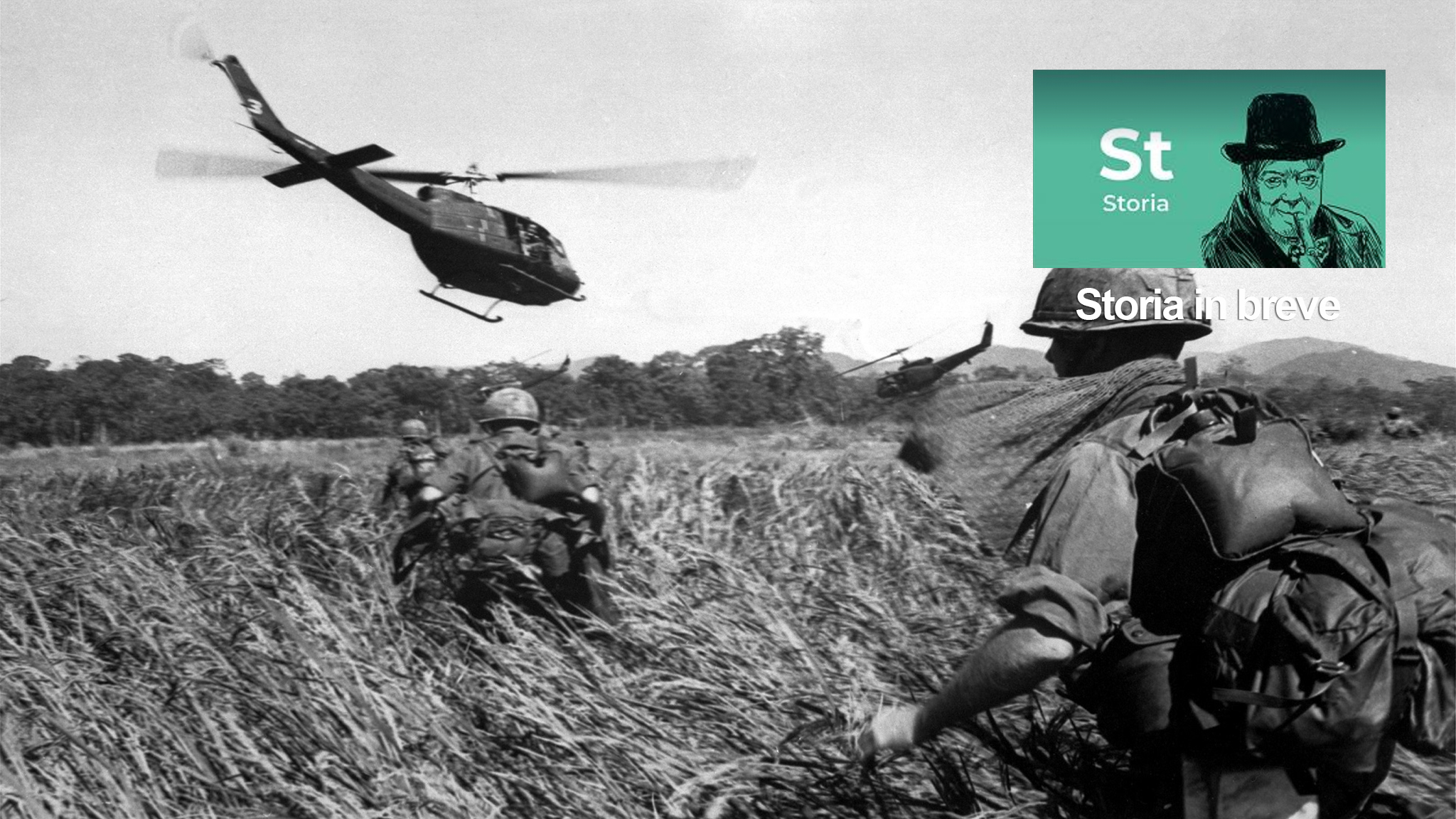
Si inizia però a imporre una figura cruciale per la futura indipendenza del paese, Ho Chi-minh , che dal 1941 ispira e guida un fronte nazionalista comunista che si oppone con fermezza fino alla fine del conflitto mondiale alle forze giapponesi e all'amministrazione francese. La rovinosa caduta del Giappone dopo le bombe atomiche di Hiroshima e Nagasaki favoriscono le forze Vietminh che ad agosto del 1945 prendono il potere proclamando l'indipendenza della Repubblica Democratica del Vietnam. La Francia non rimane a guardare e nel 1946 occupa il Vietnam del Sud con l'appoggio delle truppe britanniche e il momentaneo tacito assenso degli Stati Uniti. Inizia una guerra tra i partigiani del Nord e l'esercito francese che si protrae fino al 1949 , anno in cui viene proclamato uno Stato del Vietnam del Sud , con capitale Saigon , questa volta riconosciuto anche dagli americani. Il conflitto si comincia ad intrecciare anche con la guerra fredda, rappresentando secondo la visione statunitense, non più un conflitto locale, ma un rischio di un'espansione comunista. Gli scontri andranno avanti fino al 1954, con la sconfitta francese. Agli Accordi di Ginevra nello stesso anno il paese viene diviso in due Stati indipendenti lungo il 17° parallelo con l'impegno di tenere entro due anni elezioni nazionali libere per la riunificazione del paese. La Conferenza di Ginevra sancisce la sostituzione della Francia con degli Stati Uniti come potenza dominatrice del Sud-Est asiatico. Gli Stati Uniti intensificano il sostegno al governo del Sud, ponendo un'attenzione sempre più ampia nel Sud-Est asiatico. L’ amministrazione Kennedy moltiplica rifornimenti militari e ‘consiglieri’ arrivando da 685 nel 1961 a ben 16.000 in soli tre anni, nel 1963 . L'’offensiva vietcong non si arresta e il Vietnam del Sud continua a rimanere un paese instabile, travagliato da ripetuti golpe militari. Lentamente la guerra in Vietnam diventa un vero banco di prova della credibilità e del prestigio internazionale della potenza americana. Tre amministrazioni impegnate, costi sempre più elevati in termini economici e di vite umane, per un evento destinato a diventare il conflitto simbolo del secondo Novecento. Una puntata della Storia in breve ne approfondisce gli eventi principali e gli snodi, con la guida del Prof. Gianluca Fiocco e il supporto delle Teche Rai.
Excerpt from a page describing this subject · 6,039 chars · not written by Vinony
Wikidata facts
- Instance of
- proxy war
- Part of
- Cold War
- Country
- Vietnam
- Location
- Vietnam
- Image
- VietnamMural.jpg
- Number of deaths
- 4211459
- Significant event
- Gulf of Tonkin incident
- Said to be same as
- Second Indochina War
- Participant
- Australia
Show 7 more facts
- start time
- 1955-11-01
- end time
- 1975-04-30
- Commons category
- Vietnam War
- topic's main category
- Category:Vietnam War
- on focus list of Wikimedia project
- Wikipedia:Vital articles/Level/4
- topic has template
- Template:Campaignbox Vietnam War
Sources (6)
via Wikidata · CC0
~40 min read
Encyclopedic overview
Belligerents
North Vietnam
Excerpted from Wikipedia’s “Vietnam War” article, available under the CC BY-SA 4.0 licence.
Gallery (13)
Available in 151 languages
- Español
- Français
- Deutsch
- 中文
- 日本語
- Русский
- Português
- Italiano
- العربية
- हिन्दी
- Abkhazian
- abstract
- Afrikaans
- Albanian
- Albanian
- Amharic
- Angika
- Aragonese
Show 132 more
- Armenian
- Assamese
- Asturian
- azb
- Azerbaijani
- Bahasa Indonesia
- Balinese
- Bangla
- Bashkir
- Basque
- bat_smg
- be_x_old
- Belarusian
- blk
- Bosnian
- Breton
- Bulgarian
- Buriat
- Burmese
- Catalan
- cdo
- Central Kurdish
- Chechen
- Cornish
- Corsican
- Crimean Tatar
- Croatian
- Czech
- Danish
- Egyptian Arabic
- Esperanto
- Estonian
- Faroese
- Fiji Hindi
- Filipino
- Finnish
- fiu_vro
- Friulian
- Galician
- Georgian
- Greek
- Guarani
- Hakka Chinese
- Hebrew
- Hungarian
- Icelandic
- Ido
- Iloko
- Interlingua
- Irish
- Javanese
- Jju
- Kazakh
- Khmer
- Kurdish
- Kyrgyz
- Lao
- Latin
- Latvian
- Lezghian
- Limburgish
- Lithuanian
- Lombard
- Low German
- Luxembourgish
- Macedonian
- Malagasy
- Malay
- Malayalam
- Marathi
- Mazanderani
- Minangkabau
- Mingrelian
- Mirandese
- Mongolian
- Moroccan Arabic
- Nederlands
- Nepali
- Newari
- Northern Frisian
- Norwegian
- Norwegian Nynorsk
- Occitan
- Ossetic
- Pashto
- Piedmontese
- Polski
- Punjabi
- Romanian
- Romansh
- Rusyn
- Sardinian
- Scots
- Scottish Gaelic
- Serbian
- Serbian (Latin)
- Sicilian
- simple
- Sindhi
- Sinhala
- Slovak
- Slovenian
- Somali
- South Ndebele
- Svenska
- Swahili
- Talysh
- Tamil
- Tatar
- Telugu
- Tiếng Việt
- Toki Pona
- Türkçe
- Ukrainian
- Urdu
- Uzbek
- Venetian
- Veps
- Waray
- Welsh
- Western Frisian
- Western Panjabi
- Wu Chinese
- Yakut
- Yiddish
- zh_classical
- zh_min_nan
- zh_yue
- Zhuang
- فارسی
- ไทย
- 한국어
via Wikidata sitelinks · CC0