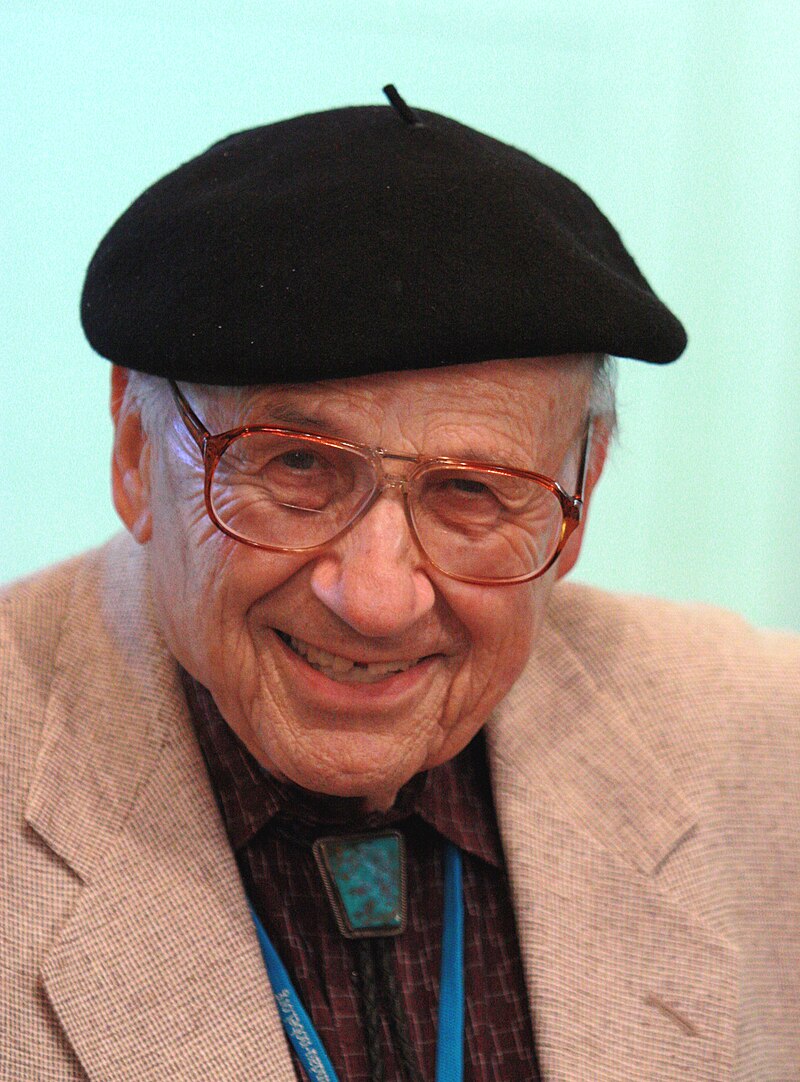
File:Walter_Kohn.jpg · Wikimedia Commons · See Wikimedia Commons
Walter Kohn
Sign in to saveAmerican physicist (1923–2016)
OverviewAI-generated
Walter Kohn (1923–2016) was an Austrian-Canadian-American physicist, chemist, and university teacher. Born in Vienna, he held citizenship in Austria, Canada, and the United States. He received his Doctor of Philosophy under the supervision of Julian Schwinger. Kohn’s field of work was theoretical physics, and his notable work includes density functional theory. He was employed by the University of California, Santa Barbara, the University of California, San Diego, and Carnegie Mellon University.
Kohn was a member of the Royal Society, the Austrian Academy of Sciences, the National Academy of Sciences, and the International Academy of Quantum Molecular Science. He received the Nobel Prize in Chemistry, the UNESCO Niels Bohr Medal, the Three Physicists Prize, and the Oliver E. Buckley Condensed Matter Prize. He died in Santa Barbara of laryngeal cancer.
Synthesized by Vinony from 38 facts across 8 sources: Wikidata, Crossref, Open Library, MusicBrainz, Wikiquote, Nobel Prize, Vinony collections, Vinony graph. Generated from structured data (not the Wikipedia text) and checked against those facts — may still contain errors.
Nobel Prize
- The Nobel Prize in Chemistry1998
“for his development of the density-functional theory”
Shared · 1/2 portion
Wikidata facts
- Instance of
- human
- Given name
- Walter
- Family name
- Kohn
- Gender
- male
- Citizenship
- Austria
- Place of birth
- Vienna
- Place of death
- Santa Barbara
- Occupation
- chemist
- Educated at
- Akademisches Gymnasium
- Employer
- Carnegie Mellon University
- Languages spoken
- English language
- Notable work
- density functional theory
- Academic degree
- Doctor of Philosophy
- Doctoral advisor
- Julian Schwinger
- Student of
- Julian Schwinger
- Field of work
- theoretical physics
- Image
- WalterKohnGraz21042006 1.jpg
Show 10 more facts
- Commons category
- Walter Kohn
- date of birth
- 1923-03-09
- Erdős number
- 3
- date of death
- 2016-04-19
- cause of death
- laryngeal cancer
- P8168
- Rockwell
- maintained by WikiProject
- WikiProject Mathematics
- manner of death
- natural causes
- interested in
- physics
Sources (6)
via Wikidata · CC0
~8 min read
Encyclopedic overview
A banner on a lightpole at the University of California, Santa Barbara, commemorating Walter Kohn being awarded the Nobel Prize in Chemistry in 1998.
Walter Kohn ( German pronunciation: [ˈvaltɐ ˈkoːn]; March 9, 1923 – April 19, 2016) was an Austrian-American theoretical physicist and theoretical chemist. He was awarded, with John Pople, the Nobel Prize in Chemistry in 1998. The award recognized their contributions to understanding the electronic properties of materials. In particular, Kohn played the leading role in the development of density functional theory, which made it possible to calculate quantum mechanical electronic structure by equations involving the electronic density (rather than the many-body wavefunction). This computational simplification led to more accurate calculations on complex systems as well as many new insights, and it has become an essential tool for materials science, condensed-phase physics, and the chemical physics of atoms and molecules.
Excerpted from Wikipedia’s “Walter Kohn” article, available under the CC BY-SA 4.0 licence.