File:FAU_and_LTA.png · Wikimedia Commons · See Wikimedia Commons
zeolite
Sign in to saveAlso known as zeolites, zeolite mineral group, zeolite group, zeolite structural group
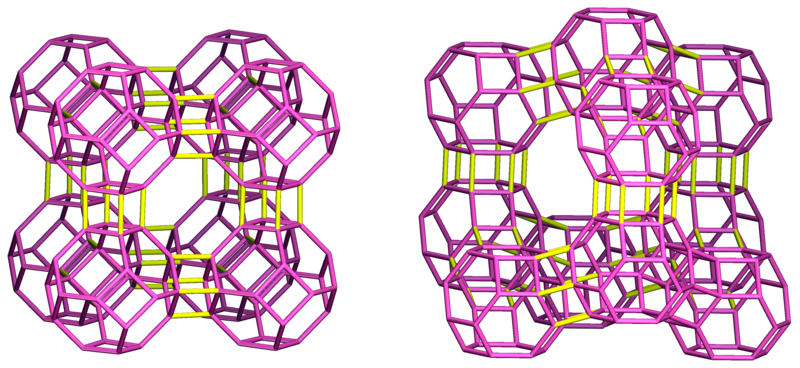
350px|thumb|Frameworks of LTA-type (left) and FAU-type zeolites (right) Zeolites are a group of several microporous, crystalline aluminosilicate minerals commonly used as commercial adsorbents and catalysts. They mainly consist of silicon, aluminium, and oxygen, and have the general formula ・y where is either a metal ion or H+.
Zeolites are microporous, crystalline minerals made primarily of silicon, aluminum, and oxygen that are widely used in industry as adsorbents (materials that capture substances on their surface) and catalysts (materials that speed up chemical reactions). Their usefulness comes from their porous structure, which allows them to trap molecules and facilitate chemical processes in commercial applications.
AI-generated from the Wikipedia summary — may contain errors.
Research
19,410 papers- Zeolite imidazolate framework-8 in bone regeneration: A systematic review.Journal of controlled release : official journal of the Controlled Release Society · 2024Tang H, Yu Y, Zhan X et al.DOI: 10.1016/j.jconrel.2023.11.049
- Zeolite Clinoptilolite: Therapeutic Virtues of an Ancient Mineral.ReviewMolecules (Basel, Switzerland) · 2019Mastinu A, Kumar A, Maccarinelli G et al.DOI: 10.3390/molecules24081517
- Advances in the Synthesis of Ferrierite Zeolite.ReviewMolecules (Basel, Switzerland) · 2020Xu H, Zhu J, Zhu L et al.DOI: 10.3390/molecules25163722
- Pervaporation Zeolite-Based Composite Membranes for Solvent Separations.ReviewMolecules (Basel, Switzerland) · 2021Castro-Muñoz R, Boczkaj GDOI: 10.3390/molecules26051242
- Effects of Zeolite as a Drug Delivery System on Cancer Therapy: A Systematic Review.Molecules (Basel, Switzerland) · 2021Hao J, Stavljenić Milašin I, Batu Eken Z et al.DOI: 10.3390/molecules26206196
- ZEOLITE: "THE MAGIC STONE"; MAIN NUTRITIONAL, ENVIRONMENTAL, EXPERIMENTAL AND CLINICAL FIELDS OF APPLICATION.ReviewNutricion hospitalaria · 2015Laurino C, Palmieri BDOI: 10.3305/nh.2015.32.2.8914
- Insights into zeolite imidazole frameworks (ZIFs) for CO(2) capture and separation: A short review.ReviewJournal of environmental sciences (China) · 2025Yu J, Qi K, Li X et al.DOI: 10.1016/j.jes.2024.12.002
- Nano-Bioremediation via Biochar, Zeolite Nanocomposites for Water Quality Enhancement: A Review.ReviewWater environment research : a research publication of the Water Environment Federation · 2025Raut SS, Sharma A, Mishra ADOI: 10.1002/wer.70151
via PubMed
Wikidata facts
- Subclass of
- aluminosilicate
- Image
- Analcime-mrz182a.jpg
- Has use
- adsorbent
Show 3 more facts
- Commons category
- Zeolite
- topic's main category
- Category:Zeolites
- IMA Mineral Symbol
- Zeo
via Wikidata · CC0
~25 min read
Encyclopedic overview
27 sectionsContents
- Production
- Characteristics
- Properties
- Framework structure
- Isomorphous replacement
- Porosity
- Natural occurrence
- Ore mining
- Synthesis
- Applications
- Ion-exchange, water purification and softening
- Catalysis
- Nuclear waste reprocessing
- Gas separation and storage
- Solar energy storage and use
- Building materials
- Niche uses
- Hemostatic agent
- Soil treatment
- Veterinary and human use
- Mineral species
- Computational study
- Safety
- See also
- References
- Further reading
- External links
350px|thumb|Frameworks of LTA-type (left) and FAU-type zeolites (right) Zeolites are a group of several microporous, crystalline aluminosilicate minerals commonly used as commercial adsorbents and catalysts. They mainly consist of silicon, aluminium, and oxygen, and have the general formula ・y where is either a metal ion or H+.
The term was originally coined in 1756 by Swedish mineralogist Axel Fredrik Cronstedt, who observed that rapidly heating a material, believed to have been stilbite, produced large amounts of steam from water that had been adsorbed by the material. Based on this, he called the material zeolith (changed later to zeolite in English, to fit the naming scheme for minerals in -ite) from the Greek , meaning "to boil" and , meaning "stone".
Excerpted from Wikipedia’s “zeolite” article, available under the CC BY-SA 4.0 licence.