Category
page 1Culinary Heritage of Switzerland

absinthe
Absinthe (, ) is an anise-flavoured spirit derived from several plants, including the flowers and leaves of Artemisia absinthium ("grand wormwood"), together with green anise, sweet fennel, and other medicinal and culinary herbs. Historically described as a highly alcoholic spirit, it is 45–74% ABV or 90–148 proof in the US. Absinthe traditionally has a natural green colour but may also be colourless. It is commonly referred to in historical literature as . While sometimes casually referred to as a liqueur, absinthe is not traditionally bottled with sugar or sweeteners. Absinthe is traditional

Emmental
Swiss cheese
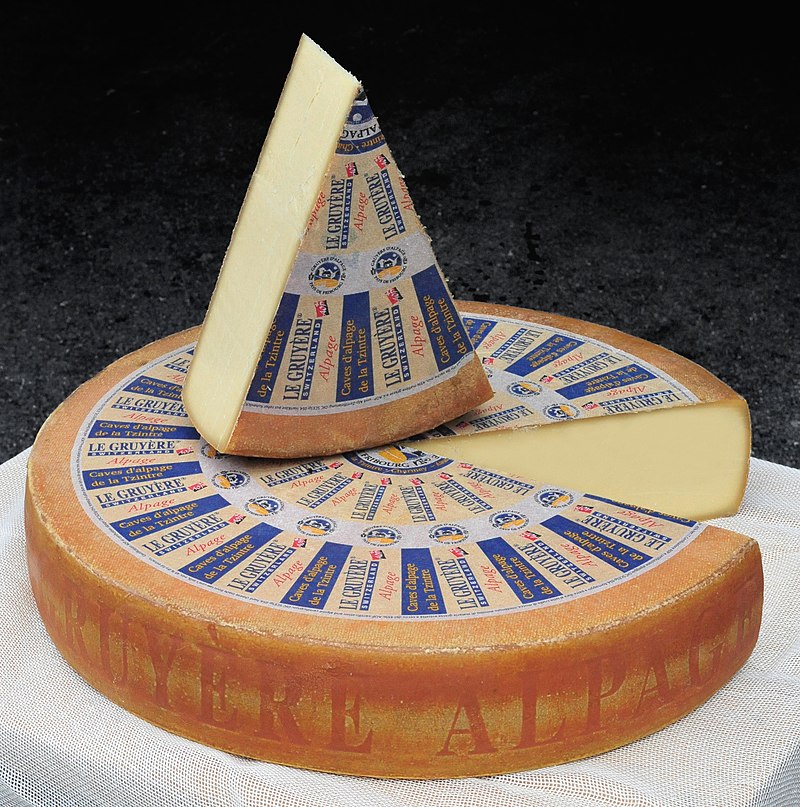
Gruyère
Swiss medium-hard Alpine cheese

rösti
' or ' () is a Swiss dish consisting mainly of potatoes, sautéed or shallow-fried in a pan. It was originally a breakfast dish, commonly eaten by farmers in the canton of Bern and in parts of the canton of Fribourg, but is now eaten all over Switzerland and around the world. The French name directly refers to the dish's origins.

Maggi
Maggi (, ) is an international brand of seasonings, instant soups, and noodles that originated in Switzerland in the late 19th century. In 1947, the Maggi brand was acquired by the Swiss giant Nestlé.

carrot cake
sweet cake that contains grated carrots as an ingredient
cordon bleu
meat and cheese dish
Yule log
traditional dessert sponge cake, made to resemble a miniature Yule log and traditionally served near Christmas
Appenzeller cheese
cheese made in Switzerland

kirsch
thumb|Kirschwasser, produced in Black Forest, Germany and bottled at 40% ABV
Kirschwasser (, , ; German for 'cherry water'), or just Kirsch (; the term used in Switzerland and France, less so in Germany), is a clear, colourless brandy from Germany, Switzerland, and France, traditionally made from double distillation of morello cherries. It is now also made from other kinds of cherries. The cherry stones are included in the fermentation process, not removed beforehand. Unlike cherry liqueurs and cherry brandies, Kirschwasser is not sweet. It is sometimes distilled from fermented cherry juice.

raclette
thumb|right|Raclette with boiled potatoes, pickles and onions
Raclette (, ) is a dish of Swiss origin, also popular in other countries, based on heating cheese and scraping off the melted part, then typically served with boiled potatoes. Raclette is historically a dish originating from the canton of Valais in Switzerland. This cheese from Valais benefits from an AOP. Raclette cheese is also a Swiss-type cheese marketed specifically to be used for this dish.
processed cheese
type of cheese
Tilsit cheese
German cheese

Sbrinz
Sbrinz is a very hard cheese produced in Central Switzerland. It is often used as grated cheese in Swiss cuisine, although it is also eaten in small pieces. The cheese is produced in only 42 dairies in Central Switzerland. Only local cow's milk is used when producing this cheese. It is kept in the region until ready for consumption. It is the hardest of Swiss cheeses together with Berner Hobelkäse.
Tête de Moine
Swiss cheese

Ovaltine
Ovaltine, also known by its original name Ovomaltine, is a brand of milk flavouring product made with malt extract, sugar (except in Switzerland), and whey. Some flavours also have cocoa. Ovaltine, a registered trademark of Associated British Foods, is made by Wander AG, a subsidiary of Twinings, which acquired the brand from Novartis in 2002, except in the United States, where Nestlé acquired the rights separately from Novartis in the late 2000s.
Rivella
Rivella is a soft drink from Switzerland, created by Robert Barth in 1952, which is produced from milk whey, and therefore includes ingredients such as lactose, lactic acid and minerals. Other than Switzerland, it is sold in several other countries and is available in several varieties depending on the country.

lebkuchen
' (), (, ) or ' (, ) are honey-sweetened German cakes, moulded cookies or bar cookies that have become part of Germany's Christmas traditions. They are similar to gingerbread.

Cervelat
thumb|Cervelat cut in pieces typically used for Wurstsalat
thumb|Cervelas ''à l'alsacienne'' with cheese and bacon
Cervelat, also cervelas, servelat or zervelat, is a sausage produced in Switzerland, France (especially Alsace and Lyon), Belgium, the Netherlands and parts of Germany. The recipe and preparation of the sausage vary regionally.
Swiss chocolate
chocolate produced in Switzerland
hippocrass
Hippocras sometimes spelled hipocras or hypocras, is a drink made from wine mixed with sugar and spices, usually including cinnamon, and possibly heated. After steeping the spices in the sweetened wine for a day, the spices are strained out through a conical cloth filter bag called a manicum hippocraticum or Hippocratic sleeve (originally devised by the 5th century BC Greek physician Hippocrates to filter water), from which the name of the drink is derived.
Vacherin Mont-d'Or
Soft cheese made in France and Switzerland
Raclette du Valais
semi-hard cheese

nocino
thumb|upright|Nocino
Nocino is a dark brown liqueur from the Emilia-Romagna region of Italy. It is made from unripe green walnuts. The walnuts and the liquor are handled using ceramic or wooden tools (to avoid oxidation) and placed in an alcoholic base. After steeping in spirit, the walnuts are removed and the alcohol is mixed with simple syrup. Nocino has an aromatic but bittersweet flavor. It may be homemade; villages and even individual families often have their own (oftentimes secret) recipes, including different additions like cinnamon, juniper berries, lemon or orange zest, vanilla pods,

Schabziger
Schabziger (), sérac or sapsago is traditional cheese exclusively produced in the Canton of Glarus in Switzerland. Schabziger is made out of skimmed cow milk and a special kind of herb, blue fenugreek (Trigonella caerulea), also called blue melilot.
Basler Läckerli
hard spice biscuit originating from Basel, Switzerland
Carac
Swiss chocolate tartlet

Landjäger
thumb|Different types of Landjäger

Tirggel
Tirggel are traditional Christmas biscuits from Zürich, Switzerland. Made from flour and honey, they are thin, hard, and sweet.

Birnbrot
Birnbrot (literally pear bread) or Birnweggen (literally pear buns) are a traditional pastry originating in Switzerland with a filling of dried pears. They exist throughout Switzerland and popular variations include "Bündener Birnbrot" (from the Kanton Graubünden), "Glarner Birnbrot" (from the Kanton Glarus), "Toggenburger Birnbrot" (from Toggenburg) and "Luzerner Birnweggen" (from Luzern).
Cenovis
Cenovis is a dark brown food paste from Switzerland consisting of yeast extract, onions, carrots and spices. Sold internationally under the brand Sonaris, it is similar to English Marmite, Brazilian Cenovit, and Australian Vegemite. Rich in vitamin B1, it may be used to flavour soups, sausages, and salads. The most popular way to consume Cenovis, however, is to spread it on a slice of buttered bread, as stated on the product's packaging. It can also be blended into butter and used as a spread or a filling for croissants and buns.
Bündner Nusstorte
Swiss cake with a filling of caramellized chopped walnuts
Vacherin fribourgeois
Semi-hard cheese from Switzerland
Basler Brot
bread traditionally made in the Swiss cantons of Basel-Stadt and Basel-Landschaft
Schenkele
A Schenkele, or Schenkela (in Alsace), Schänkeli, Schenkeli, Schenggeli, Schänggeli (in Switzerland) is a small cylindrical sweet fritter eaten around Christmas and Fasnacht in Alsace and German-speaking Switzerland.
pane ticinese
white bread traditionally made in the Swiss canton of Ticino
Aromat
Aromat is a food seasoning, developed in Switzerland by Walter Obrist for Knorr Thayngen, the Swiss branch of the German food company Knorr, in 1952. Aromat was originally called "", which means plant extract in German. Knorr dropped the name in 1953 and altered its form, from cubes to a powdered seasoning. Aromat was marketed internationally and is described by Knorr as an "all purpose savoury seasoning".
Spanisch Brötli
speciality pastry from Baden, Switzerland
Burebrot
Burebrot, Bauernbrot, Pain paysan () or Pane del nonno () is a bread made in Switzerland. Unlike most other breads, which are mainly composed of flour, yeast and water, the Burebrot also contains milk.
Rheintaler Ribelmais
maize-based food from Rhine valley
Mässmogge
Mässmogge are thumb-sized, hazelnut praline-filled sugar candies. They are a regional and seasonal specialty of Basel, Switzerland, where they are made and sold at around the time of the autumn fair.
Tomme Vaudoise
cheese