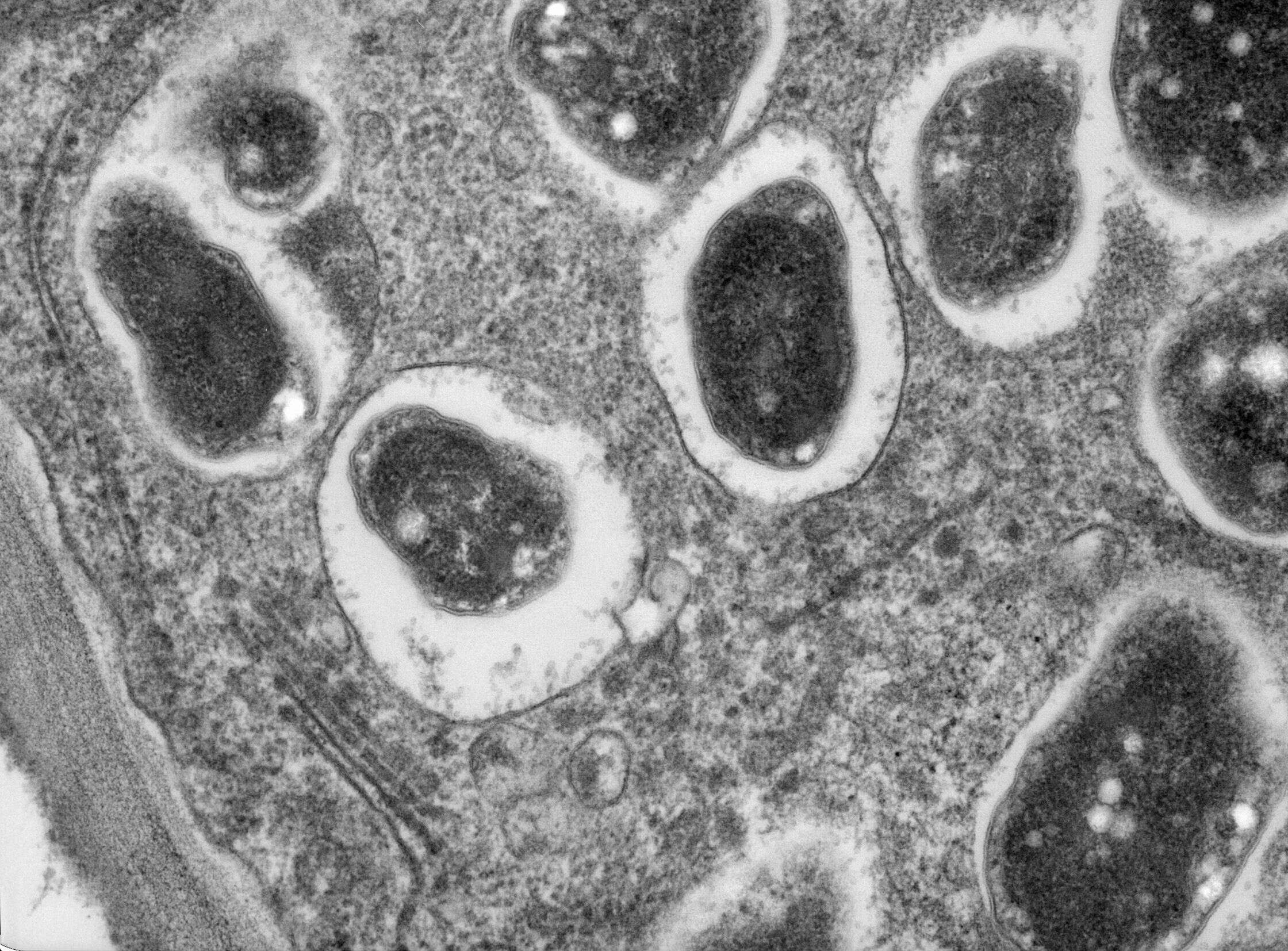
Encyclopedia of Life · EOL (see source)
Alphaproteobacteria
Sign in to saveAlphaproteobacteria or α-proteobacteria, also called α-Purple bacteria in earlier literature, is a class of bacteria in the phylum Pseudomonadota (also called "Proteobacteria"). The Magnetococcales and Mariprofundales are considered basal or sister to the Alphaproteobacteria. The Alphaproteobacteria are highly diverse and possess few commonalities, but nevertheless share a common ancestor. Like all proteobacteria, its members are gram-negative, although some of its intracellular parasitic members lack peptidoglycan and are consequently gram variable.
Species
CLASS
- KingdomBacteria
- PhylumProteobacteria
- ClassAlphaproteobacteria
α-變形菌(Alphaproteobacteria)是變形菌門(Proteobacteria)下的一個纲[3]。此綱的成員變異性極大,且共通點極少,但他們確實系出同源。α-變形菌大多都是革兰氏阴性菌,而有些包內寄生的物種缺少肽聚醣,而造成革蘭氏染色變異。[3][4] 目录 1 特性 2 演化及基因體 3 系統發生學 4 參考文獻 5 外部連結 特性 α-變形菌包含多種細菌,其中包含光自營細菌、植物共生菌(如根瘤菌)、內共生細菌(如Wolbachia),和胞內寄生細菌(如立克次體)。 此外,本綱還包含已滅絕的Proto-mitochondrion(英语:Proto-mitochondrion)。真核生物的祖先攝入了此種細菌,進行內共生作用,成為後來的粒線體[2]。還有一種生物技術上很喜歡使用的農桿菌(Rhizobium radiobacter)也是本綱成員,科學家常常使用本物種來將外來DNA導入植物基因體中。[5]另外,一些光自營生物像是遍在遠洋桿菌(Pelagibacter ubique)也屬於此綱,α-變形菌的微生物可能佔了海洋微生物的10%左右。 演化及基因體 關於本綱所屬的目,有人反對現行的分類法,尤其是Pelagibacterales(英语:Pelagibacterales)的地位,但大體上大家還是普遍接受。細菌的分類學一直是分類學家相當頭痛的問題,因為細菌的基因會彼此互相交流,且基因歧異度相當高(像是遍在遠洋桿菌由於他的寄生行為,就會精簡化他的基因體)。在某些目中,其成員的GC含量變異也大的誇張[2]。舉個例子,像是Pelagibacterales、立克次體目(Rickettsiales)和Holosporales三者的基因體都含有高AT含量,有人認為那其實是趨同演化所導致的假象[6][7][8],而反對方也有他們自己的論述[2][9][10][11]。後來有人發現用以判斷分類依據的rRNA中,GC含量好像好像不太會受基因體變異影響。因此,rRNA中GC含量較高的 Holosporales 就被和低GC含量的Pelagibacterales和立克次體目分開了[2]。 α-變形菌綱下有三個亞綱Magnetococcidae、立克次體亞綱(Rickettsidae)和柄桿菌亞綱(Caulobacteridae)[2]。基群為Magnetococcidae,此類別包含了許多趋磁细菌(由於趨磁細菌為多系群,因此只有部分包含於α-變形菌之下)[12]立克次體亞綱則由細胞內寄生的立克次體目(Rickettsiales),以及可以在胞外單獨生存的Pelagibacterales。柄桿菌亞綱則由Holosporales、紅螺旋菌目(Rhodospirillales)、鞘脂單胞菌目(Sphingomonadales)、紅細菌目( Rhodobacterales)、柄
via GBIF
Research
78,755 papers- The impact of DNA methylation in Alphaproteobacteria.Molecular microbiology · 2018
- The Origin of Mitochondrial Cristae from Alphaproteobacteria.Molecular biology and evolution · 2017
- Cell cycle control in Alphaproteobacteria.Current opinion in microbiology · 2016
- The general stress response in Alphaproteobacteria.Trends in microbiology · 2015
- Alphaproteobacteria species as a source and target of lateral sequence transfers.Trends in microbiology · 2014
via PubMed
Wikidata facts
- Instance of
- taxon
- Parent taxon
- Pseudomonadota
- Image
- Wolbachia.png
Show 10 more facts
- taxon rank
- class
- Commons category
- Alpha Proteobacteria
- taxon name
- Alphaproteobacteria
- topic's main category
- Category:Alphaproteobacteria
- Gram staining
- gram-negative bacteria
- taxon common name
- alphaproteobacterium; alphaproteobacteria
- taxonomic type
- Caulobacter
- taxon author citation
- Garrity et al. 2006
- taxon synonym
- Zetaproteobacteria
Sources (3)
via Wikidata · CC0
~7 min read
Encyclopedic overview
8 sectionsContents
- Characteristics
- Evolution and genomics
- ''Incertae sedis''
- Phylogeny
- Natural genetic transformation
- Notes
- References
- External links
Alphaproteobacteria or α-proteobacteria, also called α-Purple bacteria in earlier literature, is a class of bacteria in the phylum Pseudomonadota (also called "Proteobacteria"). The Magnetococcales and Mariprofundales are considered basal or sister to the Alphaproteobacteria. The Alphaproteobacteria are highly diverse and possess few commonalities, but nevertheless share a common ancestor. Like all proteobacteria, its members are gram-negative, although some of its intracellular parasitic members lack peptidoglycan and are consequently gram variable.
==Characteristics== The Alphaproteobacteria are a diverse taxon and comprise several phototrophic genera, several genera metabolising C1-compounds (e.g. Methylobacterium spp.), symbionts of plants (e.g. Rhizobium spp.), endosymbionts of arthropods (Wolbachia) and intracellular pathogens (e.g. Rickettsia). Moreover, the class is sister to the protomitochondrion, the bacterium that was engulfed by the eukaryotic ancestor and gave rise to the mitochondria, which are organelles in eukaryotic cells (see Endosymbiotic theory). A species of technological interest is Agrobacterium tumefaciens (also called Rhizobium radiobacter): scientists often use this species to transfer foreign DNA into plant genomes. Aerobic anoxygenic phototrophic bacteria, such as Pelagibacter ubique, are alphaproteobacteria that are a widely distributed and may constitute over 10% of the open ocean microbial community.
Excerpted from Wikipedia’s “Alphaproteobacteria” article, available under the CC BY-SA 4.0 licence.